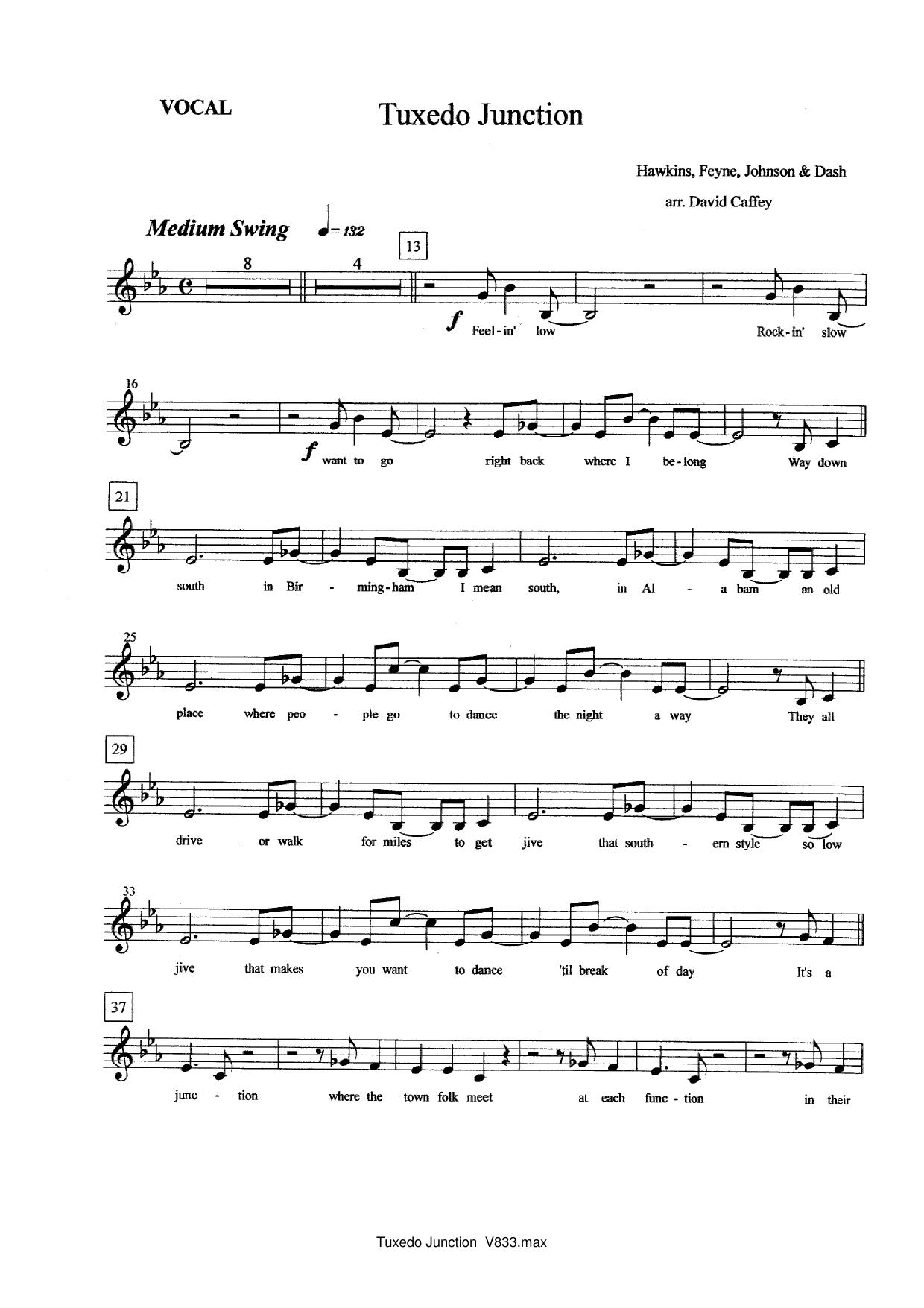
Toxedo Junction (D.Caffey) sheet music preview

Toxedo Junction (D.Caffey)

Composed by Erskine Hawkins

Arranged by D.Caffey

  • Ensemble: Big Band
  • Style: Jazz Standard
  • Pages: 37
  • Instruments (18): Vocal, Alto Saxophone 1, Alto Saxophone 2, Tenor Saxophone 1, Tenor Saxophone 2, Baritone Saxophone, Trumpet 1, Trumpet 2, Trumpet 3, Trumpet 4, Trombone 1, Trombone 2, Trombone 3, Trombone 4, Piano, Bass, Drum Set, Guitar
  • Difficulty: medium
  • Content: Individual Parts
  • Format: PDF Download (Instant)
  • Price: $24.99

Erskine Hawkins’ legendary swing anthem "Tuxedo Junction," originally penned in 1939 alongside William Johnson and Julian Dash, stands as an indelible monument of the late-swing era. Immortalized first by Hawkins’ orchestra and subsequently catapulted into global consciousness by Glenn Miller’s blockbuster recording in 1940, the tune captures the pulsating urban energy of the Birmingham, Alabama social hub from which it takes its name. As a quintessential blues-based swing standard, it bridges the gap between earthy, riff-driven territory band arrangements and the polished sophistication of the big band golden age, relying on infectious call-and-response figures and an irresistible rhythmic drive that has kept dance floors and concert halls captivated for over eight decades. Masterfully reimagined by arranger D. Caffey, this dynamic big band chart infuses the time-honored classic with a refreshing, contemporary vitality while preserving the infectious swing groove that defines the original composition. Set in a driving medium-swing tempo in 4/4 time, Caffey’s arrangement balances buoyant, foot-tapping energy with sophisticated harmonic coloring. The mood shifts effortlessly from sultry, muted brass statements to exuberant, high-octane ensemble passages. The arrangement opens with a characteristic rhythmic vamp before introducing the primary thematic material, characterized by tight, interlocking woodwind voicings and punchy brass counter-punches that evoke the classic Kansas City style modernized with richer, extended chord extensions and subtle chromatic passing tones. Caffey’s distinctive arrangement style shines through in the clever distribution of thematic material and the masterful construction of the chart’s architectural peaks. The melody is shared seamlessly across sections, with rich saxophone solis providing a lush, harmonically dense middle ground that contrasts sharply with the biting, brass-heavy shout chorus. Percussive accents and dynamic contrast are utilized to great effect, building tension through cleverly engineered modal shifts and syncopated rhythmic unisons. Featured solo space allows individual improvisers to stretch out over standard blues changes, supported by a rhythm section part that encourages authentic walking basslines and crisp, interactive ride-cymbal phrasing. The culmination is a roaring, full-ensemble climax that delivers maximum emotional impact without sacrificing transparency or balance. Tailored specifically for advanced high school, collegiate, and community jazz orchestras, this 37-page score demands precision, stylistic versatility, and strong section playing across all 16 instruments. While the technical demands on individual players are manageable for competent musicians, the primary challenge lies in achieving a unified, authentic swing articulation and maintaining an effortless, relaxed groove at moderate tempos. Ensembles that master the subtle art of backbeat placement, dynamic shading, and stylistic blend will find this arrangement an absolute crowd-pleaser—equally at home anchoring a formal concert program or energizing a festival adjudicator panel. Achieving an authentic performance of D. Caffey’s "Tuxedo Junction" begins with establishing a deeply relaxed, authoritative medium-swing feel rooted in a strong quarter-note pulse. Conductors should caution the rhythm section against rushing; the groove must sit comfortably in the pocket, with eighth notes strictly swung in a triplet subdivision. Brass players should utilize cup mutes or bucket mutes where indicated to capture the authentic late-1930s vocal timbre, ensuring that stylistic devices like doits and falls are executed with controlled pitch placement rather than loose abandon. Rehearsal should initially isolate the saxophone soli to balance intonation and unified articulation before integrating the brass counter-lines. Pay close attention to dynamic markings: the contrast between the hushed, sub-tone background figures and the explosive shout chorus is what gives this chart its dramatic narrative arc. Horn players must articulate short notes with a crisp "dit" tongue stroke, while long notes require a warm, supported vibrato appropriate for the swing idiom. Q: What instruments and parts are included in this 37-page score? A: This arrangement is scored for a standard 16-instrument big band, featuring a dedicated Vocal part, Alto Saxophone 1, Alto Saxophone 2, Tenor Saxophone 1, Tenor Saxophone 2, and the full corresponding brass and rhythm section instrumentation. Q: What is the difficulty level of this specific arrangement? A: This chart is best suited for advanced high school, collegiate, and community big bands capable of handling moderate-tempo swing phrasing, section blends, and extended harmonic structures. Q: What is the historical context and musical style of "Tuxedo Junction"? A: Originally composed by Erskine Hawkins in 1939 and made famous globally by Glenn Miller, this piece is a cornerstone jazz standard representing the pinnacle of the swing era, characterized by blues-based forms and infectious dance grooves. Q: What makes D. Caffey’s arrangement unique compared to other versions? A: Caffey updates the classic 1939 standard with fresh, contemporary extended harmonies, sophisticated saxophone soli sections, and dynamic structural pacing that elevates both the harmonic depth and the theatrical excitement of the chart. Q: What is the recommended performance duration and tempo feel? A: The arrangement is set in a driving medium-swing feel at roughly 120-126 BPM, with a typical performance duration of approximately 3 to 4 minutes depending on solo rotations.

Questions and answers

What is included in the Toxedo Junction (D.Caffey) PDF?
The verified current file contains individual parts across 37 pages.
How many instruments or parts are listed for Toxedo Junction (D.Caffey)?
The verified instrumentation list contains 18 entries for this Big Band arrangement.
Who is credited for Toxedo Junction (D.Caffey)?
Composer: Erskine Hawkins. Arranger: D.Caffey.
What difficulty is listed for Toxedo Junction (D.Caffey)?
The verified difficulty level is medium.
What style is listed for Toxedo Junction (D.Caffey)?
The catalog lists the style as Jazz Standard.
Can I preview Toxedo Junction (D.Caffey) before buying?
Yes. The product page provides a preview generated from the current PDF file.
How is Toxedo Junction (D.Caffey) delivered?
After successful payment, the digital PDF is made available for download. The displayed price is $24.99.

Musicians Also Search For

Toxedo Junction D.Caffey PDFToxedo Junction D.Caffey sheet musicToxedo Junction arranged by D.CaffeyD.Caffey big band chartsD.Caffey jazz arrangements PDFToxedo Junction Erskine Hawkins sheet musicToxedo Junction Erskine Hawkins big band arrangementsErskine Hawkins big band chartsToxedo Junction big band arrangementsToxedo Junction big band PDF downloadToxedo Junction jazz sheet musicbig band sheet music downloadToxedo Junction individual parts downloadToxedo Junction sheet music PDFToxedo Junction Jazz Standard chartsJazz Standard big band arrangementsbuy Toxedo Junction sheet musicdownload Toxedo Junction PDFToxedo Junction jazz chartsbest D.Caffey big band arrangementsErskine Hawkins arranged by D.CaffeyToxedo Junction printable sheet musicbig band repertoire PDF

All arrangements by D.Caffey All Erskine Hawkins sheet music