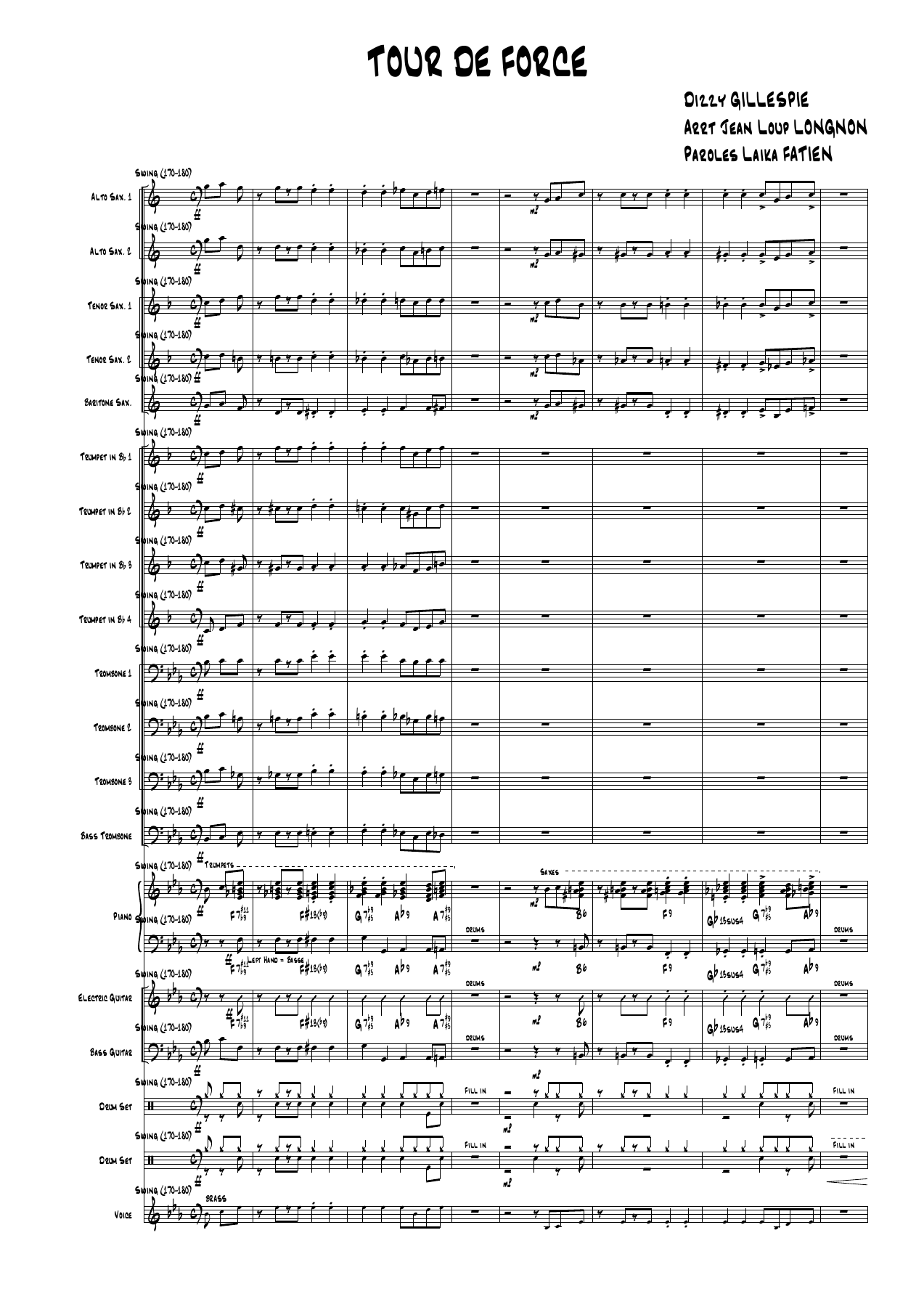
TourDeForce (J.Longnon) sheet music preview

TourDeForce (J.Longnon)

Composed by DIZZY GILLESPIE

Arranged by Jean-Loup Longnon

  • Ensemble: Big Band Vocal
  • Style: Jazz Standard
  • Pages: 47
  • Instruments (18): Alto Sax 1, Alto Sax 2, Tenor Sax 1, Tenor Sax 2, Baritone Sax, Trumpet in Bb 1, Trumpet in Bb 2, Trumpet in Bb 3, Trumpet in Bb 4, Trombone 1, Trombone 2, Trombone 3, Bass Trombone, Piano, Electric Guitar, Bass Guitar, Drum Set, Voice
  • Difficulty: medium
  • Content: Individual Parts
  • Format: PDF Download (Instant)
  • Price: $12.99

Dizzy Gillespie's "Tour De Force" stands as a quintessential bebop anthem, originally appearing on his seminal 1955 album *Groovin' High* and later on *Dizzy Gillespie at Newport* (1957). This high-octane composition epitomizes the virtuosic, harmonically sophisticated, and rhythmically intricate style that defined bebop in the mid-20th century. While not a traditional "standard" in the sense of being widely sung, its complex head, blistering tempo, and challenging chord changes have made it a rite of passage for instrumentalists and a showcase for big band prowess. It represents the pinnacle of post-war jazz innovation, pushing the boundaries of improvisation and ensemble interaction, and remains a thrilling testament to Gillespie's genius as a composer and bandleader. Jean-Loup Longnon's arrangement for big band with vocal feature transforms this instrumental tour de force into a dynamic vocal showcase while retaining all the original's exhilarating energy. Longnon, known for his masterful command of large ensemble writing and his deep respect for the bebop tradition, approaches "Tour De Force" with characteristic brilliance. His treatment maintains the original's blistering up-tempo bebop feel, typically in the range of quarter note = 280-320 BPM, in the key of F major. The arrangement opens with a powerful, tightly voiced brass fanfare, immediately setting a high-energy tone before the vocal enters with the complex, angular melody. Longnon's signature is evident in the intricate counterpoint between sections, the explosive brass soli passages that echo Gillespie's trumpet lines, and the sophisticated harmonic reharmonizations that add a contemporary sheen without betraying the bebop spirit. This arrangement is a true showstopper, designed to highlight both a virtuosic vocalist and a highly skilled big band. The vocal carries the challenging head, demanding exceptional agility, pitch accuracy, and rhythmic precision. Following the head, the arrangement features extended improvised solos, typically for trumpet and tenor saxophone, providing ample space for instrumentalists to shine over the driving rhythm section. Longnon masterfully builds tension through dynamic contrasts, leading to a thunderous shout chorus that is both harmonically rich and incredibly exciting, culminating in a powerful, full-ensemble ending. The technical demands are significant across all sections: woodwinds navigate intricate lines, brass requires strong endurance and precise articulation, and the rhythm section must maintain an unrelenting, propulsive swing. Performing "Tour De Force" is immensely rewarding, offering a thrilling experience for both musicians and audience, showcasing the band's collective virtuosity and the vocalist's command of the bebop idiom. It is ideally suited for advanced high school, college, community, and professional jazz ensembles looking for a challenging yet exhilarating addition to their repertoire. This arrangement demands a high level of technical proficiency and ensemble cohesion. The primary challenge lies in maintaining the blistering up-tempo bebop feel (quarter note = 280-320 BPM) with precision and swing. Conductors should emphasize rhythmic accuracy in the melodic lines, particularly for the vocal and woodwind sections, which often play rapid, intricate passages. Brass sections require strong endurance and clear articulation for the powerful soli and shout chorus sections; careful attention to dynamics will prevent overblowing and maintain clarity. The rhythm section must be exceptionally tight, providing a relentless, driving swing feel, with the bassist and drummer locking into a propulsive groove. Rehearsal time should focus on isolating fast melodic fragments, ensuring clean articulations, and practicing dynamic shifts. Encourage soloists to embrace the bebop language, utilizing extended harmonies and rhythmic displacement. No special techniques like plungers or doits are explicitly notated, but stylistic falls and scoops are encouraged where appropriate to enhance the authentic bebop flavor. Q: What instruments and parts are included in this arrangement? A: This arrangement is scored for a standard big band with a featured vocalist. It includes parts for 5 saxophones (AATTB), 4 trumpets, 4 trombones, piano, bass, drums, and a separate vocal lead sheet. Q: What is the difficulty level of Jean-Loup Longnon's "Tour De Force" arrangement? A: This arrangement is considered advanced. It demands high technical proficiency from all sections, particularly the vocal soloist, due to its blistering tempo, complex melodic lines, and intricate ensemble passages. Q: What musical style and historical context does this arrangement represent? A: This arrangement is a quintessential example of up-tempo bebop, originating from Dizzy Gillespie's groundbreaking work in the mid-1950s. It embodies the virtuosic and harmonically sophisticated characteristics of the bebop era. Q: What makes Jean-Loup Longnon's arrangement of "Tour De Force" unique? A: Longnon's arrangement uniquely adapts this instrumental bebop classic for a featured vocalist, while retaining its original high-energy, complex character. His signature is evident in the sophisticated voicings, intricate counterpoint, and powerful shout choruses that elevate the original's intensity. Q: What is the typical performance duration and tempo for this piece? A: The typical performance duration for this arrangement is approximately 4-6 minutes, depending on the length of the improvised solos. It is performed at a blistering up-tempo bebop feel, typically ranging from quarter note = 280-320 BPM.

Questions and answers

What is included in the TourDeForce (J.Longnon) PDF?
The verified current file contains a conductor score and individual parts across 47 pages.
How many instruments or parts are listed for TourDeForce (J.Longnon)?
The verified instrumentation list contains 18 entries for this Big Band Vocal arrangement.
Who is credited for TourDeForce (J.Longnon)?
Composer: DIZZY GILLESPIE. Arranger: Jean-Loup Longnon.
What difficulty is listed for TourDeForce (J.Longnon)?
The verified difficulty level is medium.
What style is listed for TourDeForce (J.Longnon)?
The catalog lists the style as Jazz Standard.
Can I preview TourDeForce (J.Longnon) before buying?
Yes. The product page provides a preview generated from the current PDF file.
How is TourDeForce (J.Longnon) delivered?
After successful payment, the digital PDF is made available for download. The displayed price is $12.99.

Musicians Also Search For

TourDeForce Jean-Loup Longnon PDFTourDeForce Jean-Loup Longnon sheet musicTourDeForce arranged by Jean-Loup LongnonJean-Loup Longnon big band vocal chartsJean-Loup Longnon jazz arrangements PDFTourDeForce DIZZY GILLESPIE sheet musicTourDeForce DIZZY GILLESPIE big band vocal arrangementsDIZZY GILLESPIE big band vocal chartsTourDeForce big band vocal arrangementsTourDeForce big band vocal PDF downloadTourDeForce jazz sheet musicbig band vocal sheet music downloadTourDeForce conductor score PDFTourDeForce individual parts downloadTourDeForce sheet music PDFTourDeForce Jazz Standard chartsJazz Standard big band vocal arrangementsbuy TourDeForce sheet musicdownload TourDeForce PDFTourDeForce jazz chartsbest Jean-Loup Longnon big band vocal arrangementsDIZZY GILLESPIE arranged by Jean-Loup LongnonTourDeForce printable sheet musicbig band vocal repertoire PDF

All arrangements by Jean-Loup Longnon All DIZZY GILLESPIE sheet music