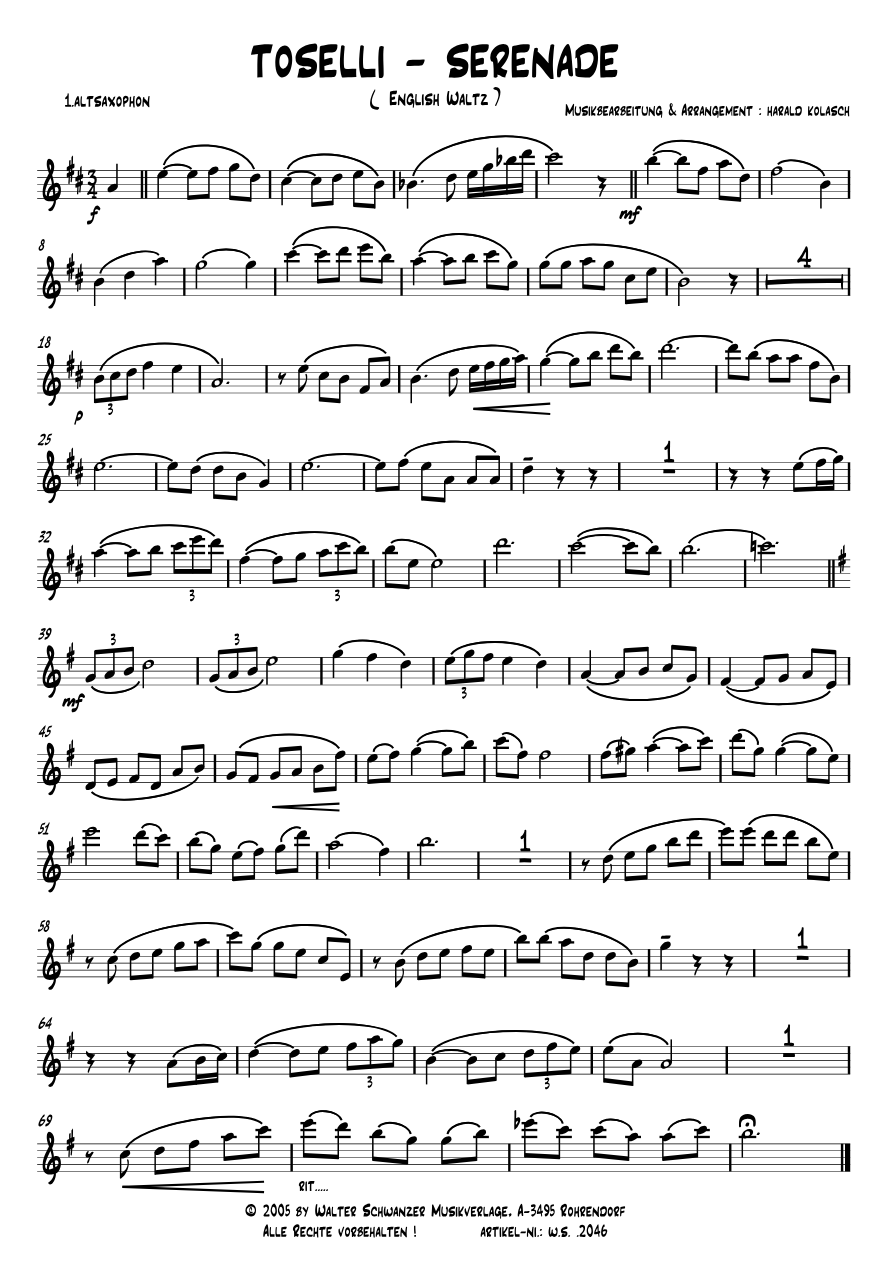
Toselli-Serenade (H.Kolasch)
Composed by Enrico Toselli
Arranged by H. Kolasch
- Ensemble: Big Band Dance
- Style: Slow Waltz
- Pages: 16
- Instruments (15): Alto Saxophone 1, Alto Saxophone 2, Tenor Saxophone 1, Tenor Saxophone 2, Baritone Saxophone, Trumpet 1, Trumpet 2, Trumpet 3, Trombone 1, Trombone 2, Trombone 3, Piano/Keyboard/Organ, Guitar, Bass, Drum Set
- Difficulty: easy
- Content: Individual Parts
- Format: PDF Download (Instant)
- Price: $24.99
Enrico Toselli's "Serenata" (Op. 6, No. 1), often simply known as "Toselli's Serenade," emerged from the rich tradition of late 19th and early 20th-century Italian salon music. Composed in 1900, this lyrical and melancholic piece quickly captivated audiences with its flowing melodies and expressive harmonies, becoming a staple in the classical crossover repertoire. While not originally a jazz standard, its enduring popularity and romantic character made it a natural candidate for interpretation across various genres, including dance orchestras of the early 20th century. Its poignant beauty and memorable theme have ensured its place in musical history, evoking a sense of nostalgic elegance and refined sentimentality that transcends its era. H. Kolasch's arrangement for big band dance ensemble reimagines this timeless melody as a sophisticated Slow Waltz, perfectly suited for a ballroom setting or a concert program seeking a touch of classic romance. The musical character is one of tender grace and flowing lyricism, set firmly in a 3/4 meter with a deliberate, unhurried tempo. Kolasch masterfully retains the original's melancholic charm while infusing it with the lush harmonic palette and instrumental colors of a large jazz ensemble. The key of G major provides a bright yet gentle backdrop for the unfolding melodic lines, creating a mood that is both reflective and warmly inviting. This arrangement evokes the golden age of dance bands, where elegance and musicality reigned supreme. Kolasch's distinctive approach is evident in the thoughtful voicings and the distribution of the melody. The opening statement is handled by the saxophones, their rich blend immediately establishing the waltz's romantic character. Subsequent sections feature the brass, often muted, providing a warm, cushioned accompaniment or taking over the melodic lead with a refined, understated power. There are no extended improvisational solos in the traditional jazz sense; instead, the arrangement focuses on ensemble blend and interpretation of the melodic line, with brief, expressive counter-melodies weaving through the texture. Kolasch expertly uses dynamic contrasts and subtle shifts in instrumentation to build and release tension, ensuring the piece never becomes static despite its consistent tempo. The arrangement culminates in a full ensemble statement of the theme, rich with extended harmonies that provide a satisfying and resonant conclusion. Performing "Toselli-Serenade (H.Kolasch)" is a deeply rewarding experience for a big band dance ensemble. The primary challenge lies in achieving a unified, expressive legato across all sections, particularly in the sustained melodic lines and the delicate accompanying figures. The piece demands excellent intonation and dynamic control, as the emotional impact relies heavily on nuanced phrasing. The melody is shared between the saxophone section, the lead trumpet, and the full ensemble, requiring careful blending and balance. This arrangement is ideally suited for college-level ensembles, community big bands, or professional dance orchestras looking for a sophisticated and beautiful waltz that showcases their ensemble precision and lyrical capabilities. Its blend of classical elegance and big band charm makes it a standout piece in any repertoire. This Slow Waltz arrangement demands a refined, legato approach from all sections. The primary technical challenge lies in maintaining a consistent, unhurried 3/4 tempo while achieving seamless phrasing and impeccable intonation, especially during sustained notes and melodic transitions. Conductors should emphasize a gentle, flowing pulse rather than a rigid beat. The tempo marking should be around quarter note = 108-116, allowing for a graceful, unhurried feel. Encourage musicians to "sing" through their phrases, focusing on breath support and smooth connections between notes. For the brass sections, precise articulation and dynamic control are crucial; ensure muted passages (especially cup or straight mutes for trumpets) are blended and never harsh. The saxophone section must achieve a warm, unified sound, particularly when carrying the main melody. Rehearsal time should be dedicated to balancing the inner voices and ensuring that the accompaniment supports, rather than overwhelms, the melodic lines. Focus on the subtle dynamic swells and decays to enhance the romantic character of the piece. Q: What instruments are included in this arrangement? A: This arrangement is scored for a 17-instrument big band dance ensemble. The instrumentation includes Alto Saxophone 1, Alto Saxophone 2, Tenor Saxophone 1, Tenor Saxophone 2, Baritone Saxophone, Trumpet 1, Trumpet 2, Trumpet 3, Trumpet 4, Trombone 1, Trombone 2, Trombone 3, Trombone 4, Piano, Bass, Drums, and Guitar. Q: What is the difficulty level of "Toselli-Serenade (H.Kolasch)"? A: This arrangement is suitable for intermediate to advanced ensembles, including college-level, community, and professional big bands. It requires strong ensemble blend, excellent intonation, and nuanced dynamic control, but does not feature complex improvisational sections. Q: What is the musical style and historical context of this piece? A: This is a Slow Waltz arrangement of Enrico Toselli's "Serenata" (Op. 6, No. 1), originally composed in 1900. H. Kolasch's treatment reimagines this romantic salon piece for a big band dance ensemble, blending classical lyricism with the lush harmonies and instrumentation of the early 20th-century dance orchestra era. Q: What makes H. Kolasch's arrangement unique? A: Kolasch's arrangement is unique for its faithful yet fresh interpretation of Toselli's classic, transforming it into a sophisticated Slow Waltz for big band. It emphasizes ensemble voicings, lyrical phrasing, and rich harmonies over individual improvisation, showcasing the band's ability to perform with elegance and emotional depth. Q: What is the approximate performance duration and recommended tempo? A: The performance duration for "Toselli-Serenade (H.Kolasch)" is approximately 3-4 minutes, depending on the chosen tempo. A recommended tempo is around quarter note = 108-116, allowing for a graceful and flowing Slow Waltz feel.
Musicians Also Search For
Toselli-Serenade H. Kolasch PDF • Toselli-Serenade H. Kolasch sheet music • Toselli-Serenade arranged by H. Kolasch • H. Kolasch big band dance charts • H. Kolasch jazz arrangements PDF • Toselli-Serenade Enrico Toselli sheet music • Toselli-Serenade Enrico Toselli big band dance arrangement • Enrico Toselli big band dance charts • Toselli-Serenade big band dance arrangement • Toselli-Serenade big band dance PDF download • Toselli-Serenade jazz ensemble sheet music • big band dance sheet music instant download • Toselli-Serenade individual parts download • Toselli-Serenade sheet music with parts • Toselli-Serenade Slow Waltz chart • Slow Waltz big band dance arrangements • buy Toselli-Serenade sheet music online • download Toselli-Serenade PDF • Toselli-Serenade jazz chart • best H. Kolasch big band dance arrangements • Enrico Toselli songs arranged by H. Kolasch • Toselli-Serenade printable sheet music • big band dance repertoire PDF