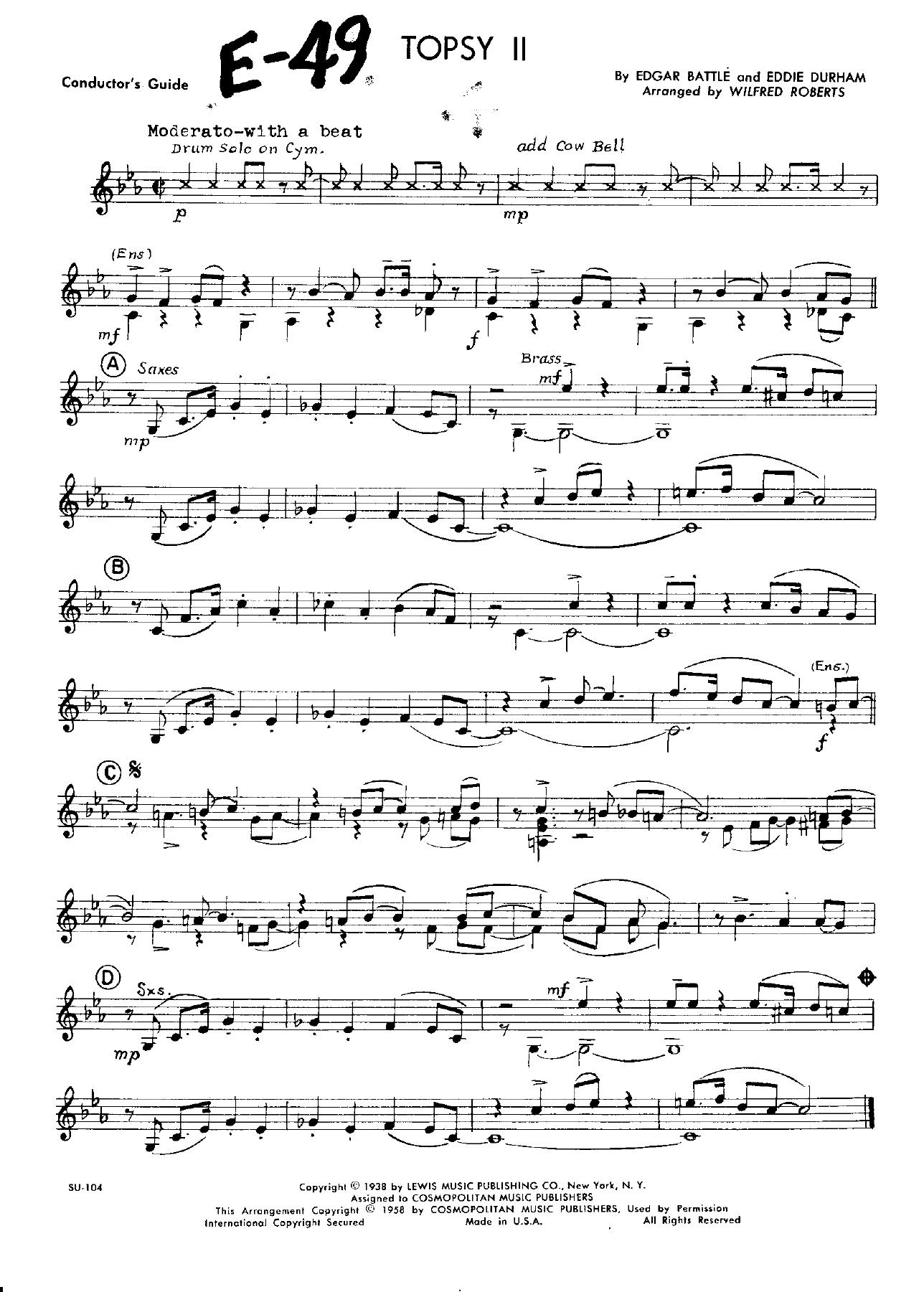
Topsy II (W.Roberts)
Composed by W. Roberts
Arranged by W.Roberts
- Ensemble: Big Band
- Style: Jazz Standard
- Pages: 24
- Instruments (16): 1st Eb Alto Saxophone, 3rd Eb Alto Saxophone, 2nd Bb Tenor Saxophone, 4th Bb Tenor Saxophone, 5th Eb Baritone Saxophone, 1st Bb Trumpet, 2nd Bb Trumpet, 3rd Bb Trumpet, 4th Bb Trumpet, 1st Trombone, 2nd Trombone, 3rd Trombone, 4th Trombone, Guitar, Piano, String Bass & Tuba
- Difficulty: medium
- Content: Individual Parts
- Format: PDF Download (Instant)
- Price: $24.99
Originally popularized during the vibrant swing era and famously immortalized by legends like Count Basie and Benny Goodman, "Topsy"—and its high-energy offshoot "Topsy II"—stands as an enduring monument to Kansas City swing and riff-driven big band architecture. Written by Edgar Battle and Eddie Durham (with traditional adaptations often credited or arranged through subsequent jazz icons like Bill Roberts), the tune epitomizes the infectious, foot-stomping pulse of 1930s and 1940s dance halls. It bridges the gap between head arrangements born out of late-night jam sessions and tightly orchestrated swing-era precision, making it a masterclass in driving momentum, call-and-response phrasing, and collective ensemble buoyancy. This robust big band adaptation by W.Roberts charges forward with a jubilant, medium-up swing groove anchored by a relentless walking bass line and crisp ride cymbal pulse. The harmonic landscape remains firmly rooted in traditional blues-infused jazz changes, yet it crackles with vibrant modal colorations and sharp dynamic contrasts. The mood is celebratory, ebullient, and unpretentious, evoking the sweat and sophistication of a mid-century ballroom while offering a sophisticated workout in time-feel. The arrangement opens with a sultry, understated motif before gradually expanding its sonic footprint, driving inexorably toward a thunderous, harmonically rich shout chorus that demands stamina and rhythmic unity from every section. W.Roberts approaches the chart with a meticulous respect for classic big band textures while injecting contemporary vitality through clever section interlocking and dynamic shading. Rather than relying on static block-chord writing, the arrangement utilizes counterpoint between the brass and saxophones, allowing inner voices to move fluidly beneath the primary melodic statements. The saxophone section enjoys lush, Duke Ellington-inspired voicings during the lyrical interludes, while the brass section is utilized for sharp, punctuation-driven stabs that mimic the classic Count Basie band's signature punch. A standout feature of this setting is the seamless trade-off of thematic material, ensuring that interest is distributed evenly across the ensemble rather than resting solely on the lead trumpet or alto chair. Designed with advanced high school, collegiate, and professional community big bands in mind, this chart strikes an ideal balance between accessibility and technical challenge. The primary hurdles lie not in extreme technical pyrotechnics, but in maintaining a consistent, relaxed swing eighth-note feel at a brisk tempo, executing precise articulation across the ensemble, and balancing the dynamic swell of the final chorus. Open solo sections provide a fantastic vehicle for developing improvisers in the tenor saxophone and piano chairs to stretch out over standard blues or rhythm changes form. Rich in historical gravitas yet fresh in its execution, this 24-page publication—complete with a comprehensive conductor’s score—delivers an unforgettable centerpiece for any festival program or standard concert set. Achieving an authentic performance of this arrangement requires absolute rhythmic precision and a deep commitment to the traditional swing subdivision. Conductors should enforce a relaxed, forward-moving medium-up tempo where the eighth notes are strictly swung—never straight, but avoiding the over-dotted triplet feel of late-era bebop. The primary technical challenge rests in the crisp execution of short, accented notes in the brass section; ensure that players use a clean tongue attack ("dit" rather than "dah") to keep the rhythm section's groove from bogging down. Special attention must be paid to dynamic balance during the transitional bridges, where the horns act as accompanists to the rhythm section. Players should utilize subtle falls and doits where indicated in the lead trumpet and lead alto parts, but these stylistic flourishes must never overpower the fundamental pitch center. Rehearsal should begin section by section, isolating the call-and-response figures between the saxophones and brass until the interlocking rhythms lock together effortlessly. Q: What instruments and parts are included in this publication? A: The 24-page publication includes a comprehensive conductor’s score and standard 17-instrument big band instrumentation, featuring parts for Alto Saxophones 1 through 3, Tenor Saxophones 2 and 4, full brass sections, and a rhythm section. Q: What is the difficulty level of this arrangement? A: This arrangement is ideally suited for advanced high school, collegiate, and professional community big bands capable of handling moderate-tempo swing feels and ensemble synchronization. Q: What is the historical style and context of "Topsy II"? A: "Topsy II" is rooted in the classic swing era and Kansas City big band tradition, famous for its infectious riff-based themes and association with legendary bandleaders like Count Basie. Q: What makes this specific arrangement by W.Roberts unique? A: W.Roberts balances traditional swing-era textures with clever counterpoint, rich inner voicings, and dynamic shading that distribute thematic material evenly across the entire ensemble. Q: What is the expected performance duration and tempo feel? A: The arrangement is designed around an energetic, medium-up swing tempo (typically around quarter note = 160-172 BPM) with a standard concert duration of approximately 3 to 4 minutes depending on solo extensions.
Questions and answers
- What is included in the Topsy II (W.Roberts) PDF?
- The verified current file contains a conductor score and individual parts across 24 pages.
- How many instruments or parts are listed for Topsy II (W.Roberts)?
- The verified instrumentation list contains 16 entries for this Big Band arrangement.
- Who is credited for Topsy II (W.Roberts)?
- Composer: W. Roberts. Arranger: W.Roberts.
- What difficulty is listed for Topsy II (W.Roberts)?
- The verified difficulty level is medium.
- What style is listed for Topsy II (W.Roberts)?
- The catalog lists the style as Jazz Standard.
- Can I preview Topsy II (W.Roberts) before buying?
- Yes. The product page provides a preview generated from the current PDF file.
- How is Topsy II (W.Roberts) delivered?
- After successful payment, the digital PDF is made available for download. The displayed price is $24.99.
Musicians Also Search For
Topsy II W.Roberts PDF • Topsy II W.Roberts sheet music • Topsy II arranged by W.Roberts • W.Roberts big band charts • W.Roberts jazz arrangements PDF • Topsy II W. Roberts sheet music • Topsy II W. Roberts big band arrangements • W. Roberts big band charts • Topsy II big band arrangements • Topsy II big band PDF download • Topsy II jazz sheet music • big band sheet music download • Topsy II conductor score PDF • Topsy II individual parts download • Topsy II sheet music PDF • Topsy II Jazz Standard charts • Jazz Standard big band arrangements • buy Topsy II sheet music • download Topsy II PDF • Topsy II jazz charts • best W.Roberts big band arrangements • W. Roberts arranged by W.Roberts • Topsy II printable sheet music • big band repertoire PDF