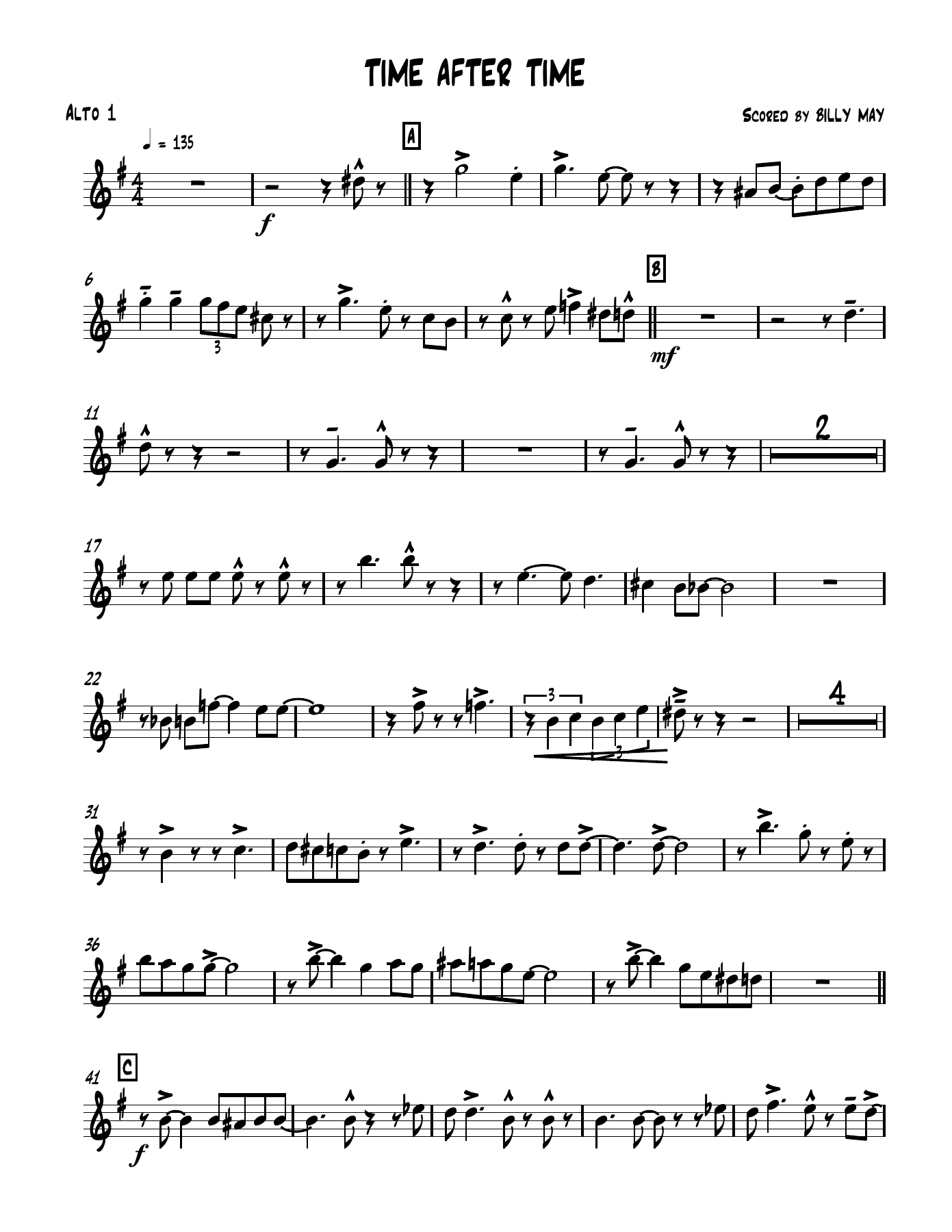
Time After Time (B.May)
Composed by Jule Styne
Arranged by B.May
- Ensemble: Big Band
- Style: Jazz Standard
- Pages: 41
- Instruments (18): Alto 1, Alto 2, Tenor 1, Tenor 2, Bari. Sax., Trumpet 1, Trumpet 2, Trumpet 3, Trumpet 4, Trombone 1, Trombone 2, Trombone 3, Bass Trombone, Piano, Guitar, Bass Guitar, Drums, Vibraphone/Voice
- Difficulty: medium
- Content: Individual Parts
- Format: PDF Download (Instant)
- Price: $24.99
"Time After Time," composed by Jule Styne with lyrics by Sammy Cahn in 1946, emerged from the golden age of American popular song, solidifying its place as a cherished jazz standard. Originally written for Frank Sinatra to introduce in the 1947 MGM film *It Happened in Brooklyn*, the song quickly gained popularity, with Sinatra's recording hitting the charts in 1947. Sarah Vaughan, backed by the Teddy Wilson Quartet, was actually the first to record the tune in November 1946. The piece embodies the romantic sentimentality of the post-World War II era, featuring a timeless theme of enduring love and faithfulness that has resonated with audiences for decades. Its melodic construction, characterized by often disjunct, leaping motions amidst stepwise connections, creates a "sine wave shape" that beautifully mirrors the ebb and flow of life and emotion, contributing to its enduring appeal as a canvas for jazz interpretation. This big band arrangement by B.May presents "Time After Time" as a medium swing ballad, carefully balancing its inherent romanticism with sophisticated jazz sensibilities. The arrangement is set in a comfortable key, allowing the lush harmonies and lyrical melody to shine without undue technical strain. The mood is one of tender reflection and warmth, evoking a classic, elegant jazz club atmosphere. B.May's approach to arranging in this style is typically characterized by a keen understanding of ensemble voicing, often employing rich, close-knit harmonies in the saxophone section and brass pads that provide a luxurious backdrop to the melodic lines. Expect subtle yet impactful dynamic shifts and a thoughtful use of instrumental color to enhance the emotional arc of the piece. B.May's distinctive treatment of "Time After Time" features the melody initially carried by a lead alto saxophone, allowing for expressive phrasing before being passed to a harmonized saxophone soli section that showcases the full warmth of the reed choir. The brass sections contribute with carefully scored counter-melodies and punctuations, building to a gentle but powerful shout chorus that provides a satisfying emotional peak without overwhelming the ballad's delicate nature. While there are no extended open solos, short, lyrical improvised breaks are indicated for tenor saxophone and trumpet, offering opportunities for individual expression within the arranged framework. The technical challenges lie primarily in achieving a cohesive ensemble sound, precise blend and balance, and nuanced dynamic control, particularly in the sustained chord voicings and smooth transitions between sections. The reward for performers is an arrangement that is both musically engaging and deeply satisfying to play, allowing the band to convey the profound emotional depth of this classic standard. This arrangement is ideally suited for college, community, and advanced high school jazz ensembles. Its detailed scoring provides ample opportunity for developing ensemble musicianship, including intonation, blend, and rhythmic precision within a ballad context. The accessible yet sophisticated harmonic language and melodic treatment make it an excellent choice for groups looking to perform a beloved jazz standard with authenticity and artistry, offering a rewarding experience for both the musicians and the audience. Conductors should emphasize a relaxed, medium swing feel throughout, ensuring the rhythm section maintains a supple, unhurried groove. Pay close attention to dynamic shaping, particularly in the sustained brass and saxophone pads, allowing phrases to breathe and build naturally. Intonation is paramount, especially in the close voicings of the saxophone soli and the brass chorales; encourage musicians to listen across sections. Rehearsal time should be dedicated to achieving seamless transitions between melodic statements and background figures, ensuring the accompaniment supports rather than competes with the primary melodic voice. Articulations should be light and legato where indicated, with precise releases on sustained notes. While no special techniques like plunger mutes or doits are explicitly required, encouraging expressive vibrato and nuanced phrasing will greatly enhance the overall musicality. Q: What instruments are included in this arrangement? A: This big band arrangement is scored for 18 instruments, including Alto Saxophone 1, Alto Saxophone 2, Tenor Saxophone 1, Tenor Saxophone 2, Baritone Saxophone, 4 Trumpets, 4 Trombones, Piano, Bass, Drums, and Guitar. The full score is also provided. Q: What is the difficulty level of this arrangement? A: This arrangement is rated as medium-advanced, suitable for college, community, and advanced high school jazz ensembles. It requires good command of ensemble playing, intonation, and nuanced musical expression. Q: What is the musical style and historical context of "Time After Time"? A: "Time After Time" is a romantic jazz standard composed by Jule Styne in 1946, embodying the classic American Songbook era. It's a medium swing ballad known for its lyrical melody and timeless theme of enduring love, first popularized by Frank Sinatra. Q: What makes B.May's arrangement of "Time After Time" unique? A: B.May's arrangement features rich, sophisticated voicings, particularly in the saxophone soli and brass pads, creating a lush harmonic backdrop. It includes lyrical improvised breaks for tenor saxophone and trumpet, culminating in a tasteful shout chorus that enhances the emotional arc of the piece. Q: What is the approximate performance duration and tempo of this piece? A: The approximate performance duration for this arrangement is 4-5 minutes, depending on the improvised sections. It is set at a medium swing tempo, typically around 100-110 beats per minute, allowing for expressive melodic interpretation.
Questions and answers
- What is included in the Time After Time (B.May) PDF?
- The verified current file contains individual parts across 41 pages.
- How many instruments or parts are listed for Time After Time (B.May)?
- The verified instrumentation list contains 18 entries for this Big Band arrangement.
- Who is credited for Time After Time (B.May)?
- Composer: Jule Styne. Arranger: B.May.
- What difficulty is listed for Time After Time (B.May)?
- The verified difficulty level is medium.
- What style is listed for Time After Time (B.May)?
- The catalog lists the style as Jazz Standard.
- Can I preview Time After Time (B.May) before buying?
- Yes. The product page provides a preview generated from the current PDF file.
- How is Time After Time (B.May) delivered?
- After successful payment, the digital PDF is made available for download. The displayed price is $24.99.
Musicians Also Search For
Time After Time B.May PDF • Time After Time B.May sheet music • Time After Time arranged by B.May • B.May big band charts • B.May jazz arrangements PDF • Time After Time Jule Styne sheet music • Time After Time Jule Styne big band arrangements • Jule Styne big band charts • Time After Time big band arrangements • Time After Time big band PDF download • Time After Time jazz sheet music • big band sheet music download • Time After Time individual parts download • Time After Time sheet music PDF • Time After Time Jazz Standard charts • Jazz Standard big band arrangements • buy Time After Time sheet music • download Time After Time PDF • Time After Time jazz charts • best B.May big band arrangements • Jule Styne arranged by B.May • Time After Time printable sheet music • big band repertoire PDF