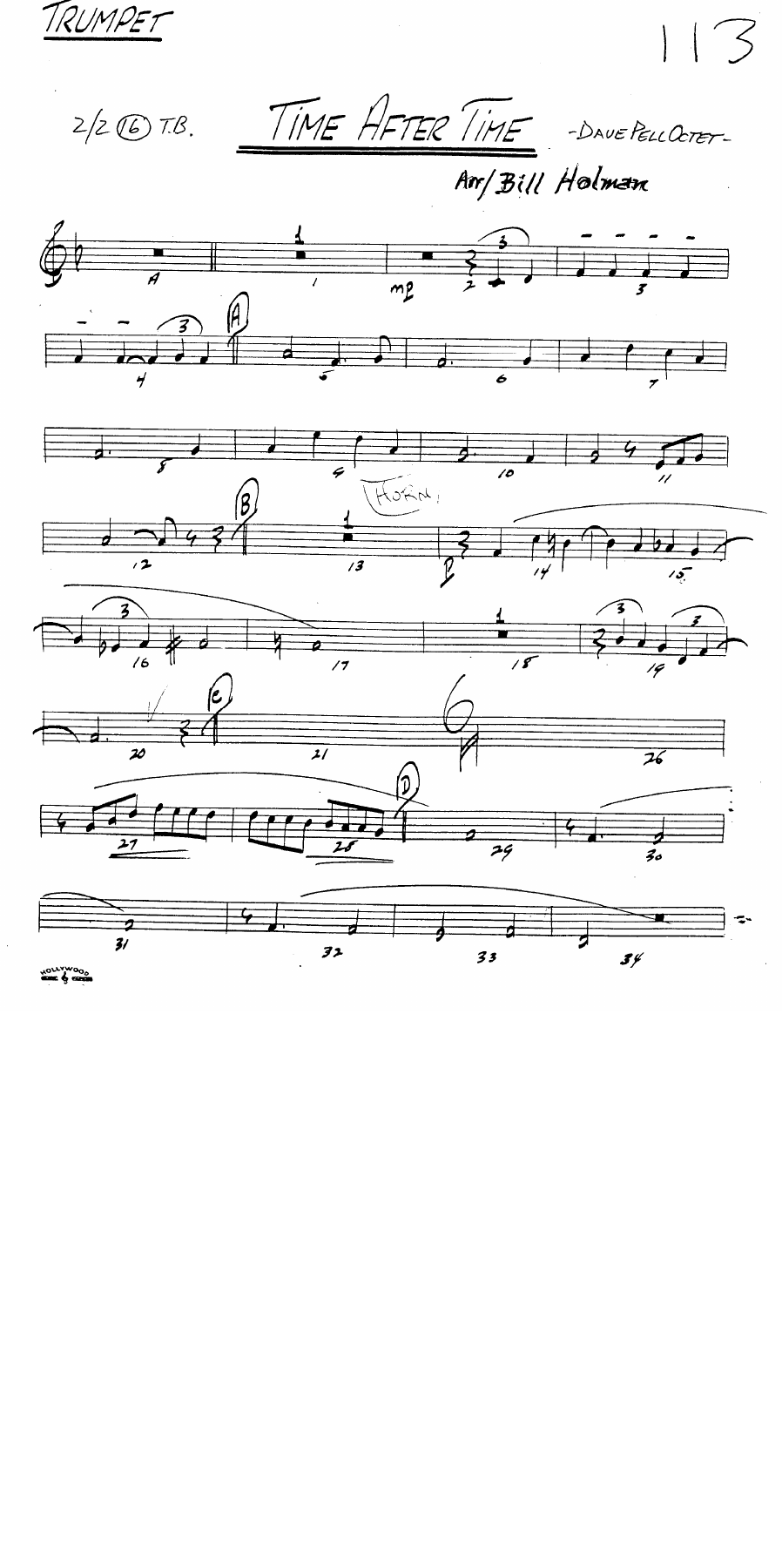
Time After Time (B.Ts,Bs,Trp,Trb+Rhythm) sheet music preview

Time After Time (B.Ts,Bs,Trp,Trb+Rhythm)

Composed by Cyndi Lauper, Rob Hyman

Arranged by Bill Holman - Dave Pell Octet - Ts,Bs,Trp,Trb+Rhythm

  • Ensemble: Small Ensemble
  • Style: Jazz Standard
  • Pages: 16
  • Difficulty: easy
  • Content: Sheet Music
  • Format: PDF Download (Instant)
  • Price: $12.99

The song "Time After Time" exists in two distinct musical universes, both of which have achieved widespread recognition. The jazz standard, composed by Jule Styne with lyrics by Sammy Cahn in 1946, emerged from the Great American Songbook and was introduced by Frank Sinatra in the 1947 MGM film *It Happened in Brooklyn*. Its heartfelt lyrics of enduring love and devotion, combined with a harmonically sophisticated yet fluid melody, quickly cemented its place in the jazz repertoire, with notable early interpretations by artists such as Chet Baker, Sarah Vaughan, and Stan Getz. Decades later, a different "Time After Time" became a pop phenomenon. Written by Cyndi Lauper and Rob Hyman, and released in January 1984, this version became Lauper's first number one hit, defining a generation with its poignant lyrics and distinctive 80s sound. This particular arrangement, however, draws its inspiration from the classic jazz standard by Styne and Cahn, offering a sophisticated small ensemble treatment. This arrangement captures the essence of a medium swing, cool jazz aesthetic, characteristic of the Dave Pell Octet's sound. The original Dave Pell Octet, formed from the nucleus of the Les Brown Big Band, pioneered a "West Coast Cool" approach in the 1950s, focusing on accessible yet musically rich interpretations of the Great American Songbook. This rendition of "Time After Time" likely resides in a comfortable, moderate tempo, allowing for clarity in the intricate voicings and a relaxed, lyrical flow. The mood is one of understated elegance and warmth, evoking a sense of nostalgic romance. While the specific key is not provided in the details, jazz standards are often presented in keys that are comfortable for the featured instruments, allowing for expressive phrasing and improvisation. The energy is refined rather than boisterous, emphasizing melodic beauty and harmonic richness. Bill Holman, a legendary figure in jazz arranging, crafted this particular small ensemble setting. Holman is renowned for his ability to transform familiar melodies into compelling reimaginations, whether for large ensembles like Stan Kenton's orchestra or for smaller groups. His signature style often incorporates sophisticated counterpoint, inventive voicings, and a keen sense of musical development. For the Dave Pell Octet, Holman contributed to their distinctive sound, which blended jazz integrity with a commercial appeal, often featuring one-chorus solos within meticulously arranged frameworks. Expect intricate horn lines, possibly with sax soli sections that showcase the ensemble's blend and precision. Holman's arrangements frequently feature subtle reharmonizations and unexpected melodic twists that keep the listener engaged. The melody of "Time After Time" is typically carried by the lead horn, often alternating with soli passages involving the full horn section (tenor sax, baritone sax, trumpet, trombone). This arrangement likely features designated solo sections, providing opportunities for improvisation over the song's classic changes. Given the instrumentation, solos would traditionally be featured for tenor saxophone, trumpet, and trombone, with potential for a baritone saxophone feature as well. Technical challenges might include precise articulation in the horn lines, maintaining a consistent medium swing feel, and navigating Holman's characteristic harmonic subtleties. The rewarding aspects of performing this piece lie in its beautiful melodic content, the opportunity for expressive improvisation, and the satisfaction of executing a meticulously crafted small ensemble arrangement by a master like Holman. It offers a chance to explore the nuanced world of West Coast cool jazz. This arrangement is ideally suited for college-level jazz ensembles, advanced community bands, or professional small groups. The sophistication of Holman's writing, even in a small ensemble context, demands a high level of musicianship, including strong sight-reading skills, an understanding of jazz harmony, and the ability to blend and articulate precisely within a compact horn section. While not overly challenging in terms of extreme ranges or blistering tempos, the musicality required to bring out the nuances of Holman's voicings and the cool jazz aesthetic makes it best for experienced players. To achieve the authentic cool jazz feel of this arrangement, conductors should emphasize a relaxed, yet precise medium swing tempo. Encourage musicians to internalize the rhythmic subtlety, avoiding a rushed or stiff interpretation. Articulation is key; aim for a light, detached feel on eighth notes, with smooth legato phrasing on longer melodic lines. The horn section should focus on impeccable blend and balance, particularly in the soli passages where Holman's voicings are prominent. Pay close attention to dynamics, utilizing subtle crescendos and diminuendos to shape phrases and highlight melodic contours. Rehearsal should focus on isolating the intricate counterpoint between the horns, ensuring each line is clear yet integrated into the overall texture. Soloists should be encouraged to develop lyrical, melodic improvisations that complement the arrangement's sophisticated character, rather than relying on purely technical displays. The rhythm section should lay down a steady, unobtrusive groove, providing a supportive harmonic and rhythmic foundation without overpowering the horns. Q: What instruments are included in this arrangement? A: This arrangement is scored for a small ensemble consisting of Tenor Saxophone, Baritone Saxophone, Trumpet, Trombone, and a standard Rhythm Section (Piano, Bass, Drums, and potentially Guitar). Q: What is the difficulty level of this arrangement? A: This arrangement is considered advanced intermediate to advanced, suitable for college-level jazz ensembles, skilled community bands, or professional small groups due to its sophisticated harmonic language and intricate voicings. Q: What musical style and historical context does this arrangement represent? A: This arrangement is a jazz standard in the "West Coast Cool" style, drawing from the 1946 composition by Jule Styne and Sammy Cahn, and interpreted through the lens of Bill Holman's arranging for the Dave Pell Octet of the 1950s. Q: What makes this arrangement unique compared to other versions of "Time After Time"? A: This arrangement stands out due to Bill Holman's distinctive small ensemble writing, featuring his characteristic voicings, counterpoint, and a refined cool jazz aesthetic, as originally conceived for the Dave Pell Octet. Q: What is the typical performance duration or tempo for this piece? A: As a medium swing jazz standard, the performance duration will typically be around 3-5 minutes, depending on the number and length of improvised solos, maintaining a comfortable, unhurried tempo.

Musicians Also Search For

Time After Time Bill Holman - Dave Pell Octet - Ts,Bs,Trp,Trb+Rhythm PDFTime After Time Bill Holman - Dave Pell Octet - Ts,Bs,Trp,Trb+Rhythm sheet musicTime After Time arranged by Bill Holman - Dave Pell Octet - Ts,Bs,Trp,Trb+RhythmBill Holman - Dave Pell Octet - Ts,Bs,Trp,Trb+Rhythm small ensemble chartsBill Holman - Dave Pell Octet - Ts,Bs,Trp,Trb+Rhythm jazz arrangements PDFTime After Time Cyndi Lauper, Rob Hyman sheet musicTime After Time Cyndi Lauper, Rob Hyman small ensemble arrangementCyndi Lauper, Rob Hyman small ensemble chartsTime After Time small ensemble arrangementTime After Time small ensemble PDF downloadTime After Time jazz ensemble sheet musicsmall ensemble sheet music instant downloadTime After Time sheet music with partsTime After Time Jazz Standard chartJazz Standard small ensemble arrangementsbuy Time After Time sheet music onlinedownload Time After Time PDFTime After Time jazz chartbest Bill Holman - Dave Pell Octet - Ts,Bs,Trp,Trb+Rhythm small ensemble arrangementsCyndi Lauper, Rob Hyman songs arranged by Bill Holman - Dave Pell Octet - Ts,Bs,Trp,Trb+RhythmTime After Time printable sheet musicsmall ensemble repertoire PDF

All arrangements by Bill Holman - Dave Pell Octet - Ts,Bs,Trp,Trb+Rhythm All Cyndi Lauper, Rob Hyman sheet music