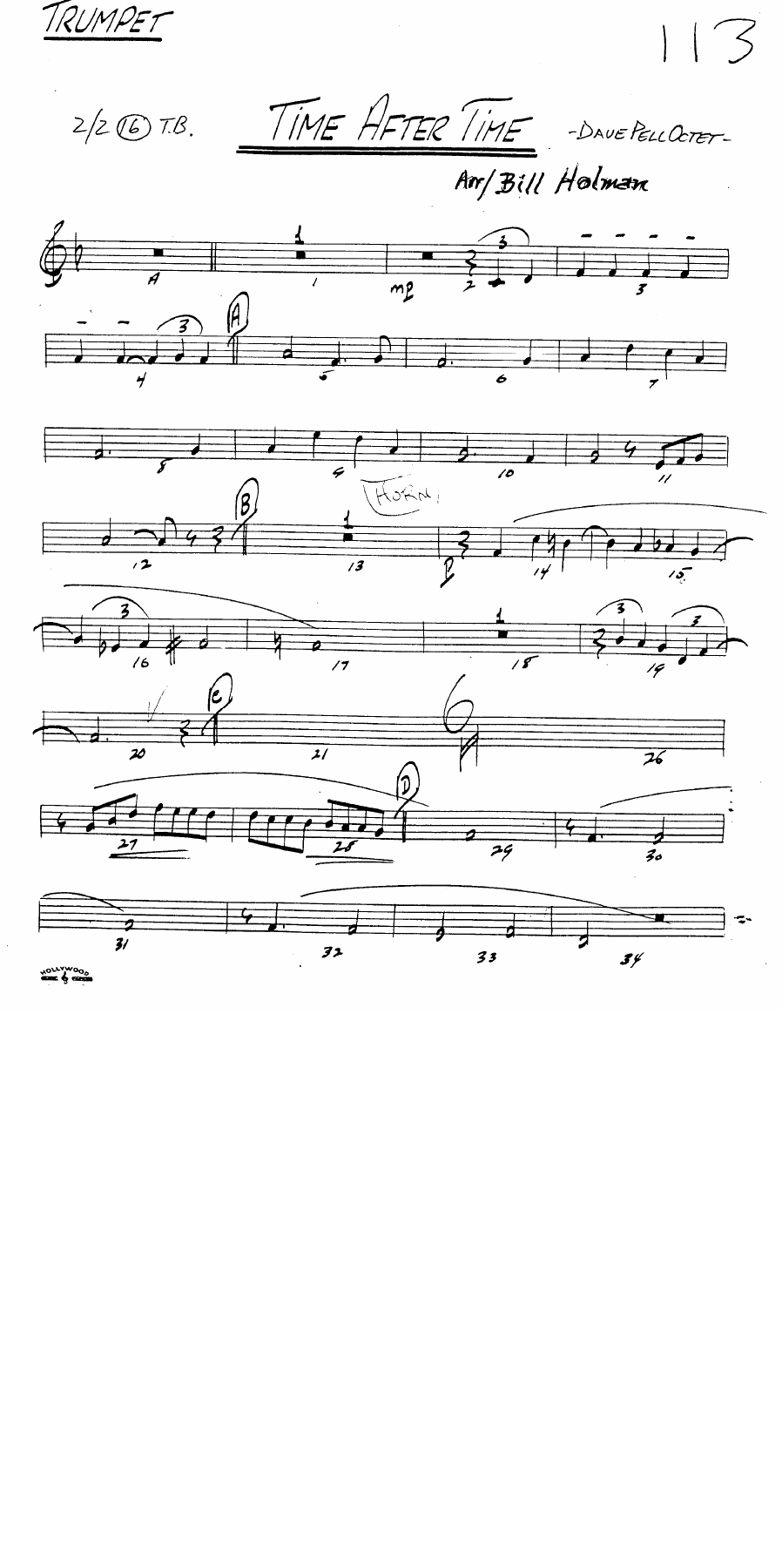
Time After Time (B.Holman) sheet music preview

Time After Time (B.Holman)

Composed by Jule Styne

Arranged by Bill Holman

  • Ensemble: Small Ensemble
  • Style: Jazz Standard
  • Pages: 16
  • Instruments (8): Trumpet, Trombone, Tenor Saxophone, Baritone Saxophone, Piano, Guitar, Bass, Drums
  • Difficulty: easy
  • Content: Individual Parts
  • Format: PDF Download (Instant)
  • Price: $12.99

"Time After Time," a timeless ballad originally penned by Jule Styne with lyrics by Sammy Cahn, first graced the airwaves in 1947, quickly becoming a quintessential jazz standard. Emerging from the Golden Age of American songwriting, its poignant melody and evocative lyrics captured the post-war sentiment, earning it enduring popularity. While initially a hit for Frank Sinatra, it was Chet Baker's iconic 1954 recording that cemented its status as a jazz cornerstone, showcasing its versatility as a vehicle for improvisation and emotional depth. The song's harmonic sophistication, characterized by its elegant chord changes and expressive melodic contours, makes it a favorite among vocalists and instrumentalists alike, representing the pinnacle of mid-20th-century popular song craft. Bill Holman, a titan of jazz arranging, brings his unparalleled genius to this small ensemble rendition of "Time After Time." Known for his intricate yet effortlessly swinging charts, Holman's signature style is immediately recognizable here. Rather than a simple head chart, this arrangement is a masterclass in sophisticated counterpoint and harmonic reinterpretation. Expect his characteristic extended harmonies, often featuring lush, close-voiced chords that create a rich, warm texture without ever sounding dense. Holman's genius lies in his ability to make complex musical ideas sound natural and flowing, maintaining the original's lyrical integrity while infusing it with his distinct modern jazz sensibility. His arrangements frequently feature interwoven melodic lines and unexpected harmonic turns that challenge and delight both performers and listeners. This particular arrangement presents "Time After Time" as a medium-slow swing ballad, maintaining the original's reflective mood but with an understated rhythmic drive. The melody is initially presented by a lead instrument, likely a trumpet or alto saxophone, with subtle, supportive voicings from the other horns. Holman masterfully employs soli sections where the ensemble moves as one, creating moments of breathtaking beauty and harmonic richness. While there are no explicit "shout choruses" in the traditional big band sense, the arrangement builds dynamically, culminating in a powerful yet controlled ensemble statement. Featured solo sections are provided, offering ample space for improvisation over the standard's well-loved changes. Technical challenges include precise intonation within the close voicings, nuanced dynamic control, and the ability to articulate Holman's often intricate rhythmic figures with a relaxed swing feel. The rewarding aspect lies in performing a truly artistic reinterpretation of a classic, where every part contributes to a cohesive and deeply expressive musical statement. This arrangement is ideally suited for college-level jazz ensembles, advanced community bands, or professional small groups seeking a sophisticated and challenging piece for their repertoire. The demands on individual musicianship, particularly in terms of blend, balance, and harmonic awareness, make it an excellent vehicle for developing ensemble skills. It requires players who can navigate complex harmonies and articulate a refined swing feel, making it less suitable for novice high school bands. Its depth and nuance will resonate with audiences who appreciate the artistry of a meticulously crafted jazz arrangement. Conductors should emphasize a relaxed, medium-slow swing feel, ensuring the rhythmic pulse is consistent but never rushed. Pay close attention to dynamic contrasts, particularly in the soli sections, to allow Holman's intricate voicings to speak clearly. Intonation is paramount, especially within the close-voiced harmonic passages; encourage musicians to listen across the ensemble rather than just to their section. The arrangement benefits from a careful balance, ensuring the lead voice is always prominent without overpowering the supporting harmonies. Rehearsal time should be dedicated to dissecting the harmonic movement and ensuring each musician understands their role in creating the overall texture. There are no special techniques like plungers or doits required, but precise articulation, particularly for sustained notes and subtle rhythmic figures, will bring out the arrangement's elegance. Q: What instruments are included in this "Time After Time (B.Holman)" small ensemble arrangement? A: This arrangement typically includes parts for a standard jazz small ensemble, often featuring a lead trumpet, alto saxophone, tenor saxophone, trombone, piano, bass, and drums. Specific instrumentation may vary slightly but generally adheres to this core. Q: What is the difficulty level of this Bill Holman arrangement of "Time After Time"? A: This arrangement is considered advanced intermediate to advanced. It requires strong individual musicianship, excellent intonation, and a developed understanding of jazz harmony and phrasing, making it suitable for college-level or professional ensembles. Q: What is the musical style and historical context of this arrangement? A: This is a sophisticated small ensemble jazz arrangement of the classic 1947 Jule Styne standard "Time After Time," presented in a medium-slow swing ballad style, reflecting Bill Holman's distinctive modern jazz arranging aesthetic. Q: What makes Bill Holman's treatment of "Time After Time" unique? A: Holman's arrangement is distinguished by its intricate yet flowing harmonic voicings, sophisticated counterpoint, and a nuanced reinterpretation of the melody, transforming the standard into a deeply expressive and harmonically rich ensemble piece. Q: What is the approximate performance duration or tempo for this arrangement? A: This arrangement is designed to be played at a medium-slow swing tempo, typically around 80-90 beats per minute, resulting in a performance duration of approximately 4-5 minutes, depending on the length of improvised solos.

Questions and answers

What is included in the Time After Time (B.Holman) PDF?
The verified current file contains individual parts across 16 pages.
How many instruments or parts are listed for Time After Time (B.Holman)?
The verified instrumentation list contains 8 entries for this Small Ensemble arrangement.
Who is credited for Time After Time (B.Holman)?
Composer: Jule Styne. Arranger: Bill Holman.
What difficulty is listed for Time After Time (B.Holman)?
The verified difficulty level is easy.
What style is listed for Time After Time (B.Holman)?
The catalog lists the style as Jazz Standard.
Can I preview Time After Time (B.Holman) before buying?
Yes. The product page provides a preview generated from the current PDF file.
How is Time After Time (B.Holman) delivered?
After successful payment, the digital PDF is made available for download. The displayed price is $12.99.

Musicians Also Search For

Time After Time Bill Holman PDFTime After Time Bill Holman sheet musicTime After Time arranged by Bill HolmanBill Holman small ensemble chartsBill Holman jazz arrangements PDFTime After Time Jule Styne sheet musicTime After Time Jule Styne small ensemble arrangementsJule Styne small ensemble chartsTime After Time small ensemble arrangementsTime After Time small ensemble PDF downloadTime After Time jazz sheet musicsmall ensemble sheet music downloadTime After Time individual parts downloadTime After Time sheet music PDFTime After Time Jazz Standard chartsJazz Standard small ensemble arrangementsbuy Time After Time sheet musicdownload Time After Time PDFTime After Time jazz chartsbest Bill Holman small ensemble arrangementsJule Styne arranged by Bill HolmanTime After Time printable sheet musicsmall ensemble repertoire PDF

All arrangements by Bill Holman All Jule Styne sheet music