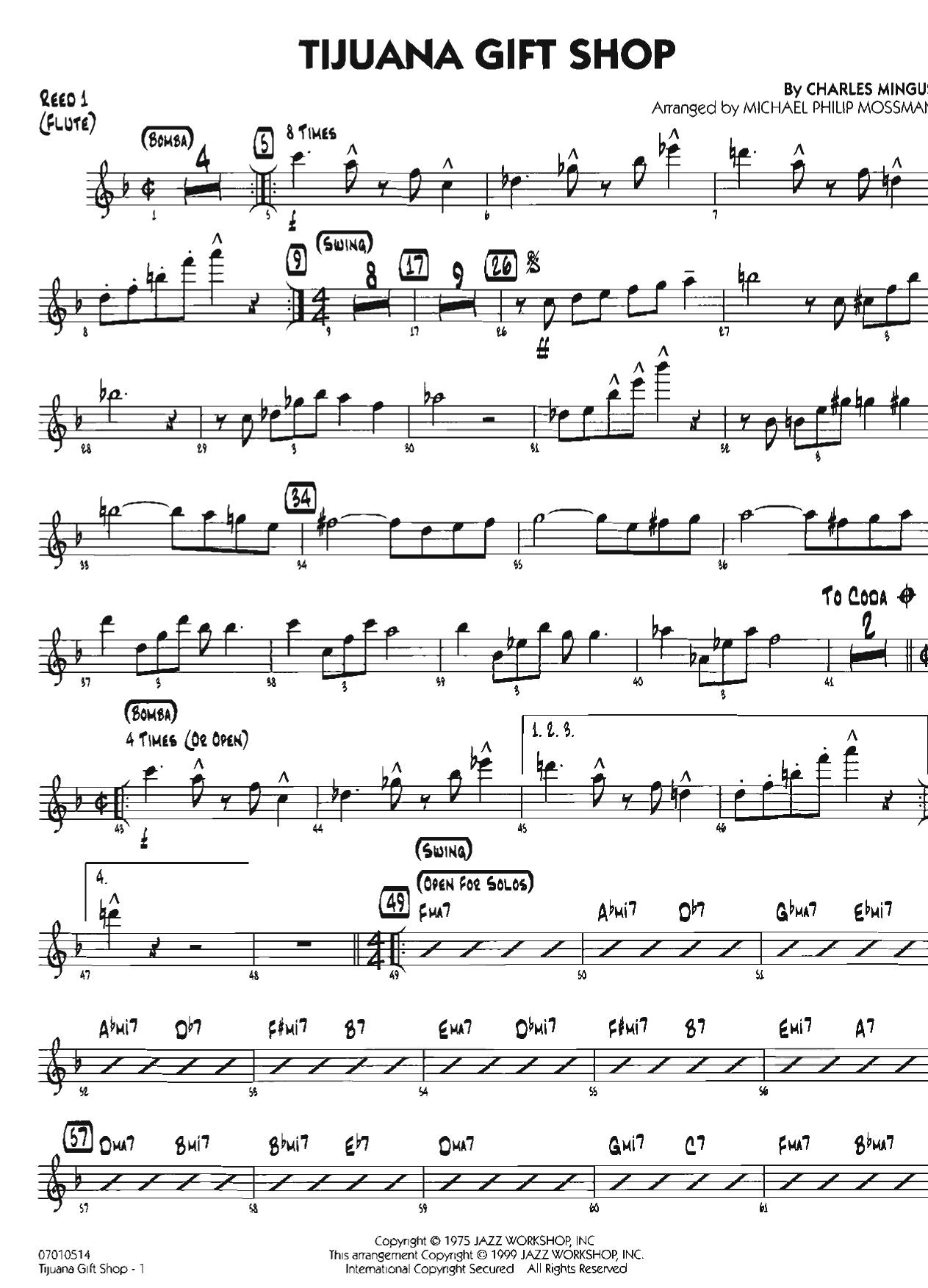
Tijuana Gift Shop (M.P.Mossman) sheet music preview

Tijuana Gift Shop (M.P.Mossman)

Composed by Michael Philip Mossman

Arranged by Charles Mingus

  • Ensemble: Big Band
  • Pages: 43
  • Instruments (15): Reed 1 (Flute), Reed 2 (Alto Sax), Reed 3 (Soprano Sax), Reed 4 (Flute), Reed 5 (Baritone Sax), Trumpet 1, Trumpet 2, Trumpet 3, Trombone 1, Trombone 2, Tuba (Bass Trombone), Piano, Bass, Drums, Aux. Percussion (Congas)
  • Difficulty: medium
  • Content: Individual Parts
  • Format: PDF Download (Instant)
  • Price: $24.99

Composed by the legendary jazz icon Charles Mingus and captured during his fertile late-1950s creative period—culminating in landmark releases like *Tijuana Moods*—"Tijuana Gift Shop" stands as a brilliant exploration of cross-cultural musical synthesis. Originally conceived to evoke the sultry, sun-baked atmosphere and vibrant street life of the Mexican border town, the piece represents Mingus’s unique genius for fusing combustible modern jazz with earthy, folkloric Latin grooves. This sophisticated big band adaptation by renowned composer, trumpeter, and arranger Michael Philip Mossman successfully translates Mingus's idiosyncratic, spatially adventurous small-group writing into a massive, texturally rich canvas fit for a full jazz ensemble. Driven by an infectious, undulating Latin-swing groove, the composition balances playful, quirky melodic lines with underlying moments of raw, blues-soaked intensity. The musical character shifts deftly between breezy, laid-back vamp sections and explosive brass punctuations that evoke the colorful sensory overload of a border marketplace. Mossman honors Mingus’s restless compositional spirit by utilizing dense, modern harmonies, pungent dissonances, and shifting metric feels that keep both performers and listeners on edge. The arrangement opens with a seductive, swaggering vamp in the lower reeds before exposing the main thematic material, creating an atmosphere that is simultaneously mysterious, humorous, and intensely rhythmic. Mossman’s arrangement showcases masterclass craftsmanship in big band orchestration, dividing melodic weight imaginatively across the entire roster. Rich sax solis—frequently anchored by a sultry baritone saxophone voice—interlock tightly with rhythmic counter-melodies in the trombones and punchy, Stravinskian bursts from the trumpets. The chart provides generous breathing room for open solo sections, inviting featured improvisers to stretch out over cyclical modal vamps reminiscent of Mingus's workshop ethos. Technical demands center primarily on rhythmic precision, articulation control, and stylistic versatility; players must seamlessly transition between angular bebop phrasing and relaxed, organic Latin subdivisions without losing forward momentum. Ensembles ranging from advanced high school and collegiate jazz orchestras to professional repertory bands will find this chart an exhilarating challenge and a crowd-pleasing addition to any program. Because it relies heavily on ensemble interplay, dynamic contrast, and stylistic authenticity rather than sheer technical speed, it serves as an exceptional vehicle for developing sectional listening skills and groove awareness. Concluding with a raucous, high-energy shout chorus that pulls together all the thematic fragments of the journey, this 43-page masterwork delivers an unforgettable concert centerpiece. Achieving an authentic reading of this arrangement requires careful attention to the underlying rhythmic pulse. The tempo should maintain a steady, unhurried Latin-swing groove where eighth notes possess an inherent forward lean rather than a stiff, mechanical bounce. Conductors should emphasize articulation discipline within the saxophone section, ensuring that staccato figures are dry and accented notes carry a warm, vocal-like weight. Brass players will encounter passages benefiting from stylistic mutes—specifically straight and cup mutes in the trumpets—to mimic the biting, nasal tones characteristic of Mingus's original recordings. Ensure that the rhythm section locks tightly in the pocket; the bassist and drummer bear the responsibility of sustaining the hypnotic vamp foundations beneath changing horn textures. During open solo sections, the rhythm accompaniment should remain reactive and interactive, building tension through dynamic swells rather than simple volume increases. Rehearsals should initially isolate the tricky cross-rhythms in the brass, bringing them up to tempo alongside a metronome emphasizing beats two and four before integrating the full ensemble texture. Q: What instrumentation and parts are included in this arrangement? A: This 43-page chart is scored for a standard big band configuration featuring 8 core instrumental voices expanded across a full complement of saxophones (Alto, Tenor, Baritone), trumpets, and trombones, supported by a complete rhythm section score. Q: What is the difficulty level of this chart? A: This arrangement is graded at a medium-advanced level, making it well-suited for proficient high school bands, collegiate ensembles, and professional jazz orchestras looking for substantive repertoire. Q: What style and historical era does the music represent? A: The piece is rooted in the Latin-infused modern jazz style pioneered by Charles Mingus during his late 1950s creative peak, blending adventurous modal harmony with traditional Latin dance rhythms. Q: What makes Michael Philip Mossman’s arrangement unique? A: Mossman brilliantly reimagines Mingus's intricate small-group aesthetic for a large ensemble, utilizing clever cross-sectional scoring, sultry reed solis, and authentic groove vamps that capture the humor and grit of the original composition. Q: What is the recommended tempo and performance duration? A: The chart features a moderate, laid-back Latin groove tempo designed to run approximately 4 to 5 minutes, allowing ample space for dynamic development and extended soloist features.

Questions and answers

What is included in the Tijuana Gift Shop (M.P.Mossman) PDF?
The verified current file contains a conductor score and individual parts across 43 pages.
How many instruments or parts are listed for Tijuana Gift Shop (M.P.Mossman)?
The verified instrumentation list contains 15 entries for this Big Band arrangement.
Who is credited for Tijuana Gift Shop (M.P.Mossman)?
Composer: Michael Philip Mossman. Arranger: Charles Mingus.
What difficulty is listed for Tijuana Gift Shop (M.P.Mossman)?
The verified difficulty level is medium.
Can I preview Tijuana Gift Shop (M.P.Mossman) before buying?
Yes. The product page provides a preview generated from the current PDF file.
How is Tijuana Gift Shop (M.P.Mossman) delivered?
After successful payment, the digital PDF is made available for download. The displayed price is $24.99.

Musicians Also Search For

Tijuana Gift Shop Charles Mingus PDFTijuana Gift Shop Charles Mingus sheet musicTijuana Gift Shop arranged by Charles MingusCharles Mingus big band chartsCharles Mingus jazz arrangements PDFTijuana Gift Shop Michael Philip Mossman sheet musicTijuana Gift Shop Michael Philip Mossman big band arrangementsMichael Philip Mossman big band chartsTijuana Gift Shop big band arrangementsTijuana Gift Shop big band PDF downloadTijuana Gift Shop jazz sheet musicbig band sheet music downloadTijuana Gift Shop conductor score PDFTijuana Gift Shop individual parts downloadTijuana Gift Shop sheet music PDFbuy Tijuana Gift Shop sheet musicdownload Tijuana Gift Shop PDFTijuana Gift Shop jazz chartsbest Charles Mingus big band arrangementsMichael Philip Mossman arranged by Charles MingusTijuana Gift Shop printable sheet musicbig band repertoire PDF

All arrangements by Charles Mingus All Michael Philip Mossman sheet music