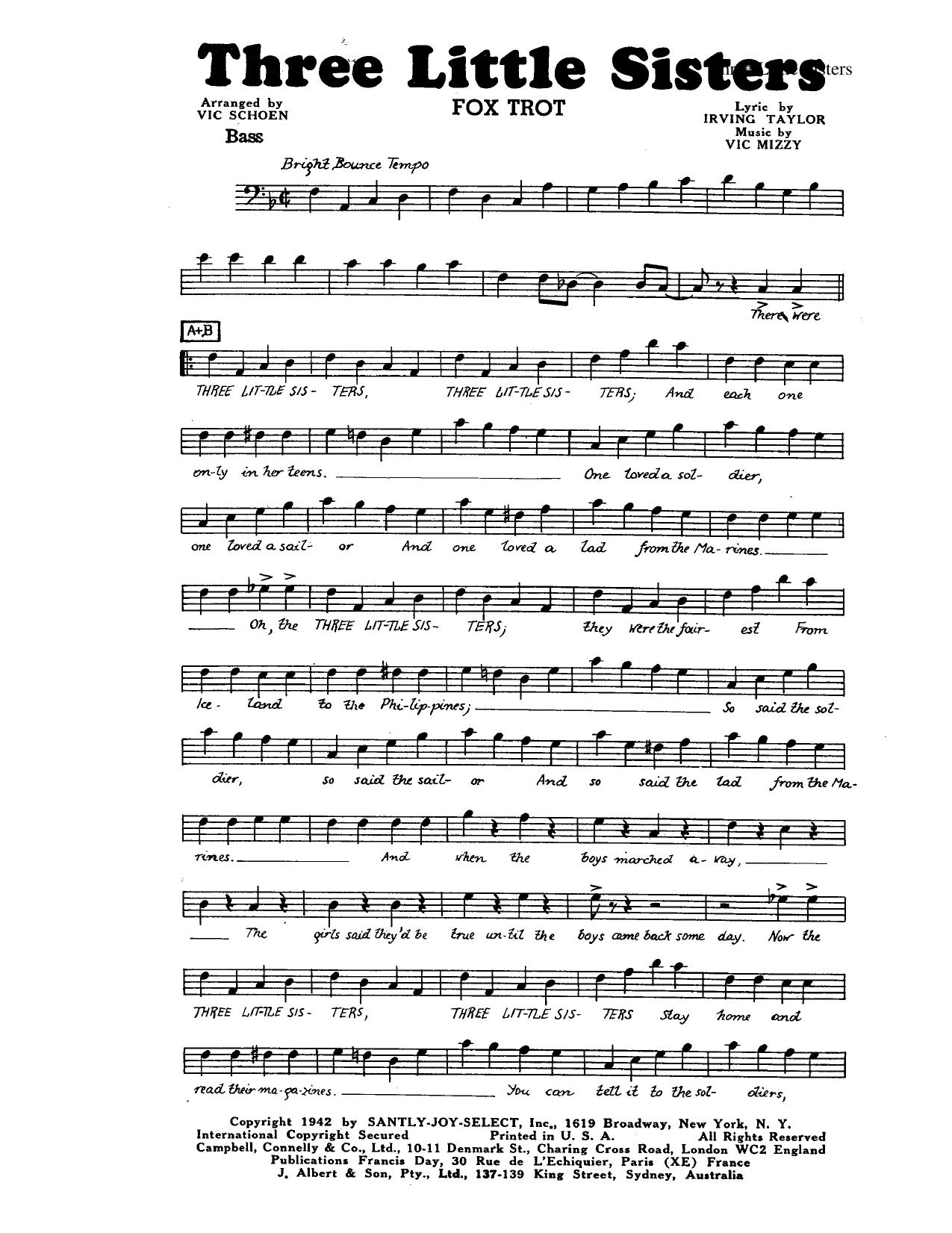
Three Little Sisters (V.Schoen)
Composed by Al Hoffman
Arranged by Vic Schoen
- Ensemble: Big Band
- Pages: 41
- Instruments (14): Bass, Guitar, Drums, 2d Trombone, 1st Trombone, 4th Sax. Bb Tenor, 3rd Sax. Eb Alto, 2d Sax. Bb Tenor, 1st Sax. Eb Alto, 3rd Trumpet in Bb, 2nd Trumpet in Bb, 1st Trumpet in Bb, Violin, Piano
- Difficulty: medium
- Content: Individual Parts
- Format: PDF Download (Instant)
- Price: $24.99
Written originally by Al Hoffman and Milton Drake, "Three Little Sisters" is an indelible artifact of the World War II era, famously recorded by the Andrews Sisters in 1942. This buoyant tune captures the buoyant, morale-boosting spirit of the swing era, telling a heartwarming story of three siblings separated by wartime service. As a quintessential novelty-swing number, the composition quickly transcended its wartime origins to become a beloved staple of the American Songbook and a favorite vehicle for vocal harmony groups and big bands alike. Its enduring appeal lies in its infectious, upbeat syncopation and a narrative charm that instantly transports listeners back to the golden age of radio and USO camp shows. Driving with a bright, infectious medium-swing feel in 4/4 time, this arrangement radiates an upbeat, exuberant energy defined by crisp articulation and driving rhythm section interplay. The mood is relentlessly optimistic, bouncing between playful minor-mode stanzas and triumphant major-key releases that evoke the camaraderie and irrepressible optimism of 1940s swing culture. The harmonies are rich yet transparent, prioritizing vocal-like clarity in the horn sections while maintaining a propulsive groove that practically demands foot-tapping from the audience. Vic Schoen, renowned as the architectural genius behind the Andrews Sisters’ most iconic Decca recordings, brings his signature arranging brilliance to this chart. Schoen’s writing is masterclass-level vocal scoring adapted for instrumental forces, utilizing tight, interlocking block voicings for the saxophones and bright, punchy brass punctuation. Rather than relying on sprawling, modern extended harmonies, Schoen achieves maximum impact through clever counterpoint, dynamic shifts, and crisp rhythm section setups. The arrangement features brilliant call-and-response sections between the brass and reeds, punctuated by a tightly wound shout chorus that builds relentless momentum before a clever, high-spirited ending. Melody distribution is shared collaboratively across the ensemble, with the alto and tenor saxophones frequently carrying the primary thematic material in tight harmony, echoing the close vocal styling of the original recordings. Trumpets and trombones provide sharp dynamic contrast through conversational interjections and sustained pads. While the technical demands are moderate, precision is paramount; the chart requires absolute rhythmic unison, clean articulation, and a light, bouncing swing eighth-note feel to sparkle. The most rewarding aspect of performance lies in executing Schoen’s sparkling dynamic contrasts and capturing the authentic, buoyant vernacular of the early 1940s big band sound. Advanced high school, collegiate, and professional community big bands will find this arrangement an absolute joy to rehearse and perform. Because it relies heavily on ensemble discipline, stylistic authenticity, and clean sectional blend rather than blistering ultra-fast tempos or labyrinthine avant-garde harmonies, it serves as an exceptional educational tool for teaching traditional swing phrasing while remaining a certified crowd-pleaser on any professional concert program. Conductors should anchor this chart with a steady, driving medium-swing tempo, avoiding the temptation to rush; the groove must feel effortless and buoyant. The primary technical challenge lies in achieving absolute rhythmic uniformity across the saxophone and brass sections during rapid-fire staccato passages. Ensure the rhythm section keeps the hi-hat crisp on beats two and four, with a walking bassline that supports the underlying changes without overpowering the horns. Articulation is everything: quarter notes should have a slight tenuto weight, while eighth notes must swing naturally with controlled tongue placement rather than heavy accents. Pay close attention to the dynamic markings, particularly the sudden sub-ito piano drops and explosive brass swells, which give the chart its theatrical, vintage flair. Rehearsal should begin slowly with the horns isolated to lock in intonation on Schoen's tight chord clusters before integrating the rhythm section's persistent, driving pulse. Q: What instruments and parts are included in this arrangement? A: This chart is scored for a flexible 9-instrument big band instrumentation, featuring Alto Saxophone, Tenor Saxophone, Baritone Saxophone, Trumpet, and Trombone parts, alongside a complete rhythm section. Q: What is the difficulty level of this Vic Schoen arrangement? A: It is graded as medium-easy to medium, making it accessible for proficient high school ensembles while offering enough stylistic nuance to engage collegiate and professional musicians. Q: What is the historical style and context of "Three Little Sisters"? A: It is an authentic 1942 swing-era tune famously associated with the Andrews Sisters, capturing the upbeat, morale-boosting vocal harmony style of World War II-era American popular music. Q: What makes this specific arrangement by Vic Schoen unique? A: Schoen applies his legendary vocal-accompaniment writing style to the instrumental big band, utilizing tight block voicings, clever call-and-response figures, and crisp sectional counterpoint that mirror classic 1940s radio recordings. Q: What is the performance duration and recommended tempo for this piece? A: The arrangement runs approximately 2.5 to 3 minutes in length and is designed to be performed at a bright, comfortable medium-swing tempo of around 132 to 140 beats per minute.
Questions and answers
- What is included in the Three Little Sisters (V.Schoen) PDF?
- The verified current file contains individual parts across 41 pages.
- How many instruments or parts are listed for Three Little Sisters (V.Schoen)?
- The verified instrumentation list contains 14 entries for this Big Band arrangement.
- Who is credited for Three Little Sisters (V.Schoen)?
- Composer: Al Hoffman. Arranger: Vic Schoen.
- What difficulty is listed for Three Little Sisters (V.Schoen)?
- The verified difficulty level is medium.
- Can I preview Three Little Sisters (V.Schoen) before buying?
- Yes. The product page provides a preview generated from the current PDF file.
- How is Three Little Sisters (V.Schoen) delivered?
- After successful payment, the digital PDF is made available for download. The displayed price is $24.99.
Musicians Also Search For
Three Little Sisters Vic Schoen PDF • Three Little Sisters Vic Schoen sheet music • Three Little Sisters arranged by Vic Schoen • Vic Schoen big band charts • Vic Schoen jazz arrangements PDF • Three Little Sisters Al Hoffman sheet music • Three Little Sisters Al Hoffman big band arrangements • Al Hoffman big band charts • Three Little Sisters big band arrangements • Three Little Sisters big band PDF download • Three Little Sisters jazz sheet music • big band sheet music download • Three Little Sisters individual parts download • Three Little Sisters sheet music PDF • buy Three Little Sisters sheet music • download Three Little Sisters PDF • Three Little Sisters jazz charts • best Vic Schoen big band arrangements • Al Hoffman arranged by Vic Schoen • Three Little Sisters printable sheet music • big band repertoire PDF