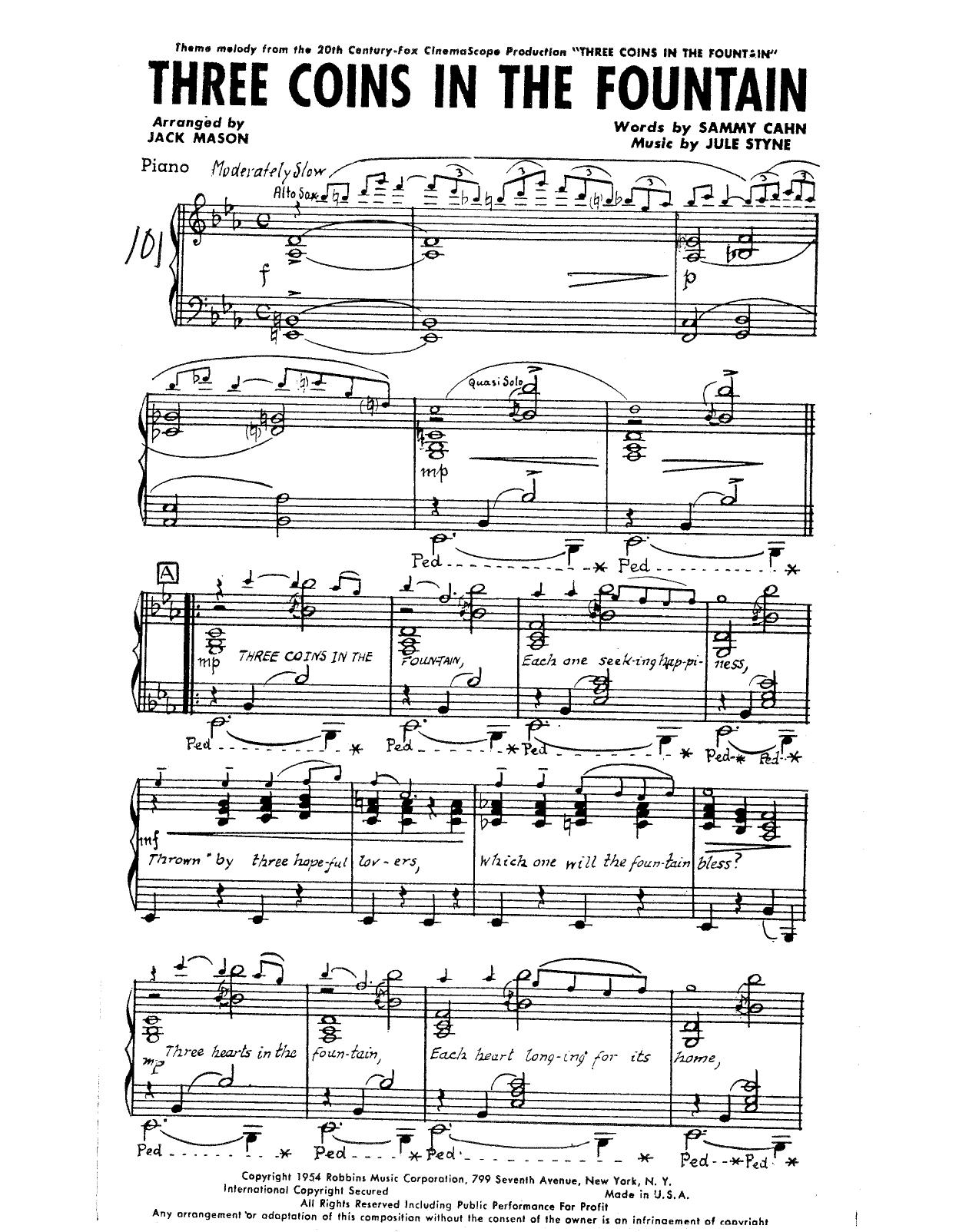
Three Coins In The Fountain (J.Mason) sheet music preview

Three Coins In The Fountain (J.Mason)

Composed by Jule Styne

Arranged by Jack Mason

  • Ensemble: Big Band
  • Pages: 33
  • Instruments (16): Piano, Violins A-B-C, Bass, Guitar, Drums, 1st Saxophone Eb Alto, 3rd Saxophone Eb Alto, 2nd Saxophone Bb Tenor, 4th Saxophone Bb Tenor, 5th Saxophone Eb Baritone, 1st Trombone, 2nd Trombone, 3rd Trombone, 1st Bb Trumpet, 2nd Bb Trumpet, 3rd Bb Trumpet
  • Difficulty: medium
  • Content: Individual Parts
  • Format: PDF Download (Instant)
  • Price: $24.99

Academy Award-winning composition "Three Coins in the Fountain," written by Jule Styne with lyrics by Sammy Cahn for the 1954 romantic film of the same name, occupies a cherished space in the mid-century American songbook. Originally introduced by Frank Sinatra and famously covered by major vocalists and instrumentalists alike, the tune epitomizes the lush, cinematic optimism of the 1950s pop-jazz crossover era. While born out of Hollywood, its inherently sweeping melody, sophisticated harmonic progression, and romantic yearning made it an immediate favorite for jazz interpreters seeking rich soil for improvisation and lush harmonic exploration. Jack Mason’s sophisticated big band interpretation transforms the cinematic vocal standard into a sweeping instrumental showcase that blends traditional swing elegance with rich, orchestral textures. Unfolding at a relaxed, flowing medium tempo, the arrangement captures an evocative, dreamy mood that builds organically into moments of soaring emotional intensity. The harmonic palette utilizes extended chords, warm major-seventh voicings, and subtle chromatic passing tones that evoke the glistening waters of the famous Roman fountain while maintaining a deeply satisfying jazz pulse. The overall energy balances sophisticated cool-school introspection with the undeniable warmth of a classic mid-century ballroom chart. Mason’s signature arranging style shines through the integration of a expanded 20-instrument roster, which uniquely incorporates a violin section (Violins A-B-C, 2, and 3) alongside the standard big band instrumentation and piano. This string integration is not merely decorative; it weaves counter-melodies and shimmering pad textures directly into the ensemble fabric, bridging the gap between traditional big band swing and a lush studio orchestra sound. The alto saxophone 1 and piano share primary melodic duties early on, passing thematic phrases back and forth before the full ensemble swells into a richly voiced, horn-and-strings soli section. The chart avoids heavy-handed shout choruses in favor of a magnificent, cascading developmental peak that showcases dynamic contrast, demanding precise breath control and intonation from the brass and woodwinds alike. Advanced high school, collegiate, and professional community big bands will find this 33-page arrangement an exceptional vehicle for developing ensemble blend, string-horn balance, and rubato-to-tempo transitions. The primary technical challenges lie in the subtle rubato phrasing required at the opening, the blend between the rhythm section, horns, and the specialized violin parts, and maintaining pristine intonation through the shifting key centers. Solo opportunities are tastefully integrated, allowing a featured soloist—ideally on alto saxophone or piano—to stretch out over a lush, supportive background accompaniment. Performing this chart offers a rewarding masterclass in texture, color, and phrasing. Musicians will relish the cinematic grandeur of the writing, which stands out in a standard jazz concert program by offering a sophisticated change of pace from hard-driving up-tempo swingers. The interplay between the rhythm section, the soaring violin parts, and the warm brass voicings creates a captivating sonic landscape that resonates deeply with audiences seeking both nostalgia and high-level musicianship. Conductors approaching this arrangement should establish a fluid, conversational tempo right from the downbeat, avoiding a rigid mechanical grid. The key technical challenge involves balancing the 20-instrument ensemble—specifically integrating the violin sections (A-B-C, 2, 3) with the traditional saxophone, brass, and piano lineup. Ensure the strings do not overpower the delicate woodwind lines; instead, treat them as an extension of the upper harmonic spectrum. Articulation should be long and connected (legato) throughout the thematic statements, reserving accented punctuation for the dynamic peaks. The rhythm section must maintain an understated, floating swing feel, utilizing sparse, tasteful comping on the piano to leave room for the rich string pads. Rehearsal time should be dedicated to sectional tuning of the chordal extensions in the brass and strings, paying careful attention to the smooth resolution of chromatic passing tones. Q: What instruments and parts are included in this arrangement? A: This 33-page chart is scored for a 20-instrument ensemble, featuring standard big band instrumentation including piano, Alto Saxophone 1, and an expanded string section consisting of Violins A-B-C, Violins 2, and Violins 3 alongside traditional brass and rhythm components. Q: What is the difficulty level of this Jack Mason arrangement? A: This arrangement is best suited for advanced high school, collegiate, and professional community big bands capable of handling sophisticated harmonic voicings, delicate ensemble blend, and integration with a string section. Q: What is the musical style and historical context of the piece? A: Written by Jule Styne for the 1954 Oscar-winning film, this piece represents the lush, cinematic crossover era of mid-century pop-jazz, adapted here into a sophisticated instrumental jazz arrangement. Q: What makes this specific arrangement by Jack Mason unique? A: It uniquely bridges traditional big band jazz with a cinematic string orchestra texture by incorporating specialized violin parts that provide shimmering counter-melodies and rich pad accompaniments behind the horns. Q: What is the performance duration and tempo feel of the piece? A: The arrangement is performed at a relaxed, flowing medium tempo with a romantic, dreamy mood, resulting in a performance duration of approximately 3 to 4 minutes depending on the length of the improvised solo section.

Questions and answers

What is included in the Three Coins In The Fountain (J.Mason) PDF?
The verified current file contains a conductor score and individual parts across 33 pages.
How many instruments or parts are listed for Three Coins In The Fountain (J.Mason)?
The verified instrumentation list contains 16 entries for this Big Band arrangement.
Who is credited for Three Coins In The Fountain (J.Mason)?
Composer: Jule Styne. Arranger: Jack Mason.
What difficulty is listed for Three Coins In The Fountain (J.Mason)?
The verified difficulty level is medium.
Can I preview Three Coins In The Fountain (J.Mason) before buying?
Yes. The product page provides a preview generated from the current PDF file.
How is Three Coins In The Fountain (J.Mason) delivered?
After successful payment, the digital PDF is made available for download. The displayed price is $24.99.

Musicians Also Search For

Three Coins In The Fountain Jack Mason PDFThree Coins In The Fountain Jack Mason sheet musicThree Coins In The Fountain arranged by Jack MasonJack Mason big band chartsJack Mason jazz arrangements PDFThree Coins In The Fountain Jule Styne sheet musicThree Coins In The Fountain Jule Styne big band arrangementsJule Styne big band chartsThree Coins In The Fountain big band arrangementsThree Coins In The Fountain big band PDF downloadThree Coins In The Fountain jazz sheet musicbig band sheet music downloadThree Coins In The Fountain conductor score PDFThree Coins In The Fountain individual parts downloadThree Coins In The Fountain sheet music PDFbuy Three Coins In The Fountain sheet musicdownload Three Coins In The Fountain PDFThree Coins In The Fountain jazz chartsbest Jack Mason big band arrangementsJule Styne arranged by Jack MasonThree Coins In The Fountain printable sheet musicbig band repertoire PDF

All arrangements by Jack Mason All Jule Styne sheet music