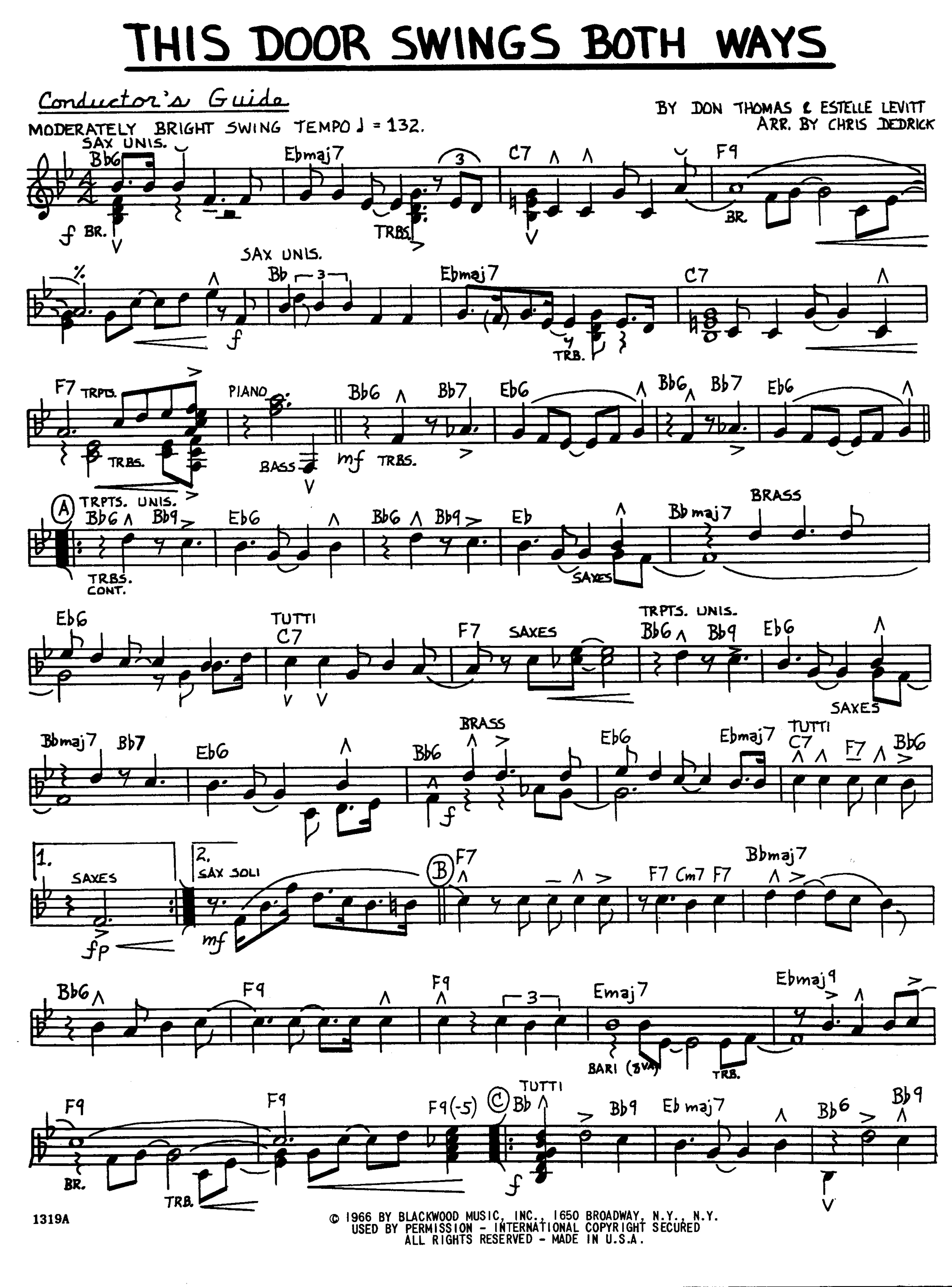
This Door Swings Both Way (C.Dedrick) sheet music preview

This Door Swings Both Way (C.Dedrick)

Composed by C. Dedrick

Arranged by C.Dedrick

  • Ensemble: Big Band
  • Style: Jazz Standard
  • Pages: 25
  • Instruments (22): Conductor's Guide, 1st Eb Alto Sax, 2nd Bb Tenor Sax, 3rd Eb Alto Sax, 4th Bb Tenor Sax, 5th Eb Baritone Sax, 1st Bb Trumpet, 2nd Bb Trumpet, 3rd Bb Trumpet, 4th Bb Trumpet, 1st Trombone, 2nd Trombone, 3rd Trombone, 4th Trombone, Piano, Bass, Guitar, Drums, Vocal, 1st F Horn, 2nd F Horn, Tuba
  • Difficulty: medium
  • Content: Individual Parts
  • Format: PDF Download (Instant)
  • Price: $24.99

Composed and arranged by the versatile multi-instrumentalist and composer Chris Dedrick, "This Door Swings Both Way" stands as a brilliant showcase of sophisticated contemporary big band writing. Chris Dedrick, widely celebrated for his intricate yet accessible charts for studio ensembles and educational jazz bands alike, brings a refined compositional voice to this piece. Rooted in the post-swing, modern mainstream jazz tradition, the composition bridges the gap between classic big band counterpoint and contemporary harmonic structures, offering an engaging listening and playing experience that avoids dated clichés while honoring the genre's rich lineage. Musically, the chart unfolds with a crisp, infectious medium-up swing groove characterized by an interactive rhythm section and a driving, conversational pulse. The harmonic landscape is lush, featuring extended tertian harmonies, clever chromatic voice-leading, and subtle modal shifts that propel the momentum forward without ever losing its tonal center. The mood shifts fluidly between playful, syncopated ensemble statements and relaxed, swinging interludes. The dynamic arc is carefully calibrated, building from understated, intimate horn whispers up to a powerful, harmonically rich shout chorus that demands precision and dynamic control from every section. Dedrick’s arrangement style shines through the meticulous voice-leading within the saxophone soli and the clever interplay between the brass and reed sections. Instead of relying on standard block-chord writing, Dedrick frequently utilizes linear counterpoint and sparse, transparent textures that allow individual lines to breathe. The melody is initially introduced by the saxophones with delicate brass punctuation, gradually expanding to involve the full ensemble. Featured solo space allows improvisers to stretch out over a solid, approachable jazz form, while the ensemble backing figures provide sophisticated rhythmic and harmonic motivation behind the soloist. Advanced high school ensembles, collegiate jazz orchestras, and professional community big bands will find this chart an ideal vehicle for developing internal ensemble listening and stylistic versatility. While the technical demands require clean articulation and a solid grasp of swing subdivision, the reward lies in the natural flow of the chart's construction. Standout moments include a cleverly devised modulation that recontextualizes the main theme and a final chorus that drives hard to a crisp, punchy terminal chord, ensuring an unforgettable impact on any concert or festival program. The primary technical challenge in performing "This Door Swings Both Way" lies in maintaining a consistent, relaxed medium-up swing feel without rushing the tempo. Conductors should ensure the rhythm section—particularly the ride cymbal and hi-hat on beats two and four—locks into a driving, pocket-oriented groove that anchors the ensemble. Articulation is critical: eighth notes must be properly swung with appropriate weight given to off-beat accents, following standard modern big band stylistic conventions. Watch closely for dynamic contrast between the understated background figures and the bolder, tutti ensemble hits. Horn sections should practice their interplay slowly to balance the counter-melodies accurately, ensuring that inner voices are never buried beneath the lead trumpet or lead alto. No extended techniques such as extreme plunger mutes or unconventional altissimo are strictly required, but clean execution of standard stylistic markers—like short accents, smooth doits, and controlled falls—will elevate the performance from correct to compelling. Q: What instruments and parts are included in this big band arrangement? A: The instrumentation comprises a standard 21-instrument big band setup, featuring 5 saxophones (Alto 1, Tenor 2, Alto 3, Tenor 4, Baritone 5), standard brass configurations, a full rhythm section, and a comprehensive conductor score. Q: What is the difficulty level of this chart? A: This arrangement is graded as medium-advanced, making it ideally suited for advanced high school jazz ensembles, collegiate bands, and professional community big bands looking to refine their swing style and ensemble blend. Q: What is the musical style and historical context of the piece? A: Composed in a modern mainstream jazz idiom by Chris Dedrick, the piece reflects the sophisticated arranging traditions of contemporary studio big bands while maintaining deep roots in classic swing and post-bop aesthetics. Q: What makes this arrangement by C.Dedrick unique? A: Its uniqueness lies in Dedrick's transparent textures, linear counterpoint, and clever harmonic voice-leading, which move beyond standard block-chord writing to create an interactive, highly conversational dialogue between sections. Q: What is the performance duration and recommended tempo? A: While performance time can vary slightly based on the length of improvised solos, the chart is designed around a brisk, energetic medium-up swing tempo that typically spans between 4 to 5 minutes.

Questions and answers

What is included in the This Door Swings Both Way (C.Dedrick) PDF?
The verified current file contains a conductor score and individual parts across 25 pages.
How many instruments or parts are listed for This Door Swings Both Way (C.Dedrick)?
The verified instrumentation list contains 22 entries for this Big Band arrangement.
Who is credited for This Door Swings Both Way (C.Dedrick)?
Composer: C. Dedrick. Arranger: C.Dedrick.
What difficulty is listed for This Door Swings Both Way (C.Dedrick)?
The verified difficulty level is medium.
What style is listed for This Door Swings Both Way (C.Dedrick)?
The catalog lists the style as Jazz Standard.
Can I preview This Door Swings Both Way (C.Dedrick) before buying?
Yes. The product page provides a preview generated from the current PDF file.
How is This Door Swings Both Way (C.Dedrick) delivered?
After successful payment, the digital PDF is made available for download. The displayed price is $24.99.

Musicians Also Search For

This Door Swings Both Way C.Dedrick PDFThis Door Swings Both Way C.Dedrick sheet musicThis Door Swings Both Way arranged by C.DedrickC.Dedrick big band chartsC.Dedrick jazz arrangements PDFThis Door Swings Both Way C. Dedrick sheet musicThis Door Swings Both Way C. Dedrick big band arrangementsC. Dedrick big band chartsThis Door Swings Both Way big band arrangementsThis Door Swings Both Way big band PDF downloadThis Door Swings Both Way jazz sheet musicbig band sheet music downloadThis Door Swings Both Way conductor score PDFThis Door Swings Both Way individual parts downloadThis Door Swings Both Way sheet music PDFThis Door Swings Both Way Jazz Standard chartsJazz Standard big band arrangementsbuy This Door Swings Both Way sheet musicdownload This Door Swings Both Way PDFThis Door Swings Both Way jazz chartsbest C.Dedrick big band arrangementsC. Dedrick arranged by C.DedrickThis Door Swings Both Way printable sheet musicbig band repertoire PDF

All arrangements by C.Dedrick All C. Dedrick sheet music