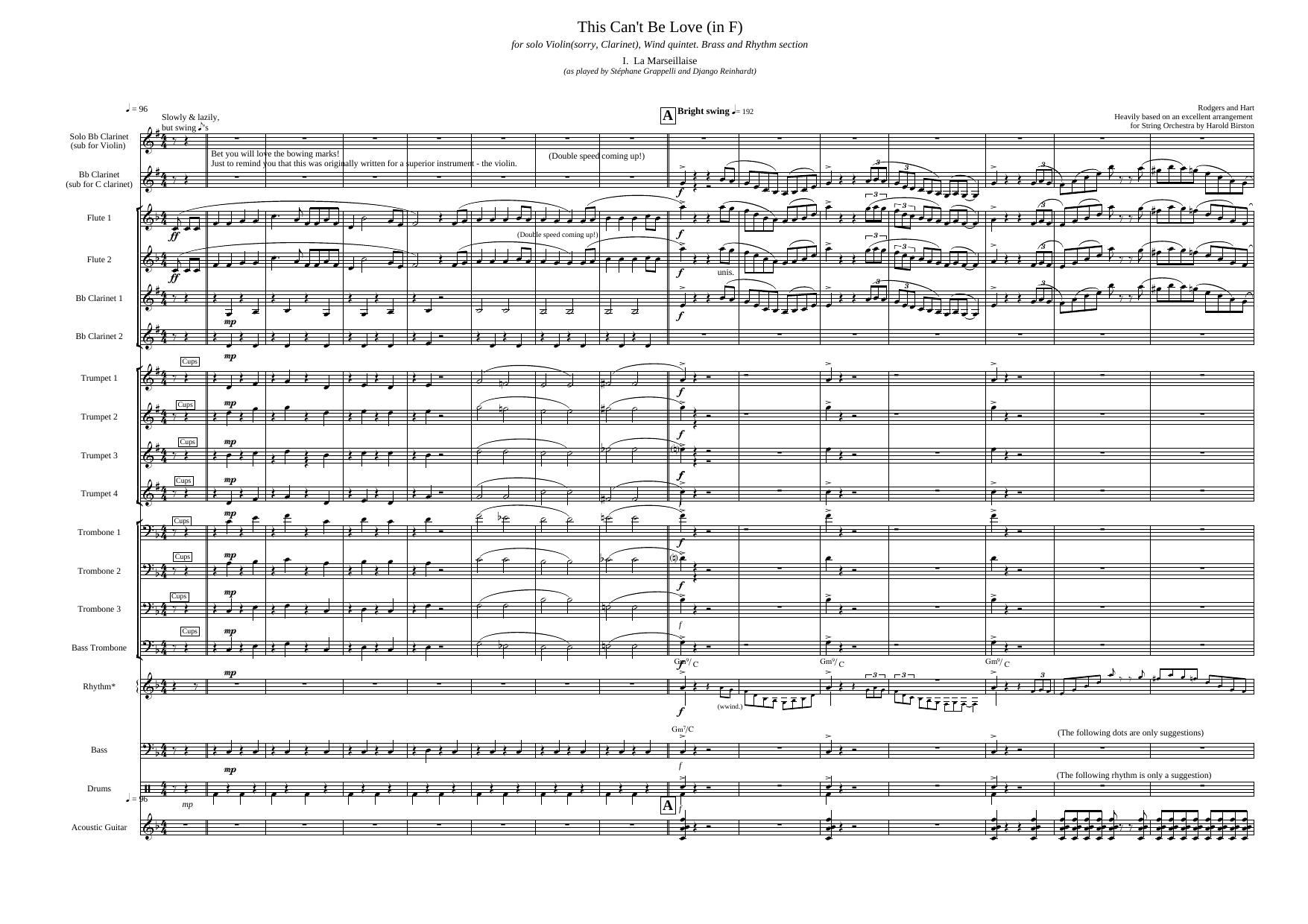
This Can'Be Love (R.Rodgers)
Composed by Richard Rodgers
Arranged by R.Rodgers
- Ensemble: Big Band
- Style: Jazz Standard
- Pages: 79
- Instruments (18): Solo Bb Clarinet (sub for Violin), Bb Clarinet (sub for C clarinet), Flute 1, Flute 2, Bb Clarinet 1, Bb Clarinet 2, Trumpet 1, Trumpet 2, Trumpet 3, Trumpet 4, Trombone 1, Trombone 2, Trombone 3, Bass Trombone, Rhythm, Bass, Drums, Acoustic Guitar
- Difficulty: advanced
- Content: Individual Parts
- Format: PDF Download (Instant)
- Price: $24.99
Richard Rodgers and Lorenz Hart’s timeless 1938 show tune "This Can't Be Love" introduced audiences in the Broadway musical *The Boys from Syracuse* before swiftly transcending the theater district to become a foundational pillar of the Great American Songbook. Celebrated for its deceptively simple, major-mode buoyancy and sophisticated harmonic movement, the song has been interpreted by virtually every major figure in jazz history, from the legendary Nat King Cole Trio to upbeat instrumental explorations by Sonny Rollins and Ahmad Jamal. Its enduring appeal lies in the clever lyricism and a deceptively straightforward AABA form that invites both lyrical melodic playing and adventurous harmonic improvisation, establishing it as an essential vehicle for mid-tempo swing exploration. Brimming with an effervescent, upbeat medium-swing feel, this arrangement captures the sparkling optimism and sophisticated wit characteristic of the golden age of American musical theater merged with classic big band vernacular. Set in a bright, driving tempo that encourages an agile, light-footed rhythm section approach, the chart unfolds with a luminous energy. The mood shifts effortlessly between playful, walking-bass-driven ensemble statements and lush, harmonically rich brass interludes that evoke the breezy elegance of 1950s Count Basie or Benny Goodman arrangements, while maintaining a distinctly modern clarity in its chordal extensions and counter-lines. The orchestration showcases a brilliant mastery of color, utilizing an expanded 18-instrument palette that features dual flutes and versatile clarinet doublings—including Bb clarinet substitutions for violin and C clarinet—to introduce woodwind textures rarely heard in standard dance-band writing. The arranger weaves these woodwinds into intricate, shimmering solis that contrast sharply with punchy, blues-infused brass declarations. Sectional interplay is handled with exceptional craftsmanship: the saxophones frequently carry the initial thematic weight before handing off to soaring trumpet lines, while the rhythm section is given ample room to drive the pulse with crisp ride-cymbal patterns and agile piano comping that avoids muddying the transparent upper-structure voicings. Advanced high school ensembles, collegiate jazz orchestras, and professional community big bands will find this 79-page masterwork an immensely rewarding addition to their repertoire. The chart balances approachable melodic statements with technical demands that require precise articulation, immaculate section blend, and strong stylistic control over swing eighth notes. Solo opportunities are thoughtfully integrated into the form, allowing standout improvisers in the horn section to stretch out over standard changes. Between the comprehensive, multi-movement conductor score and the meticulously detailed individual parts, this publication delivers an authentic, high-caliber big band experience that honors Rodgers' iconic melodic gift while offering fresh, sophisticated developmental writing. Achieving the ideal execution of "This Can't Be Love" requires prioritizing a light, articulate swing feel over sheer volume. The rhythm section acts as the primary engine; the drummer should maintain a steady, driving ride cymbal pattern with a feathered bass drum touch, avoiding heavy downbeats that could bog down the bright tempo. Pianists and guitarists must focus on sparse, rhythmic comping utilizing upper-structure extensions, steering clear of thick block chords that clash with the woodwind voicings. Woodwind players doubling on flute and clarinet should prioritize intonation and blend, particularly during the exposed soli sections where sectional unison is critical. Brass players need to execute clean, clipped short notes (staccato) in the background figures to allow the melody to cut through cleanly. Rehearsal time should be dedicated first to locking in the dynamic contrasts between the subdued developmental sections and the bright, swinging ensemble tutti passages, ensuring the articulation remains uniform across all sections. Q: What specific instruments and parts are included in this publication? A: The 79-page package includes a comprehensive conductor score alongside parts for 18 instruments, featuring Flute 1, Flute 2, Bb Clarinet 1, Bb Clarinet (sub for C clarinet), Bb Clarinet (sub for Violin), and a full complement of standard big band brass and rhythm section parts. Q: What is the overall difficulty level of this arrangement? A: This arrangement is graded as advanced, making it ideal for skilled high school jazz ensembles, collegiate bands, and professional community big bands that possess strong section blend and reading capabilities. Q: What is the historical context and musical style of the piece? A: Originating from the 1938 Rodgers and Hart Broadway musical *The Boys from Syracuse*, this piece is presented in a classic medium-swing jazz standard style that pays homage to the sophisticated dance orchestra traditions of the mid-20th century. Q: What makes this particular arrangement unique? A: The arrangement stands out through its sophisticated integration of classical woodwind colors—including dual flutes and multiple clarinet substitutions for traditional string parts—layered into classic big band swing voicings. Q: What is the performance duration and tempo feel of the chart? A: The chart is designed for a bright, driving medium-swing tempo that typically yields a performance duration of approximately 3 to 4 minutes, depending on the number of improvised solo choruses taken.
Questions and answers
- What is included in the This Can'Be Love (R.Rodgers) PDF?
- The verified current file contains a conductor score and individual parts across 79 pages.
- How many instruments or parts are listed for This Can'Be Love (R.Rodgers)?
- The verified instrumentation list contains 18 entries for this Big Band arrangement.
- Who is credited for This Can'Be Love (R.Rodgers)?
- Composer: Richard Rodgers. Arranger: R.Rodgers.
- What difficulty is listed for This Can'Be Love (R.Rodgers)?
- The verified difficulty level is advanced.
- What style is listed for This Can'Be Love (R.Rodgers)?
- The catalog lists the style as Jazz Standard.
- Can I preview This Can'Be Love (R.Rodgers) before buying?
- Yes. The product page provides a preview generated from the current PDF file.
- How is This Can'Be Love (R.Rodgers) delivered?
- After successful payment, the digital PDF is made available for download. The displayed price is $24.99.
Musicians Also Search For
This Can'Be Love R.Rodgers PDF • This Can'Be Love R.Rodgers sheet music • This Can'Be Love arranged by R.Rodgers • R.Rodgers big band charts • R.Rodgers jazz arrangements PDF • This Can'Be Love Richard Rodgers sheet music • This Can'Be Love Richard Rodgers big band arrangements • Richard Rodgers big band charts • This Can'Be Love big band arrangements • This Can'Be Love big band PDF download • This Can'Be Love jazz sheet music • big band sheet music download • This Can'Be Love conductor score PDF • This Can'Be Love individual parts download • This Can'Be Love sheet music PDF • This Can'Be Love Jazz Standard charts • Jazz Standard big band arrangements • buy This Can'Be Love sheet music • download This Can'Be Love PDF • This Can'Be Love jazz charts • best R.Rodgers big band arrangements • Richard Rodgers arranged by R.Rodgers • This Can'Be Love printable sheet music • big band repertoire PDF