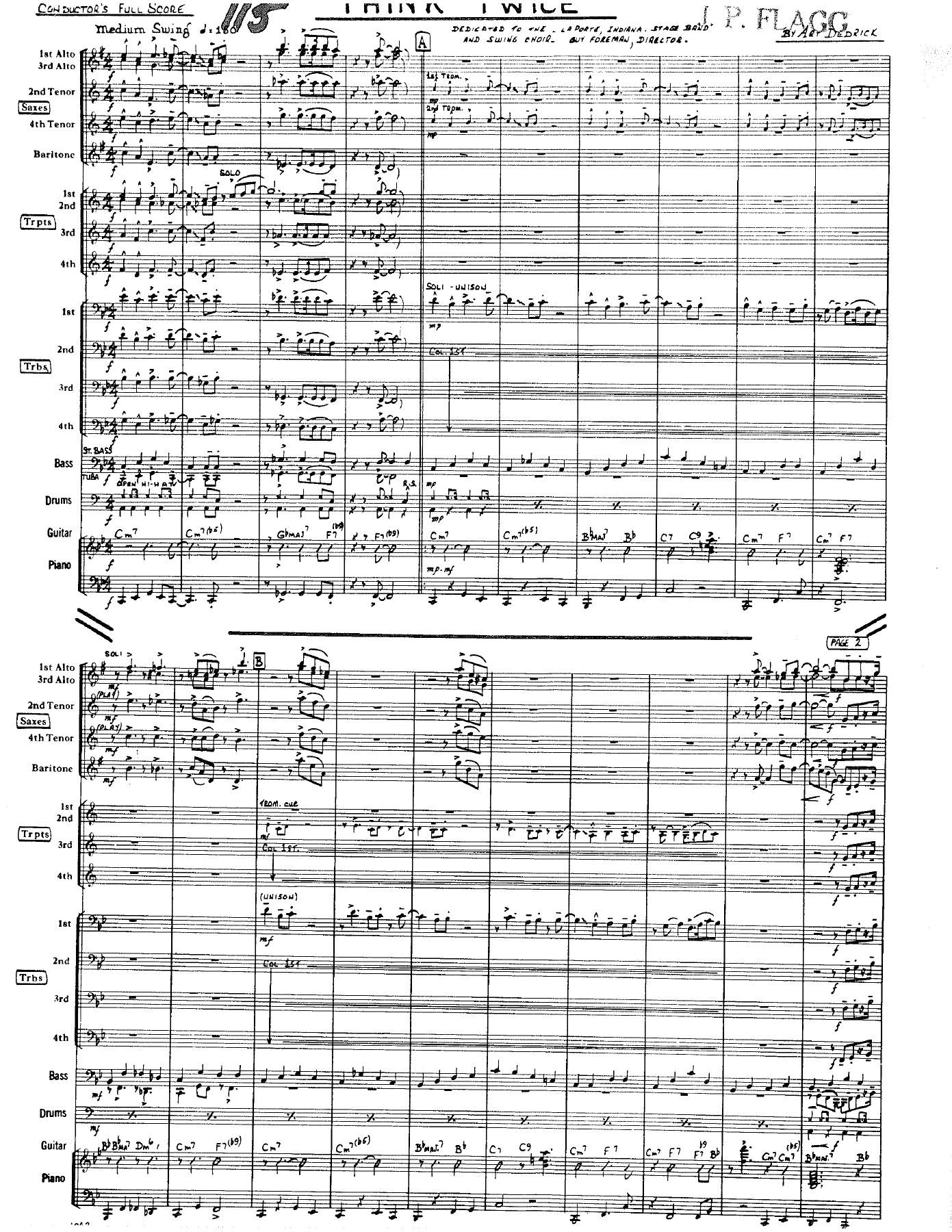
Think Twice (A.Dedrick) vocal
Composed by Art Dedrick
Arranged by Art Dedrick
- Ensemble: Big Band
- Style: Jazz Standard
- Pages: 36
- Instruments (21): Conductor's Full Score, Swing Choir (Male Voices, Female Voices, Altos), 1st Eb Alto Sax, 2nd Bb Tenor Sax, 3rd Eb Alto Sax, 4th Bb Tenor Sax, 5th Eb Baritone Sax, 1st Bb Trumpet, 2nd Bb Trumpet, 3rd Bb Trumpet, 4th Bb Trumpet, 1st Trombone, 2nd Trombone, 3rd Trombone, 4th Trombone, Tuba, Guitar, Piano, Bass, Drums, Vibes
- Difficulty: medium
- Content: Individual Parts
- Format: PDF Download (Instant)
- Price: $24.99
Art Dedrick's "Think Twice (vocal)" stands as a quintessential example of mid-20th-century big band writing, reflecting the sophisticated yet accessible jazz sound that defined the era. While many jazz standards originate from Broadway or pop, "Think Twice" is a testament to Dedrick's prowess as both a composer and arranger, crafting an original work that embodies the characteristics of a timeless standard. Its composition, likely in the post-swing, pre-bebop transition period, captures a moment when big bands were refining their sound, moving towards more intricate harmonies and voicings while retaining a strong melodic core and danceable rhythm. Dedrick, known for his prolific output of educational and professional charts, consistently delivered arrangements that were both challenging and rewarding, bridging the gap between academic study and practical performance. This arrangement establishes a relaxed, medium-swing feel from the outset, typically around 120-130 BPM, making it an ideal vehicle for developing rhythmic precision and ensemble blend. The mood is one of understated cool and melodic introspection, yet with an underlying current of rhythmic vitality. Scored in a comfortable key for vocalists, likely F or Eb major, it allows the singer to deliver the thoughtful lyrics with ease. Dedrick's signature approach is evident in the clear, well-articulated melodic lines, often passed between sections, and his masterful use of block voicings that provide rich harmonic support without overwhelming the soloist. The arrangement's energy builds organically, moving from a smooth opening to more dynamic ensemble sections, showcasing the full power of the 17-piece big band. Distinctive to Dedrick's treatment are his meticulously crafted soli sections, particularly for the saxophone choir, which weave intricate melodic and harmonic counterpoint. These sections are not merely background but integral to the piece's character, demanding tight ensemble playing and precise articulation. The vocal melody is initially presented by the singer, often with subtle brass or sax pads, before the band takes over for instrumental choruses. Featured solo opportunities are strategically placed, typically for tenor saxophone or trumpet, allowing for improvisational expression within the established harmonic framework. Technical challenges include maintaining a consistent swing feel across all sections, achieving precise attacks and releases in the soli passages, and balancing the vocal line with the band's accompaniment. The rewarding aspect lies in the chart's inherent musicality and the satisfaction of executing Dedrick's elegant voicings and dynamic contrasts. This arrangement is ideally suited for advanced high school, college, community, and professional big bands seeking a polished, authentic jazz standard that highlights both ensemble precision and individual soloistic flair. "Think Twice (vocal)" requires a nuanced approach to achieve its intended medium-swing feel. Conductors should emphasize a relaxed, unhurried quarter note, ensuring the eighth notes swing evenly without rushing. The primary technical challenge lies in the saxophone soli sections, which demand meticulous attention to articulation, blend, and intonation; rehearse these passages slowly, focusing on unified phrasing. Brass sections should strive for a warm, supported tone in the accompaniment figures, reserving power for the shout chorus. Pay close attention to dynamic markings, as Dedrick uses them to shape the piece's emotional arc. The vocal chart is designed to be supportive, so ensure the band never overpowers the soloist. Rehearsal should also focus on seamless transitions between vocal and instrumental sections, maintaining the groove throughout. No special techniques like plunger mutes or falls are explicitly notated, allowing for a clean, classic big band sound. Q: What instruments and parts are included in this arrangement? A: This big band arrangement includes parts for 17 instruments: Alto Saxophone 1, Alto Saxophone 2, Tenor Saxophone 1, Tenor Saxophone 2, Baritone Saxophone, Trumpet 1, Trumpet 2, Trumpet 3, Trumpet 4, Trombone 1, Trombone 2, Trombone 3, Trombone 4, Guitar, Piano, Bass, and Drums, plus a dedicated vocal lead sheet. Q: What is the difficulty level of "Think Twice (vocal)"? A: This arrangement is considered advanced intermediate to advanced. It is suitable for experienced high school, college, community, and professional big bands due to its intricate saxophone solis, demanding ensemble blend, and requirement for mature interpretation of the medium-swing style. Q: What is the musical style and historical context of this piece? A: "Think Twice (vocal)" is an original jazz standard composed and arranged by Art Dedrick, embodying the sophisticated big band sound of the mid-20th century. It features a classic medium-swing feel, rich harmonies, and a focus on melodic integrity, characteristic of the post-swing era. Q: What makes Art Dedrick's arrangement of "Think Twice (vocal)" unique? A: Dedrick's arrangement is distinguished by its elegant voicings, meticulously crafted saxophone soli sections that are integral to the piece, and a balanced approach that supports the vocalist while providing substantial instrumental passages. It showcases his signature ability to write charts that are both musically engaging and technically rewarding. Q: What is the typical performance duration and tempo for this arrangement? A: The typical performance duration for "Think Twice (vocal)" is approximately 3 to 4 minutes, depending on the length of improvised solos. It is designed to be performed at a medium-swing tempo, generally between 120-130 beats per minute.
Questions and answers
- What is included in the Think Twice (A.Dedrick) vocal PDF?
- The verified current file contains a conductor score and individual parts across 36 pages.
- How many instruments or parts are listed for Think Twice (A.Dedrick) vocal?
- The verified instrumentation list contains 21 entries for this Big Band arrangement.
- Who is credited for Think Twice (A.Dedrick) vocal?
- Composer: Art Dedrick. Arranger: Art Dedrick.
- What difficulty is listed for Think Twice (A.Dedrick) vocal?
- The verified difficulty level is medium.
- What style is listed for Think Twice (A.Dedrick) vocal?
- The catalog lists the style as Jazz Standard.
- Can I preview Think Twice (A.Dedrick) vocal before buying?
- Yes. The product page provides a preview generated from the current PDF file.
- How is Think Twice (A.Dedrick) vocal delivered?
- After successful payment, the digital PDF is made available for download. The displayed price is $24.99.
Musicians Also Search For
Think Twice Art Dedrick PDF • Think Twice Art Dedrick sheet music • Think Twice arranged by Art Dedrick • Art Dedrick big band charts • Art Dedrick jazz arrangements PDF • Think Twice Art Dedrick big band arrangements • Think Twice big band arrangements • Think Twice big band PDF download • Think Twice jazz sheet music • big band sheet music download • Think Twice conductor score PDF • Think Twice individual parts download • Think Twice sheet music PDF • Think Twice Jazz Standard charts • Jazz Standard big band arrangements • buy Think Twice sheet music • download Think Twice PDF • Think Twice jazz charts • best Art Dedrick big band arrangements • Think Twice printable sheet music • big band repertoire PDF