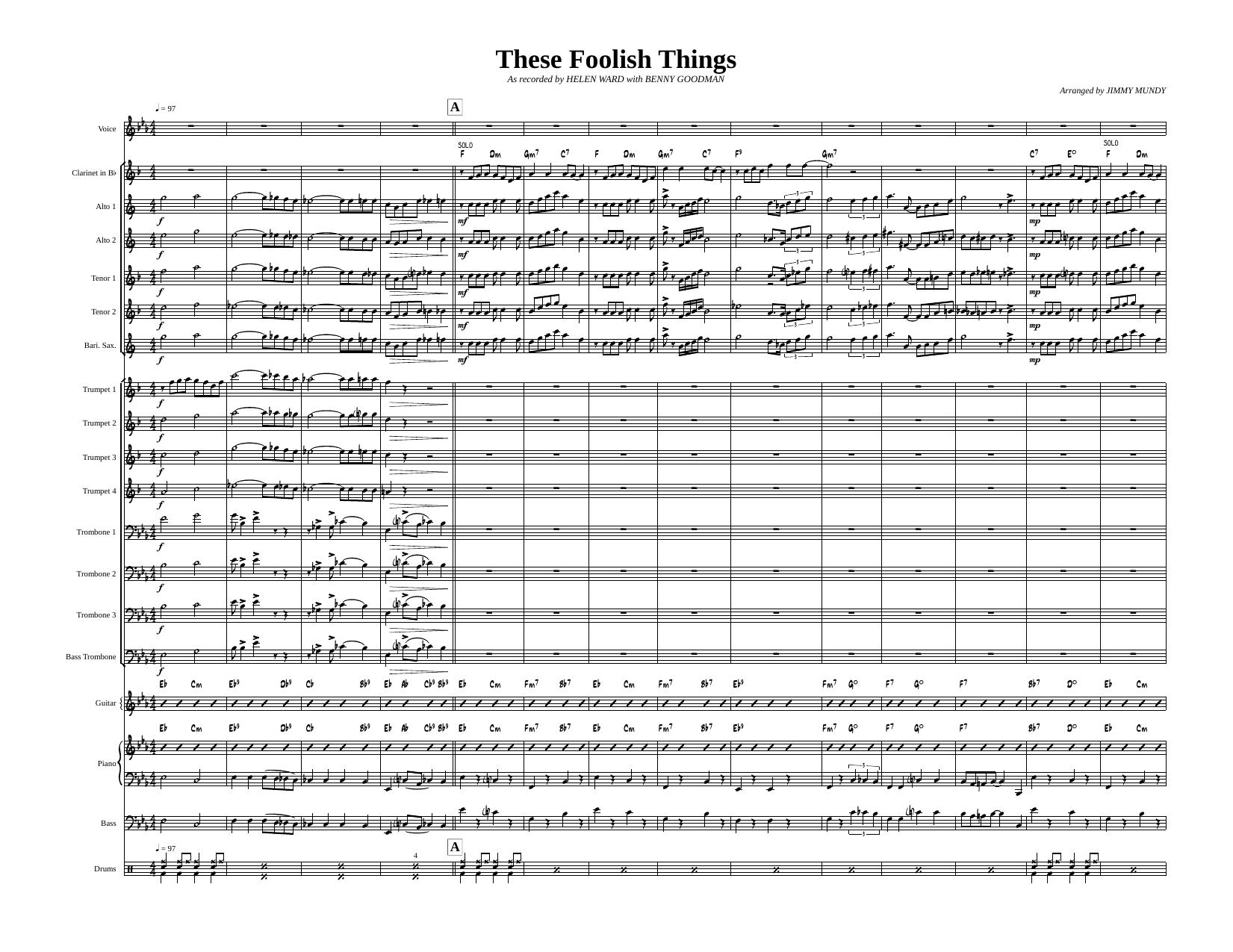
These Foolish Things (B.Goodman - HWArd - J.Mundy)
Composed by Harry Link
Arranged by Benny Goodman
- Ensemble: Big Band
- Pages: 37
- Instruments (19): Voice, Clarinet in Bb, Alto 1, Alto 2, Tenor 1, Tenor 2, Bari. Sax., Trumpet 1, Trumpet 2, Trumpet 3, Trumpet 4, Trombone 1, Trombone 2, Trombone 3, Bass Trombone, Guitar, Piano, Bass, Drums
- Difficulty: medium
- Content: Individual Parts
- Format: PDF Download (Instant)
- Price: $24.99
Masterfully crafted by the legendary King of Swing, the Benny Goodman Orchestra's treatment of "These Foolish Things (Remind Me of You)" stands as a quintessential artifact of the 1930s big band golden age. Originally penned in 1936 by Jack Strachey and Eric Maschwitz with American lyrics by Harry Link, the tune rapidly ascended to the status of an immutable jazz standard. While countless vocalists and instrumentalists embraced its bittersweet melodic contours, Goodman’s instrumental conception—brought to vibrant life through the brilliant arranging pen of Jimmy Mundy—transformed the nostalgic ballad into a masterclass of swing-era arrangement, balancing lush, harmonically rich sectional writing with infectious, driving rhythmic momentum. Unfolding at a sophisticated, relaxed medium-swing tempo, the chart evokes an atmosphere of late-night metropolitan elegance mingled with poignant introspection. The harmonic landscape is anchored in traditional swing idioms yet elevated by Mundy’s sophisticated chord extensions and clever counter-melodies. The arrangement avoids monolithic ensemble blocks, instead favoring a transparent texture where the interplay between the reed and brass sections mirrors the conversational intimacy of a small combo, all while maintaining the massive acoustic footprint of a full big band. The emotional trajectory shifts seamlessly from wistful, velvety lyricism in the exposition to an uplifting, foot-tapping buoyancy that epitomizes the optimistic spirit of mid-depression-era swing culture. Benny Goodman’s signature aesthetic—defined by immaculate precision, propulsive drive, and a deep reverence for the blues-infused swing feel—permeates every measure of this score. Mundy’s arrangement showcases classic Goodman hallmarks, including crystalline clarinet-led lead lines, tightly interlocked sax solis, and punchy, dynamic brass counterpunches that propel the form forward. The arrangement ingeniously balances moments of exposed vulnerability, where the rhythm section lays down a feather-light comping bed behind a featured soloist, with robust ensemble shout choruses that utilize classic 1930s drop-2 voicings. These contrasting textures ensure that the arrangement maintains high listener engagement and offers every section a chance to shine with distinct stylistic clarity. Tailored primarily for advanced high school, collegiate, and professional or community jazz orchestras, this 37-page publication provides an authentic window into the historic Goodman book. Achieving stylistic authenticity requires meticulous attention to the articulation of eighth-note triplets, a relaxed backbeat on beats two and four, and careful balance within the brass section to allow the upper-register trumpet leads and warm trombone harmonies to bloom without overpowering the rhythm section. Because the arrangement relies heavily on subtle dynamic shifts and immaculate phrasing rather than sheer velocity, it serves as an exceptional pedagogical tool for developing a band's internal sense of swing, blend, and stylistic maturity. Executing this Jimmy Mundy arrangement with authenticity demands a deep commitment to the stylistic nuances of the 1930s swing aesthetic. The conductor should anchor the ensemble around a steady, unhurried medium-swing tempo, ensuring the rhythm section maintains a light, buoyant pulse rather than a heavy, modern stomp. The acoustic piano should lean into a sparse, stride-influenced or four-to-the-bar comping style that locks in precisely with the guitar and string bass, avoiding overly dense, modern chord extensions that clash with the period-authentic harmony. Horn players must pay strict attention to articulation: unaccented notes should be properly detached with a warm, rounded tongue, while marked accents require a sharp front edge followed immediately by a drop in volume to let the inner voices breathe. Brass players should utilize subtle, tasteful vibrato on sustained notes, keeping in mind that the overall sonic ideal prioritizes ensemble blend and lyrical phrasing over raw decibel levels. Rehearsals should initially isolate the sax soli passages to ensure unified intonation and identical phrasing shapes before integrating the brass and rhythm sections. Q: What instruments and parts are included in this publication? A: This comprehensive 37-page arrangement includes a full conductor score alongside individual instrumental parts tailored for a classic 7-instrument/section instrumentation featuring Alto Saxophone, Tenor Saxophone, Trumpet, Trombone, Piano, and rhythm section components. Q: What is the difficulty level of this arrangement? A: This chart is graded as advanced, making it best suited for collegiate, professional, or highly accomplished high school big bands that possess strong foundational swing phrasing and sectional blend. Q: What is the historical and stylistic context of this piece? A: The arrangement reflects the height of the 1930s swing era, combining Harry Link's timeless standard with the iconic arranging style of Jimmy Mundy and the performance practices of the Benny Goodman Orchestra. Q: What makes this specific arrangement unique compared to other versions of the tune? A: It features Jimmy Mundy’s signature transparent voicings and tight conversational interplay between reeds and brass, capturing the sophisticated, late-night elegance and drive characteristic of the Goodman library. Q: What is the recommended performance duration and tempo feel? A: The arrangement is designed to be performed at a relaxed, sophisticated medium-swing tempo, typically yielding a performance duration of approximately three to four minutes depending on chosen solo rotations.
Questions and answers
- What is included in the These Foolish Things (B.Goodman - HWArd - J.Mundy) PDF?
- The verified current file contains a conductor score and individual parts across 37 pages.
- How many instruments or parts are listed for These Foolish Things (B.Goodman - HWArd - J.Mundy)?
- The verified instrumentation list contains 19 entries for this Big Band arrangement.
- Who is credited for These Foolish Things (B.Goodman - HWArd - J.Mundy)?
- Composer: Harry Link. Arranger: Benny Goodman.
- What difficulty is listed for These Foolish Things (B.Goodman - HWArd - J.Mundy)?
- The verified difficulty level is medium.
- Can I preview These Foolish Things (B.Goodman - HWArd - J.Mundy) before buying?
- Yes. The product page provides a preview generated from the current PDF file.
- How is These Foolish Things (B.Goodman - HWArd - J.Mundy) delivered?
- After successful payment, the digital PDF is made available for download. The displayed price is $24.99.
Musicians Also Search For
These Foolish Things Benny Goodman PDF • These Foolish Things Benny Goodman sheet music • These Foolish Things arranged by Benny Goodman • Benny Goodman big band charts • Benny Goodman jazz arrangements PDF • These Foolish Things Harry Link sheet music • These Foolish Things Harry Link big band arrangements • Harry Link big band charts • These Foolish Things big band arrangements • These Foolish Things big band PDF download • These Foolish Things jazz sheet music • big band sheet music download • These Foolish Things conductor score PDF • These Foolish Things individual parts download • These Foolish Things sheet music PDF • buy These Foolish Things sheet music • download These Foolish Things PDF • These Foolish Things jazz charts • best Benny Goodman big band arrangements • Harry Link arranged by Benny Goodman • These Foolish Things printable sheet music • big band repertoire PDF