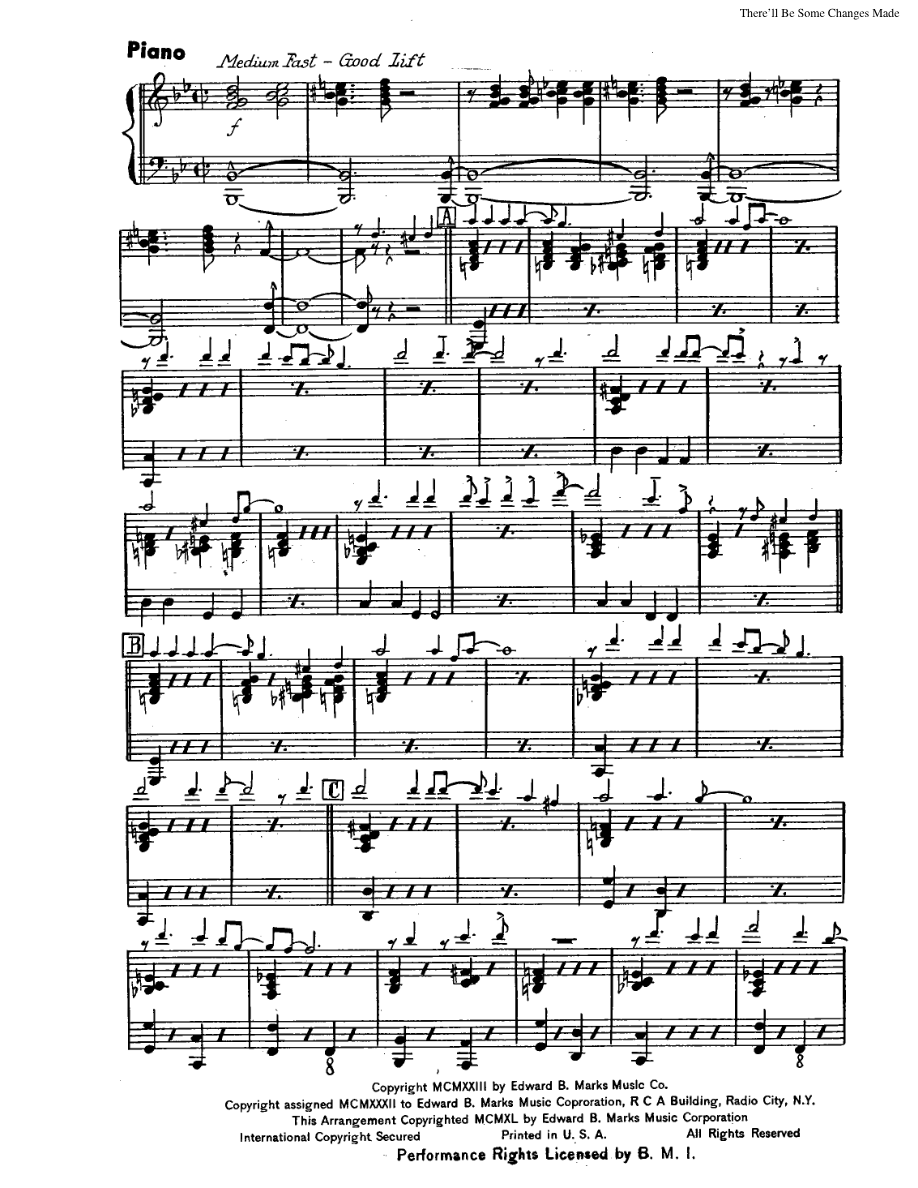
There'll Be Some Changes Made (A.Shaw)
Composed by W. Benton Overstreet
Arranged by Artie Shaw
- Ensemble: Big Band
- Style: Jazz Standard
- Pages: 32
- Instruments (15): Piano, Bass, Guitar, Drum Set, 3rd Trombone, 2nd Trombone, 1st Trombone, 4th Saxophone Bb Tenor, 3rd Saxophone Eb Alto, 2nd Saxophone Bb Tenor, 1st Saxophone Eb Alto, 3rd Trumpet in Bb, 2nd Trumpet in Bb, 1st Trumpet in Bb, Violin
- Difficulty: medium
- Content: Individual Parts
- Format: PDF Download (Instant)
- Price: $24.99
W. Benton Overstreet's "There'll Be Some Changes Made," originally penned in 1921, quickly established itself as a cornerstone of the American songbook, transcending its Tin Pan Alley origins to become a perennial jazz standard. Its enduring appeal lies in its straightforward yet poignant lyrical narrative and its adaptable harmonic structure, making it a favorite for vocalists and instrumentalists alike across various eras. While initially a vaudeville and blues hit, its definitive transformation into a jazz staple was cemented by countless interpretations from the 1920s through the swing era, notably by artists like Ethel Waters, Benny Goodman, and later, Peggy Lee. This particular arrangement, penned by the legendary "King of Clarinet" Artie Shaw, captures the essence of the swing era's sophistication and infectious energy, offering a vibrant snapshot of 1930s big band artistry. Artie Shaw's treatment of "There'll Be Some Changes Made" is a masterclass in medium-swing big band arranging. Set in the key of F Major, the arrangement maintains a bright, optimistic mood throughout, driven by a crisp, four-to-the-bar swing feel. Shaw's signature approach to voicings is immediately apparent, showcasing his preference for rich, often close-voiced saxophone soli sections that glide effortlessly over the rhythm section. The arrangement opens with a classic big band fanfare, quickly establishing the melodic theme, which is then passed between sections. A notable characteristic is Shaw's intelligent use of dynamic contrast and textural shifts, preventing any sense of monotony. The piece builds through expertly crafted ensemble passages, leading to a powerful, brass-driven shout chorus that exemplifies the era's grandiosity. Performance of this Artie Shaw arrangement offers both challenge and immense reward. The melody is predominantly carried by the saxophone section, often in unison or tight harmonies, requiring precise intonation and blend. Feature solos are typically allocated to the tenor saxophone and trumpet, providing opportunities for improvisation within the swing idiom, though written solos are provided for less experienced improvisers. Technical demands include accurate articulation, particularly in the brass sections, and maintaining a consistent, driving swing feel from the rhythm section. The arrangement's dynamic range, from subtle piano swells to full-throated fortissimo, is crucial for conveying its emotional arc. This chart is ideally suited for advanced high school, collegiate, community, and professional big bands aiming to authentically recreate the sound and style of the classic swing era. Its well-structured form and engaging musicality make it a rewarding piece to rehearse and perform, showcasing the ensemble's precision and stylistic understanding. This Artie Shaw arrangement of "There'll Be Some Changes Made" thrives on a consistent, medium-swing tempo, ideally around quarter note = 120-130 BPM. The rhythm section must establish a steady, driving four-to-the-bar feel from the outset, with the bass providing a strong walking line and the drums maintaining a crisp ride cymbal pattern. Key technical challenges include the precise articulation required in the brass sections, particularly for short, accented figures, and the tight intonation necessary for the saxophone soli passages. Conductors should emphasize dynamic contrasts, ensuring the ensemble navigates the swells and diminuendos for maximum impact. Rehearsal time should be dedicated to balancing the saxophone section's blend during melodic statements and ensuring the brass punches are unified and impactful. No special techniques like plunger mutes or doits are explicitly notated, but stylistic falls and scoops can be added tastefully by brass players. Q: What instruments and parts are included in this arrangement? A: This arrangement is scored for a standard 17-piece big band: Alto Saxophone 1, Alto Saxophone 2, Tenor Saxophone 1, Tenor Saxophone 2, Baritone Saxophone, Trumpet 1, Trumpet 2, Trumpet 3, Trumpet 4, Trombone 1, Trombone 2, Trombone 3, Trombone 4, Piano, Bass, Drums, and Guitar. Q: What is the difficulty level of this Artie Shaw arrangement? A: This arrangement is rated as advanced high school, collegiate, or community band level. It requires solid instrumental technique, strong ensemble playing, and an understanding of swing era stylistic nuances. Q: What is the musical style and historical context of "There'll Be Some Changes Made (A.Shaw)"? A: This is a classic big band arrangement of a jazz standard from the swing era (1930s). It showcases Artie Shaw's distinctive arranging style, characterized by sophisticated voicings and a driving medium-swing feel. Q: What makes Artie Shaw's treatment of this standard unique? A: Shaw's arrangement is notable for its elegant saxophone soli sections, intelligent use of dynamic contrast, and a powerful, brass-driven shout chorus, all contributing to an authentic and vibrant swing sound. Q: What is the typical performance duration and tempo for this piece? A: The typical performance duration for this arrangement is approximately 3-4 minutes. It is best performed at a medium-swing tempo, generally between 120-130 beats per minute.
Musicians Also Search For
There'll Be Some Changes Made Artie Shaw PDF • There'll Be Some Changes Made Artie Shaw sheet music • There'll Be Some Changes Made arranged by Artie Shaw • Artie Shaw big band charts • Artie Shaw jazz arrangements PDF • There'll Be Some Changes Made W. Benton Overstreet sheet music • There'll Be Some Changes Made W. Benton Overstreet big band arrangement • W. Benton Overstreet big band charts • There'll Be Some Changes Made big band arrangement • There'll Be Some Changes Made big band PDF download • There'll Be Some Changes Made jazz ensemble sheet music • big band sheet music instant download • There'll Be Some Changes Made individual parts download • There'll Be Some Changes Made sheet music with parts • There'll Be Some Changes Made Jazz Standard chart • Jazz Standard big band arrangements • buy There'll Be Some Changes Made sheet music online • download There'll Be Some Changes Made PDF • There'll Be Some Changes Made jazz chart • best Artie Shaw big band arrangements • W. Benton Overstreet songs arranged by Artie Shaw • There'll Be Some Changes Made printable sheet music • big band repertoire PDF