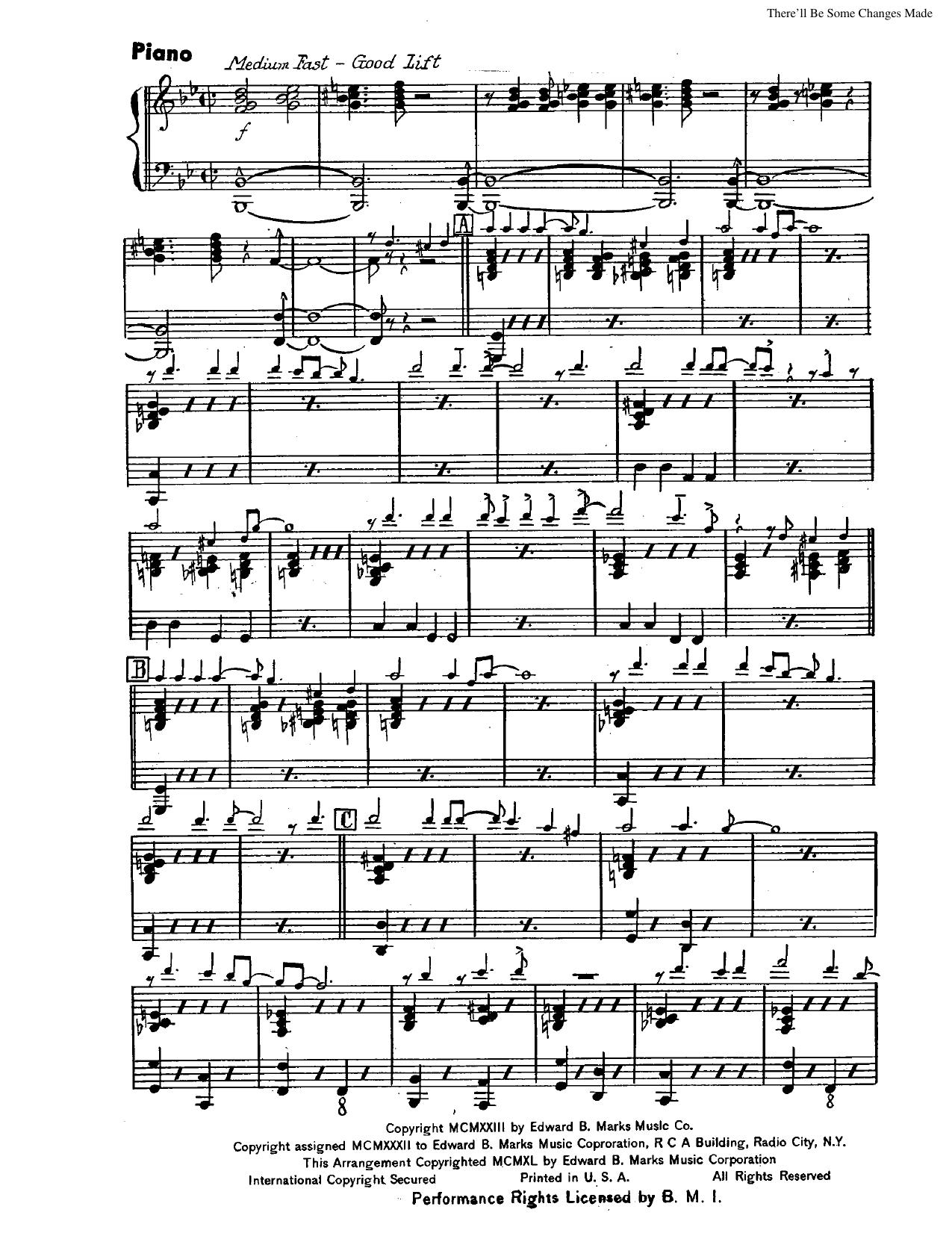
There'll Be Some Changes Made (A.Shaw) sheet music preview

There'll Be Some Changes Made (A.Shaw)

Composed by William B. Benton

Arranged by Jerry Gray

  • Ensemble: Big Band
  • Pages: 32
  • Instruments (16): Piano, Bass, 5th Sax Bari, Guitar, Violin, Drums, 3rd Trombone, 2nd Trombone, 1st Trombone, 4th Sax Bb Tenor, 3rd Sax Eb Alto, 2nd Sax Bb Tenor, 1st Sax Eb Alto, 3rd Trumpet in Bb, 2nd Trumpet in Bb, 1st Trumpet
  • Difficulty: medium
  • Content: Individual Parts
  • Format: PDF Download (Instant)
  • Price: $24.99

Artie Shaw’s swinging 1941 recording of "There'll Be Some Changes Made" immortalized a tune originally penned by William B. Benton and Overton Des Rose back in 1921. Representing the pinnacle of the big band swing era, this timeless standard bridges the gap between early jazz and sophisticated 1940s orchestration. While numerous artists tackled the song, the Shaw treatment—driven by master arranger Jerry Gray—stands out as a masterclass in counterpoint, rhythmic drive, and streamlined small-group-within-a-big-band texture. Gray, legendary for his work structuring the Glenn Miller and Artie Shaw libraries, infuses the arrangement with an infectious, driving medium-up swing feel that immediately captures the effervescent energy of the wartime dancehall scene. From the opening measures, the chart crackles with crisp articulation and a relentless 4/4 bounce. The musical character is bright, optimistic, and fiercely swinging, propelled by an interlocking web of horn lines that evoke the sophisticated cool of Shaw’s Gramercy Five recordings adapted for a full ensemble. Jerry Gray’s distinctive approach relies heavily on transparent, clarinet-led counterpoint, tight reed solis, and clever harmonic turnarounds that keep the standard 32-bar form sounding fresh and unpredictable. Rather than relying on heavy, brass-dominated shout choruses alone, Gray balances the texture, allowing the woodwinds and brass to converse contrapuntally, creating a transparent yet high-energy sonic landscape. Carried primarily by the lead alto and tenor saxophones in homage to Shaw’s reed-centric aesthetic, the melody bounces effortlessly across the ensemble before opening up for concise, swinging improvised solo sections. Technical challenges center around precise execution of swing eighth notes at a brisk tempo, maintaining clean articulation across the reed section, and balancing the delicate dynamic shifts required to let the counterpoint speak clearly. Performers and audiences alike will find the chart deeply rewarding due to its brilliant pacing—every section gets a moment to shine, culminating in a compact, high-spirited ensemble climax that drives hard to the final chord. Advanced high school, collegiate, and professional or community jazz orchestras will find this 32-page, 8-instrument arrangement an exceptional addition to their repertoire. Because it is tailored for a more concise instrumentation rather than a sprawling modern 20-piece big band, it allows smaller or specialized ensembles to achieve an authentic, professional vintage swing sound without sacrificing harmonic depth. It serves as an ideal showcase for bands looking to master stylistic authenticity, section blend, and mid-century swing phrasing. Conductors should establish a brisk, buoyant medium-swing tempo around 168 to 176 BPM, ensuring the rhythm section lays down a feather-light, driving pulse rather than a heavy, modern stomp. The primary technical hurdle lies in the precise execution of articulated swing eighth notes; all-encompassing stenciled accents must be strictly observed to capture the authentic Artie Shaw style. Reeds need to focus on effortless blend and intonation during the intricate, intertwined scalar passages, while the brass should utilize subtle, warm vibrato and controlled cup or straight mutes where indicated to replicate the 1941 recorded timbre. Rehearsals should begin under tempo, isolating the counterpoint between the saxophones and brass to ensure every inner voice is audible before pushing to performance speed. Pay close attention to dynamic contrast—let the rhythm section breathe beneath the soloists, and ensure the final chorus builds organically without forcing the tone. Q: What specific instruments and parts are included in this arrangement? A: This 32-page publication contains parts for an 8-instrument configuration, specifically tailored for Alto Saxophone, Tenor Saxophone, Trumpet, Trombone, Piano, and accompanying rhythm section elements characteristic of Jerry Gray's streamlined scoring style. Q: What is the overall difficulty level of this chart? A: This arrangement is best suited for advanced high school, collegiate, and professional or community big bands that possess strong reading skills, tight section articulation, and a solid grasp of mid-tempo swing phrasing. Q: What is the historical background of this specific version? A: Arranged by Jerry Gray, this chart is modeled after the sophisticated swing style made famous by Artie Shaw and his orchestra during the early 1940s, capturing the transition from early jazz standards to polished big band arrangements. Q: What makes Jerry Gray's arrangement unique compared to other versions of this standard? A: Gray's treatment stands out for its clever, clarinet-inspired contrapuntal writing, transparent reed-and-brass interplay, and an absence of bloated scoring, favoring a lean, high-energy texture that highlights individual section dexterity. Q: What is the recommended performance tempo and approximate duration? A: The arrangement is designed to be performed at a bright medium-swing tempo (around 168–176 BPM), resulting in a compact, high-impact performance lasting approximately three minutes.

Questions and answers

What is included in the There'll Be Some Changes Made (A.Shaw) PDF?
The verified current file contains individual parts across 32 pages.
How many instruments or parts are listed for There'll Be Some Changes Made (A.Shaw)?
The verified instrumentation list contains 16 entries for this Big Band arrangement.
Who is credited for There'll Be Some Changes Made (A.Shaw)?
Composer: William B. Benton. Arranger: Jerry Gray.
What difficulty is listed for There'll Be Some Changes Made (A.Shaw)?
The verified difficulty level is medium.
Can I preview There'll Be Some Changes Made (A.Shaw) before buying?
Yes. The product page provides a preview generated from the current PDF file.
How is There'll Be Some Changes Made (A.Shaw) delivered?
After successful payment, the digital PDF is made available for download. The displayed price is $24.99.

Musicians Also Search For

There'll Be Some Changes Made Jerry Gray PDFThere'll Be Some Changes Made Jerry Gray sheet musicThere'll Be Some Changes Made arranged by Jerry GrayJerry Gray big band chartsJerry Gray jazz arrangements PDFThere'll Be Some Changes Made William B. Benton sheet musicThere'll Be Some Changes Made William B. Benton big band arrangementsWilliam B. Benton big band chartsThere'll Be Some Changes Made big band arrangementsThere'll Be Some Changes Made big band PDF downloadThere'll Be Some Changes Made jazz sheet musicbig band sheet music downloadThere'll Be Some Changes Made individual parts downloadThere'll Be Some Changes Made sheet music PDFbuy There'll Be Some Changes Made sheet musicdownload There'll Be Some Changes Made PDFThere'll Be Some Changes Made jazz chartsbest Jerry Gray big band arrangementsWilliam B. Benton arranged by Jerry GrayThere'll Be Some Changes Made printable sheet musicbig band repertoire PDF

All arrangements by Jerry Gray All William B. Benton sheet music