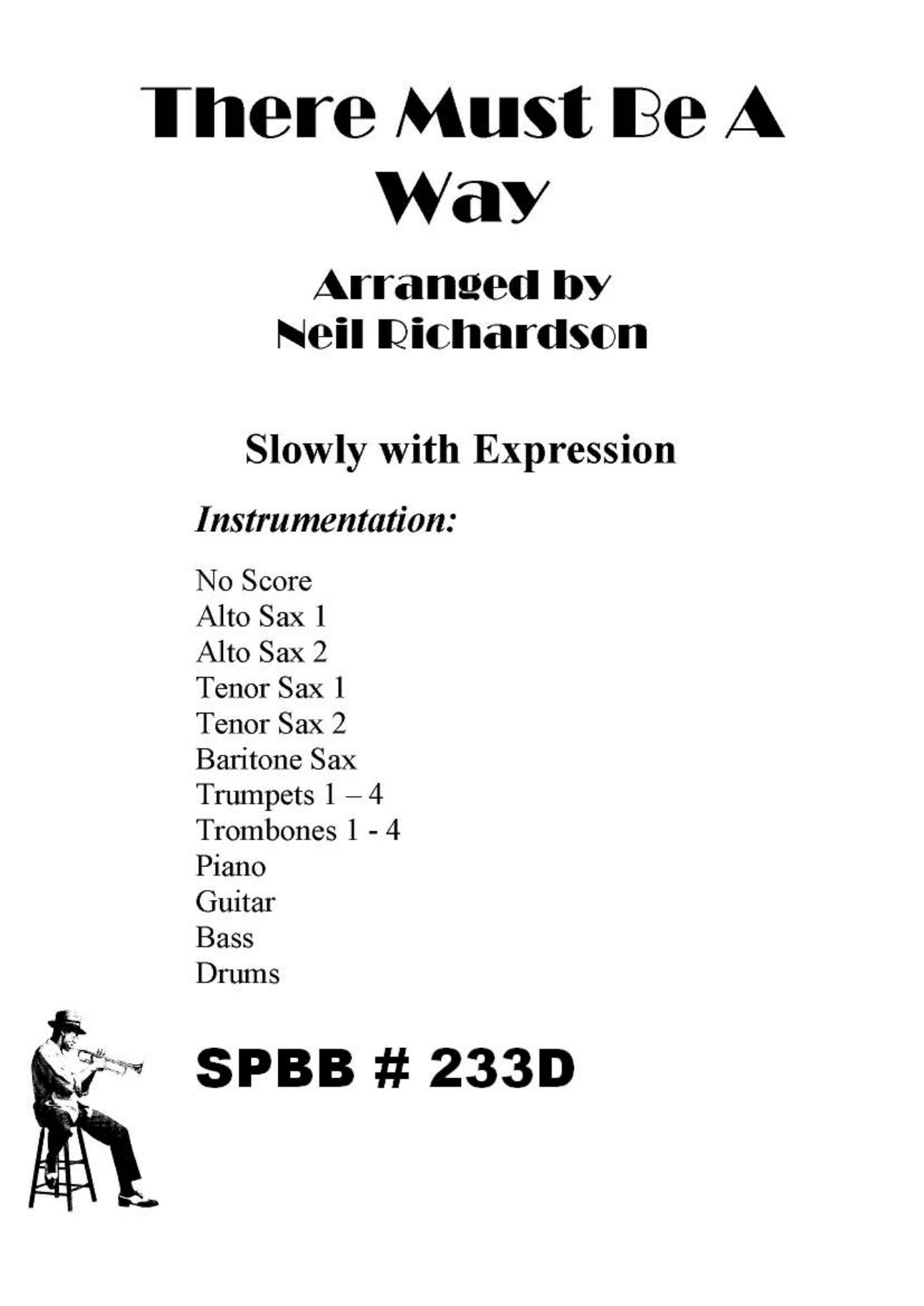
There Must Be A Way (N.Richardson) sheet music preview

There Must Be A Way (N.Richardson)

Composed by N. Richardson

Arranged by N.Richardson

  • Ensemble: Big Band
  • Style: Jazz Standard
  • Pages: 39
  • Instruments (17): 1st Eb Alto Saxophone, 2nd Eb Alto Saxophone, 1st Bb Tenor Saxophone, 2nd Bb Tenor Saxophone, Eb Baritone Saxophone, 1st Trumpet in Bb, 2nd Trumpet in Bb, 3rd Trumpet in Bb, 4th Trumpet, 1st Trombone, 2nd Trombone, 3rd Trombone, 4th Trombone, Piano, Guitar, Bass, Drums
  • Difficulty: medium
  • Content: Individual Parts
  • Format: PDF Download (Instant)
  • Price: $24.99

Composed originally in the mid-1940s by David Saxon, Robert Cook, and Sammy Gallop, "There Must Be A Way" emerged during a golden era of sentimental popular songwriting before being widely embraced by jazz and traditional pop icons like Louis Armstrong, Perry Como, and Jackie Gleason. N.Richardson’s sophisticated big band interpretation transforms this timeless melody into a masterclass of mid-century swinging elegance. Rooted in the rich tradition of the jazz standard repertoire, the composition bridges the gap between lush vocal balladry and swinging instrumental punch, capturing a nostalgic, bittersweet mood that resonates powerfully with modern audiences. Built around a steady, unhurried medium swing groove in 4/4 time, the arrangement opens with an inviting, harmonically rich introduction that establishes the sophisticated mood. N.Richardson utilizes warm, dense saxophone voicings and subtle brass cushioning to evoke a classic late-night club atmosphere. The harmonic structure balances accessible diatonic framework with clever chromatic passing chords and extended ninth and eleventh voicings. Emotional intensity builds organically throughout the chart, moving from reflective, intimate passages to vibrant, full-ensemble climaxes that showcase the quintessential colors of a 17-piece big band. N.Richardson's arranging style shines through meticulous counterpoint and dynamic section interplay. The melody is initially introduced by the saxophones with delicate brass punctuation, before passing through a tightly-knit brass soli that demands exceptional blend and intonation. A strategically placed shout chorus serves as the emotional peak of the chart, driven by rhythmic syncopation, soaring trumpet leads, and a robust low-end anchor from the baritone saxophone and bass trombone. Rather than relying on gratuitous modern modulations, the chart respects the integrity of the original song form while keeping players and listeners engaged through clever textural shifts and nuanced harmonic reharmonizations. Tailored for advanced high school, collegiate, and professional community big bands, this 40-page publication offers a rewarding challenge for ensembles looking to refine their swing feel and stylistic cohesion. The lead trumpet parts require solid upper-register endurance and control, while the rhythm section must maintain an authoritative yet driving pocket. Solo opportunities are provided within a comfortable framework, allowing featured improvisers to stretch out over standard changes. Exceptional care has been given to articulation markings throughout all seventeen parts, ensuring that the authentic swing phrasing is easily communicable from the conductor's podium down to every section player. Conducting this chart successfully requires a disciplined, relaxed medium swing feel (approx. Quarter Note = 112-120 BPM). Avoid rushing the tempo; the groove must feel deep, grounded, and effortless. Key technical hurdles include maintaining consistent balance during the exposed chordal passages in the saxophones and ensuring accurate articulation on eighth-note lines. Horn players should carefully observe all marked slurs and accents, applying a traditional jazz articulation style where offbeat eighth notes are naturally stressed and slightly detached, while downbeats remain integrated into the flowing line. Trumpet and trombone sections should utilize warm, rounded tones, reserving bright, aggressive brass coloring for the latter half of the shout chorus. Cup mutes or bucket mutes may be introduced creatively on the second head if a darker, vintage sub-tone is desired, though open-horn playing is standard. Rehearsal should begin by isolating the rhythm section to lock in the hi-hat on beats two and four, ensuring the comping chords remain sparse, tasteful, and supportive of the horns. Q: What instruments and parts are included in this publication? A: The arrangement is scored for a standard 17-instrument big band, consisting of 5 saxophones (2 altos, 2 tenors, 1 baritone), 4 trumpets, 4 trombones, and a 4-piece rhythm section (piano, guitar, bass, and drums), spanning 40 total pages of music. Q: What is the difficulty level of N.Richardson's arrangement? A: This chart is graded as advanced-intermediate to advanced, making it ideal for skilled high school ensembles, college jazz bands, and professional community big bands seeking to develop nuanced swing ensemble playing. Q: What is the historical style and musical context of the piece? A: The work is styled as a classic medium-swing jazz standard, drawing on the romantic popular song tradition of the 1940s and adapting it into the sophisticated arranging vernacular of mid-century big band jazz. Q: What specific elements make this N.Richardson arrangement unique? A: It is distinguished by its lush saxophone voicings, a tightly constructed brass soli, and a dynamic shout chorus that cleverly reharmonizes the familiar melody without losing the emotional core of the original composition. Q: What is the recommended performance duration and tempo for this arrangement? A: The piece runs approximately 3.5 to 4 minutes when performed at the recommended medium swing tempo of around 116 BPM, allowing ample space for both ensemble expression and featured improvisation.

Questions and answers

What is included in the There Must Be A Way (N.Richardson) PDF?
The verified current file contains individual parts across 39 pages.
How many instruments or parts are listed for There Must Be A Way (N.Richardson)?
The verified instrumentation list contains 17 entries for this Big Band arrangement.
Who is credited for There Must Be A Way (N.Richardson)?
Composer: N. Richardson. Arranger: N.Richardson.
What difficulty is listed for There Must Be A Way (N.Richardson)?
The verified difficulty level is medium.
What style is listed for There Must Be A Way (N.Richardson)?
The catalog lists the style as Jazz Standard.
Can I preview There Must Be A Way (N.Richardson) before buying?
Yes. The product page provides a preview generated from the current PDF file.
How is There Must Be A Way (N.Richardson) delivered?
After successful payment, the digital PDF is made available for download. The displayed price is $24.99.

Musicians Also Search For

There Must Be A Way N.Richardson PDFThere Must Be A Way N.Richardson sheet musicThere Must Be A Way arranged by N.RichardsonN.Richardson big band chartsN.Richardson jazz arrangements PDFThere Must Be A Way N. Richardson sheet musicThere Must Be A Way N. Richardson big band arrangementsN. Richardson big band chartsThere Must Be A Way big band arrangementsThere Must Be A Way big band PDF downloadThere Must Be A Way jazz sheet musicbig band sheet music downloadThere Must Be A Way individual parts downloadThere Must Be A Way sheet music PDFThere Must Be A Way Jazz Standard chartsJazz Standard big band arrangementsbuy There Must Be A Way sheet musicdownload There Must Be A Way PDFThere Must Be A Way jazz chartsbest N.Richardson big band arrangementsN. Richardson arranged by N.RichardsonThere Must Be A Way printable sheet musicbig band repertoire PDF

All arrangements by N.Richardson All N. Richardson sheet music