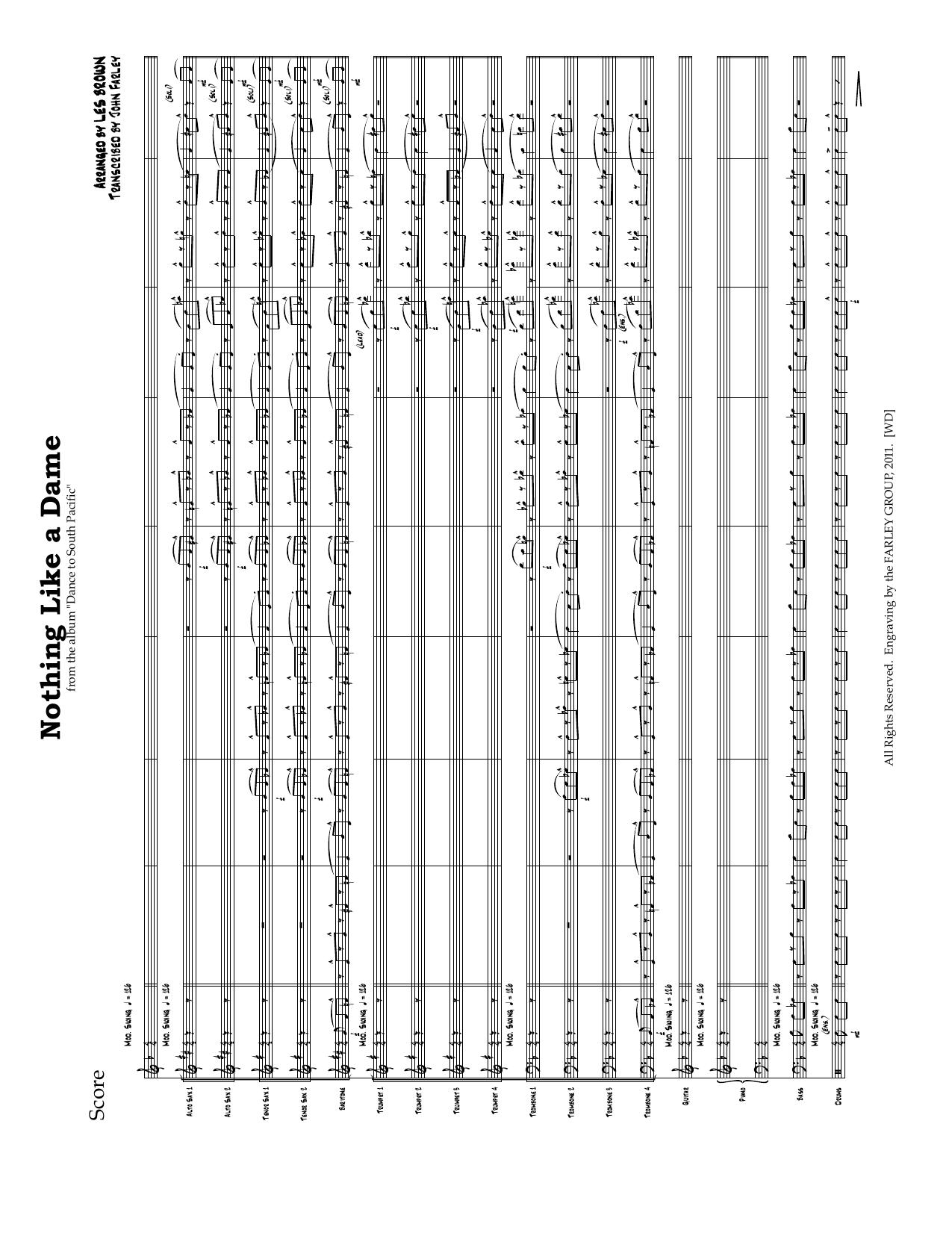
There Is Nothing Like A Dame (J.Farley)
Composed by Richard Rodgers
Arranged by John Farley
- Ensemble: Big Band
- Pages: 51
- Instruments (17): Alto Sax 1, Alto Sax 2, Tenor Sax 1, Tenor Sax 2, Baritone Sax, Trumpet 1, Trumpet 2, Trumpet 3, Trumpet 4, Trombone 1, Trombone 2, Trombone 3, Trombone 4, Guitar, Piano, Bass, Drums
- Difficulty: advanced
- Content: Individual Parts
- Format: PDF Download (Instant)
- Price: $24.99
Rodgers and Hammerstein’s iconic 1949 Broadway masterpiece *South Pacific* introduced the world to "There Is Nothing Like A Dame," an exuberant anthem of camaraderie and longing sung by the Seabees on a tropical island. While rooted in the Golden Age of American musical theater, the infectious melody and driving rhythm have long captured the imaginations of jazz arrangers looking to bridge the gap between Tin Pan Alley and big band swing. Richard Rodgers’ brilliant construction—built on sturdy, marching ostinatos and triumphant, ascending intervals—provides an ideal structural framework for harmonic expansion, rhythmic displacement, and high-octane orchestration. John Farley’s dynamic big band adaptation reimagines this theatrical showstopper as a hard-swinging, high-energy chart that channels the swagger of mid-century Count Basie and Buddy Rich charts. Operating at a brisk, driving medium-up swing tempo, the arrangement opens with a playful, brass-led vamp before establishing a resilient, walking-bass groove underneath crisp saxophone counter-melodies. The mood shifts seamlessly between tongue-in-cheek swagger and explosive, full-ensemble jubilation, evoking the camaraderie of a packed jazz club with its robust harmonic palette, extended dominant voicings, and punchy syncopated figures. Farley’s signature arranging style shines through brilliant sectional writing and a masterclass in dynamic contrast. The chart features a gorgeous, harmonically rich sax soli that recontextualizes the familiar melody through modern jazz colorations before launching directly into a blistering, roof-raising shout chorus. Brass players will find plenty of bite in the Trumpet 1 parts, which ascend with brilliant clarity, while the trombone section anchors the lower-mid register with fat, plunger-assisted punctuations and tightly voiced chordal clusters. Open solo sections for piano and tenor saxophone provide ample space for improvisers to stretch out over standard blues-inflected changes, supported by a rhythm section that drives the momentum relentlessly forward. Advanced high school, collegiate, and professional big bands will find this arrangement an absolute showstopper for festival programs, spring concerts, or themed sets. While the fast swing tempo and high register work demand technical proficiency from the lead brass and rhythm section, the payoff is immense. The clever interplay between sections and the sheer infectious energy of the source material ensure that "There Is Nothing Like A Dame" will leave audiences cheering and challenge every player on the bandstand to elevate their swing feel. Conductors should approach John Farley’s arrangement of "There Is Nothing Like A Dame" with a primary focus on time feel and articulation clarity. Set the metronome at a comfortable, driving medium-up swing (approx. quarter note = 184–192); rushing the tempo will sacrifice the necessary swagger in the brass section. The rhythm section is the engine here: the drummer should maintain a crisp, feathered ride cymbal pattern with light hi-hat chokes on beats two and four, avoiding heavy heavy-handedness so the ensemble breathes naturally. Key technical challenges include maintaining clean, uniform articulation across fast syncopated figures in the saxophone and trombone sections. Ensure that all eighth-note lines are properly swung with natural accents on beats two and four. Brass players should utilize subtle falls and doits where indicated, but avoid overusing them to preserve the crispness of the chart's punchy ensemble hits. During the sax soli, the ensemble volume must drop instantly to a controlled mezzo-piano, allowing the intricate contrapuntal lines to project cleanly over a light, comping piano and walking bass. Rehearsals should isolate the rhythm section first to lock in the groove before layering in the horn sections section by section. Q: What instruments and parts are included in this arrangement? A: This 17-instrument big band arrangement includes full scores and individual parts for Alto Saxophone 1, Alto Saxophone 2, Tenor Saxophone 1, Tenor Saxophone 2, Baritone Saxophone, 4 Trumpets, 4 Trombones, Piano, Guitar, Bass, and Drums, backed by a comprehensive 51-page conductor score. Q: What is the difficulty level of this chart? A: This arrangement is graded as advanced, making it best suited for accomplished high school bands, collegiate ensembles, and professional big bands that possess strong technical facility at brisk swing tempos and confident section playing. Q: What is the style and historical context of the piece? A: Originally composed by Richard Rodgers for the 1949 Broadway musical *South Pacific*, this arrangement reinterprets the theatrical classic through a vibrant, hard-swinging modern big band jazz lens inspired by the traditions of Basie and Rich. Q: What makes John Farley's arrangement unique? A: Farley elevates the familiar show tune by injecting sophisticated extended harmonies, a lush and intricate saxophone soli, clever plunger-mute textures, and a blistering shout chorus designed to showcase the ensemble's dynamic range. Q: What is the performance duration and recommended tempo? A: The arrangement runs approximately 3.5 to 4 minutes when performed at the recommended medium-up swing tempo of around quarter note = 188.
Questions and answers
- What is included in the There Is Nothing Like A Dame (J.Farley) PDF?
- The verified current file contains a conductor score and individual parts across 51 pages.
- How many instruments or parts are listed for There Is Nothing Like A Dame (J.Farley)?
- The verified instrumentation list contains 17 entries for this Big Band arrangement.
- Who is credited for There Is Nothing Like A Dame (J.Farley)?
- Composer: Richard Rodgers. Arranger: John Farley.
- What difficulty is listed for There Is Nothing Like A Dame (J.Farley)?
- The verified difficulty level is advanced.
- Can I preview There Is Nothing Like A Dame (J.Farley) before buying?
- Yes. The product page provides a preview generated from the current PDF file.
- How is There Is Nothing Like A Dame (J.Farley) delivered?
- After successful payment, the digital PDF is made available for download. The displayed price is $24.99.
Musicians Also Search For
There Is Nothing Like A Dame John Farley PDF • There Is Nothing Like A Dame John Farley sheet music • There Is Nothing Like A Dame arranged by John Farley • John Farley big band charts • John Farley jazz arrangements PDF • There Is Nothing Like A Dame Richard Rodgers sheet music • There Is Nothing Like A Dame Richard Rodgers big band arrangements • Richard Rodgers big band charts • There Is Nothing Like A Dame big band arrangements • There Is Nothing Like A Dame big band PDF download • There Is Nothing Like A Dame jazz sheet music • big band sheet music download • There Is Nothing Like A Dame conductor score PDF • There Is Nothing Like A Dame individual parts download • There Is Nothing Like A Dame sheet music PDF • buy There Is Nothing Like A Dame sheet music • download There Is Nothing Like A Dame PDF • There Is Nothing Like A Dame jazz charts • best John Farley big band arrangements • Richard Rodgers arranged by John Farley • There Is Nothing Like A Dame printable sheet music • big band repertoire PDF