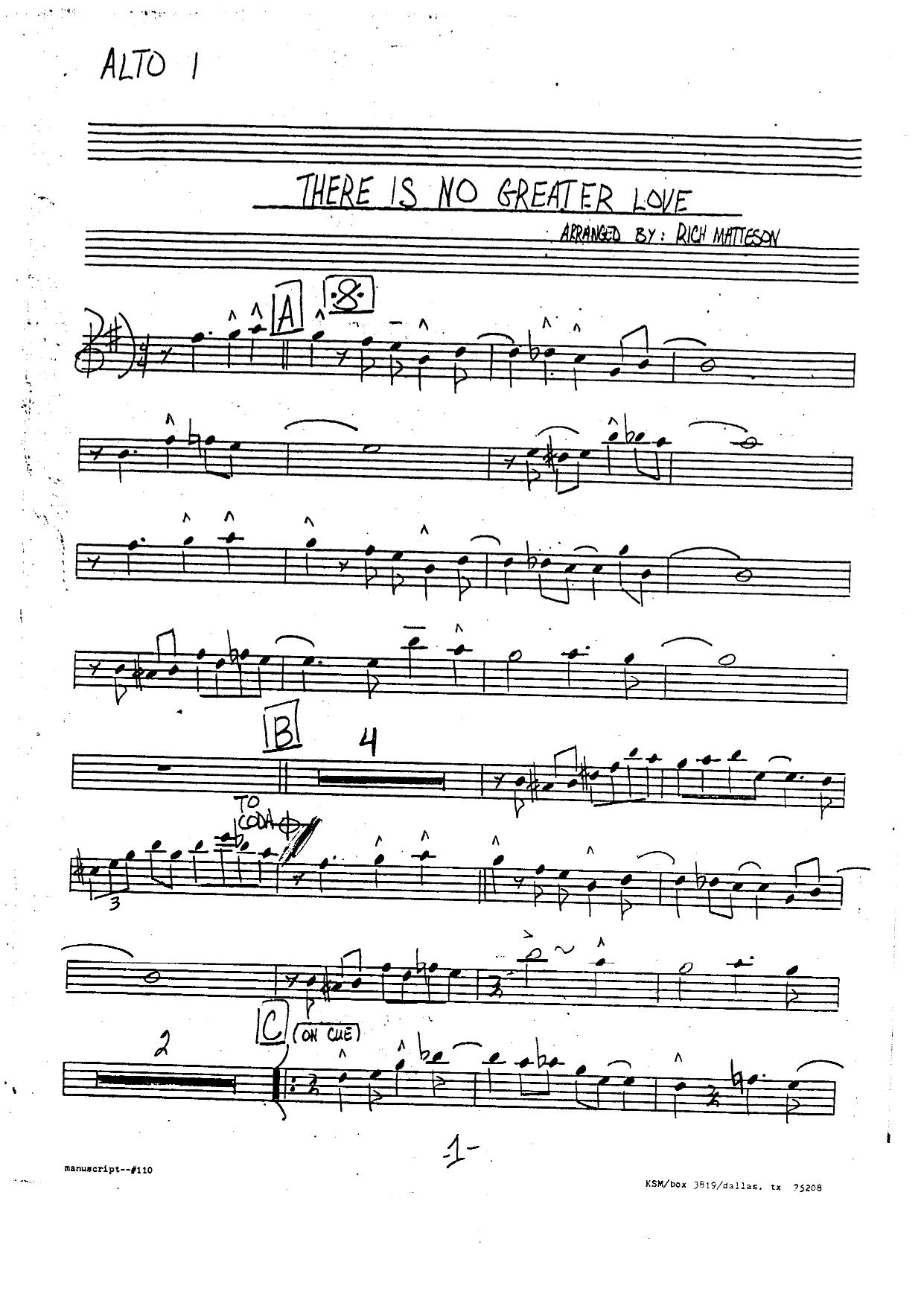
There Is No Greater Love (R.Matteson) sheet music preview

There Is No Greater Love (R.Matteson)

Composed by Isham Jones

Arranged by R.Matteson

  • Ensemble: Big Band
  • Style: Jazz Standard
  • Pages: 62
  • Instruments (20): Alto Sax I, Alto Sax II, Tenor Sax I, Tenor Sax II, Baritone Sax, Trumpet I, Trumpet II, Trumpet III, Trumpet IV, Trumpet V, Lead Trombone, Trombone I, Trombone II, Trombone III, Trombone IV, Trombone V, Piano, Guitar, Bass, Drums
  • Difficulty: advanced
  • Content: Individual Parts
  • Format: PDF Download (Instant)
  • Price: $24.99

Written by bandleader and composer Isham Jones with lyrics by Marty Symes, "There Is No Greater Love" was first introduced in 1936 and rapidly ascended to the upper echelons of the Great American Songbook. Originally conceived during the height of the swing era, the tune's deceptively simple, descending harmonic sequence and infectious melodic contour made it an immediate favorite among small-combo jazz pioneers and vocalists alike. Over the decades, it transitioned from a popular sweet-band number into an essential bebop and post-bop vehicle, immortalized by definitive instrumental readings from artists such as Miles Davis, Sonny Rollins, and Gene Ammons. Its enduring appeal lies in its perfect balance of accessibility and harmonic depth, offering a sturdy framework that invites both lyrical interpretation and adventurous improvisation. R.Matteson’s sophisticated big band interpretation honors this rich lineage while infusing the standard with a vibrant, contemporary momentum. Set in an infectious, driving medium-swing feel (approximately 120–124 BPM), the arrangement opens with a lush, harmonically rich introduction that establishes a warm, inviting mood before launching into a robust four-four groove. Matteson utilizes lush, contemporary chord extensions within the reed and brass sections, creating a dense, modern acoustic palette that evokes the sophisticated voicings of the Thad Jones-Mel Lewis Orchestra while retaining the melodic clarity of the swing era. The emotional arc moves effortlessly from introspective, smoky lyricism in the lower-register brass to jubilant, high-energy collective interplay during the developmental passages. The melodic heavy lifting is shared dynamically across the ensemble, featuring a tightly knit sax soli that showcases intricate line-writing and crisp bebop-infused articulation. Matteson carves out ample space for improvised solos, providing flexible background figures that build dramatic tension behind the soloist without cluttering the texture. The arrangement culminates in a powerhouse shout chorus characterized by cascading brass counterlines, punctuated rhythmic hits, and an exhilarating modulation that propels the band toward a roaring, dynamic climax. Every section receives substantial, engaging material, ensuring that the rhythm section remains locked in a deep pocket while horns are continually challenged by nuanced phrasing demands. Advanced high school, collegiate, and professional jazz ensembles will find this chart to be an exceptional centerpiece for festival programming or concert sets. While the technical demands require proficient sight-reading and a strong command of swing articulation—particularly regarding displaced accents and dynamic control—the payoff is immense. Matteson's meticulous craftsmanship ensures that the ensemble achieves a professional, festival-ready sound right out of the folder, making it a profoundly rewarding study in ensemble blend, balance, and modern big band style. Achieving an authentic performance of R.Matteson’s arrangement requires careful attention to the subtle swing micro-timing and articulation consistency across all sections. The tempo should remain a steady, confident medium-swing feel around 120 BPM; avoid rushing the triplet feel during the syncopated ensemble figures. Rhythm section players must maintain a transparent, driving pulse. The drummer should utilize a classic ride-cymbal pattern with a feathered bass drum ("four-on-the-floor" light pulse) and crisp hi-hat chicks on beats two and four, keeping comping sparse and supportive. Horn players need to execute short notes with a clean, defined tongue and long notes with a warm, supported vibrato, paying close attention to the marked dynamic contrasts. In rehearsal, isolate the saxophone soli first to ensure seamless blend, unified intonation, and identical phrasing before layering in the brass countermelodies. Ensure the lead trumpet handles the upper-register peaks with controlled brilliance rather than brute force, allowing the shout chorus to blossom naturally without overpowering the rhythm section. Q: What instruments and parts are included in this big band arrangement? A: This 62-page arrangement is scored for a standard 18-instrument big band, featuring Alto Saxophone 1, Alto Saxophone 2, Tenor Saxophone 1, Tenor Saxophone 2, Baritone Saxophone, four trumpets, four trombones, and a full rhythm section comprising piano, guitar, bass, and drums. Q: What is the difficulty level of R.Matteson's arrangement of "There Is No Greater Love"? A: This chart is graded as advanced, making it ideal for skilled collegiate, advanced high school, and professional community big bands that possess strong section cohesion and solid swing reading abilities. Q: What style and historical era does this piece represent? A: It is rooted in the classic jazz standard tradition originating from the 1936 swing era, reimagined here through a contemporary big band lens that incorporates modern harmonic extensions and dynamic ensemble writing. Q: What makes this specific arrangement by R.Matteson unique? A: It stands out through its sophisticated harmonic voicings, a meticulously crafted saxophone soli, and a powerful shout chorus featuring clever counterlines that breathe fresh life into Isham Jones's timeless melody. Q: What is the performance duration and suggested tempo for this chart? A: The arrangement runs approximately 4 to 5 minutes at a recommended medium-swing tempo of around 120 to 124 beats per minute.

Questions and answers

What is included in the There Is No Greater Love (R.Matteson) PDF?
The verified current file contains individual parts across 62 pages.
How many instruments or parts are listed for There Is No Greater Love (R.Matteson)?
The verified instrumentation list contains 20 entries for this Big Band arrangement.
Who is credited for There Is No Greater Love (R.Matteson)?
Composer: Isham Jones. Arranger: R.Matteson.
What difficulty is listed for There Is No Greater Love (R.Matteson)?
The verified difficulty level is advanced.
What style is listed for There Is No Greater Love (R.Matteson)?
The catalog lists the style as Jazz Standard.
Can I preview There Is No Greater Love (R.Matteson) before buying?
Yes. The product page provides a preview generated from the current PDF file.
How is There Is No Greater Love (R.Matteson) delivered?
After successful payment, the digital PDF is made available for download. The displayed price is $24.99.

Musicians Also Search For

There Is No Greater Love R.Matteson PDFThere Is No Greater Love R.Matteson sheet musicThere Is No Greater Love arranged by R.MattesonR.Matteson big band chartsR.Matteson jazz arrangements PDFThere Is No Greater Love Isham Jones sheet musicThere Is No Greater Love Isham Jones big band arrangementsIsham Jones big band chartsThere Is No Greater Love big band arrangementsThere Is No Greater Love big band PDF downloadThere Is No Greater Love jazz sheet musicbig band sheet music downloadThere Is No Greater Love individual parts downloadThere Is No Greater Love sheet music PDFThere Is No Greater Love Jazz Standard chartsJazz Standard big band arrangementsbuy There Is No Greater Love sheet musicdownload There Is No Greater Love PDFThere Is No Greater Love jazz chartsbest R.Matteson big band arrangementsIsham Jones arranged by R.MattesonThere Is No Greater Love printable sheet musicbig band repertoire PDF

All arrangements by R.Matteson All Isham Jones sheet music