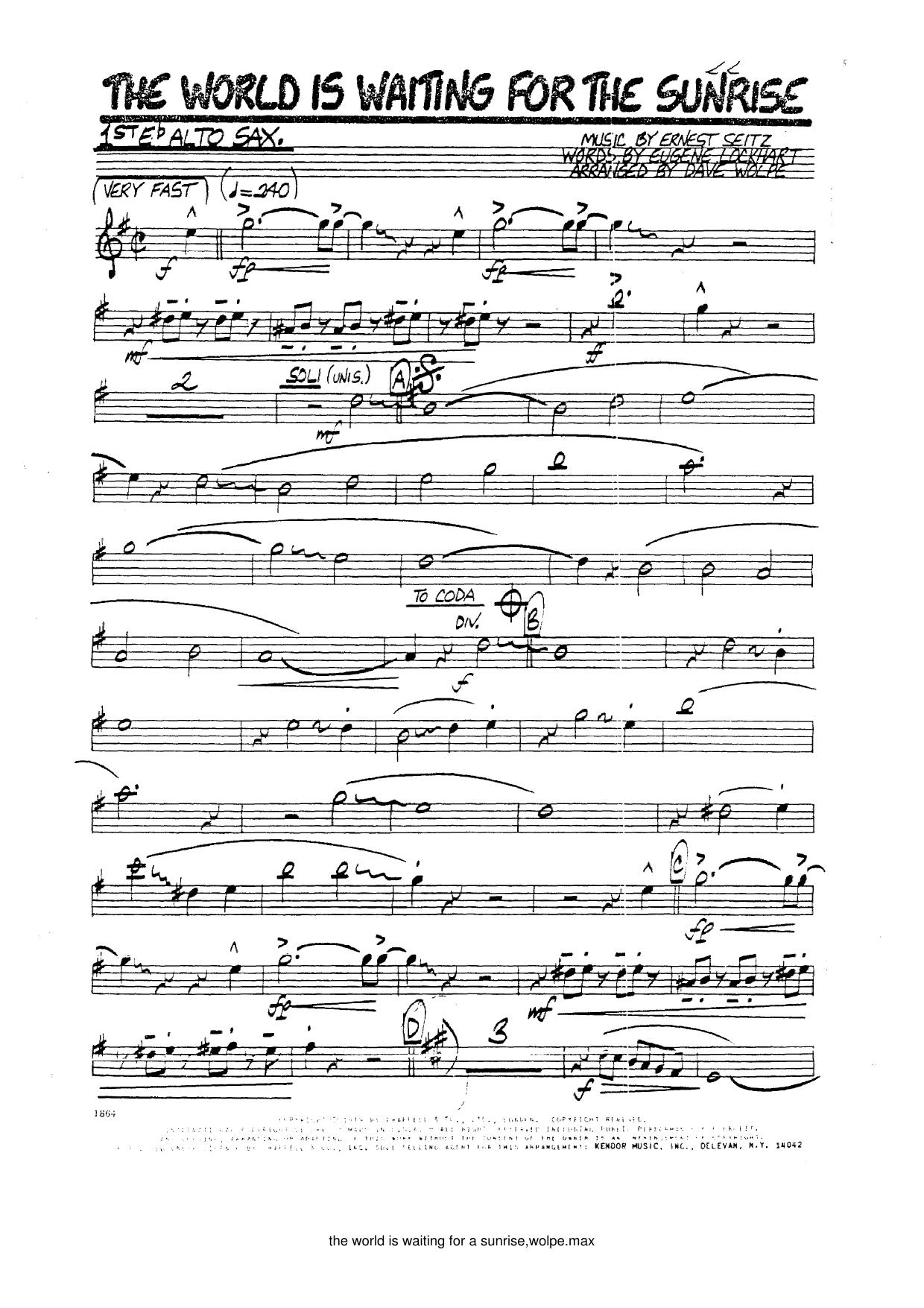
The World Is Waiting For A Sunrise (D.Wolpe) sheet music preview

The World Is Waiting For A Sunrise (D.Wolpe)

Composed by Ernest Seitz

Arranged by Dave Wolpe

  • Ensemble: Big Band
  • Pages: 32
  • Instruments (16): 1st Eb Alto Sax, 2nd Eb Alto Sax, 1st Bb Tenor Sax, 2nd Bb Tenor Sax, Eb Baritone Sax, 1st Bb Trumpet, 2nd Bb Trumpet, 3rd Trumpet, 4th Bb Trumpet, 1st Trombone, 2nd Trombone, 3rd Trombone, Bass Trombone, Bass, Drums, Piano
  • Difficulty: medium
  • Content: Individual Parts
  • Format: PDF Download (Instant)
  • Price: $24.99

Composed in 1918 by Ernest Seitz with lyrics by Mabel Wayne, "The World Is Waiting For A Sunrise" rapidly transcended its Tin Pan Alley origins to become a quintessential vehicle for early jazz and swing innovators. Immortalized through iconic recordings by Art Hickman, Jean Goldkette, and later by Les Paul and Mary Ford, the tune occupies a vital space bridging ragtime transition eras and the golden age of swing big bands. Its infectious, optimistic melody and inherent harmonic flexibility have earned it enduring status as a traditional jazz standard, frequently revisited whenever bands seek to evoke a high-energy, nostalgic atmosphere rooted in classic American popular songcraft. Driving with a bright, infectious medium-up swing feel in 4/4 time, this chart radiates an effervescent, celebratory mood from the initial downbeat. Dave Wolpe’s arrangement captures the buoyant spirit of the roaring twenties while injecting it with the sophisticated punch of a mid-century studio orchestra. The musical character shifts dynamically between crisp, rhythmic ensemble hits and sweeping, lyrical statements, evoking the golden era of late-night radio broadcasts and grand ballroom dance floors. The bright major-key tonality and relentless forward momentum ensure an uplifting experience for both performers and listeners alike. Renowned for his masterful grasp of traditional big band idioms, Dave Wolpe approaches the composition with a brilliant blend of classic voicings and modern punch. Wolpe constructs tightly-knit sax solis and robust brass interplay that recall the legendary writing styles of Sammy Nestico and Nelson Riddle. The arrangement features clever harmonic turnarounds, rich extended chord structures in the piano and guitar parts, and a textbook shout chorus that builds tension through rising chromatic lines before releasing into a full-ensemble climax. Rather than merely recycling old Dixieland tropes, Wolpe reframes the melody through a polished contemporary jazz lens. The melodic load is shared collaboratively across the ensemble, opening with crisp lead trumpet statements before passing the torch to a harmonically rich saxophone soli. Featured solo space allows a competent horn player—typically tenor saxophone or piano—to stretch out over traditional changes, supported by crisp comping from the rhythm section. Technical demands center on maintaining clean articulation at a brisk tempo, requiring clean section blend and precise rhythmic synchronization, particularly during syncopated shout chorus figures. The reward lies in the sheer stylistic payoff; audiences respond immediately to the infectious swing groove and triumphant brass crescendos. Advanced high school ensembles, collegiate jazz orchestras, and professional community big bands will find this chart an ideal fit for festival programs, vintage-themed concerts, or celebratory show openers. While the technical demands are accessible to well-prepared student musicians, the sophisticated arrangement rewards mature interpretation, dynamic control, and stylistic awareness. It stands as a premier educational and professional resource for mastering traditional swing phrasing and ensemble balance. Success with this arrangement hinges on establishing a light, driving medium-up swing tempo that never feels rushed. The rhythm section acts as the engine; the drummer should maintain a steady, feather-light ride cymbal pattern with crisp hi-hat chicks on beats two and four, avoiding heavy foot-stomping on the bass drum to keep the texture transparent. Horn players must pay strict attention to short, articulated notes, ensuring that eighth-note passages are swung naturally rather than played straight or overly dotted. Watch for dynamic contrasts between the whispered background figures and the roaring ensemble shout choruses. Brass players should utilize subtle falls and doits where indicated, keeping plunger or cup mutes close at hand if opting for stylistic color variations in the backgrounds. Rehearsal should begin slowly, locking in the articulation between the saxophones and brass before pushing up to performance tempo. Q: What instruments and parts are included in this big band arrangement? A: The instrumentation follows standard 17-piece big band configuration: 5 saxophones (Alto 1, Alto 2, Tenor 1, Tenor 2, Baritone), 4 trumpets, 4 trombones, and a 4-piece rhythm section consisting of piano, bass, guitar, and drums, supported by a comprehensive full score and 32 total pages of parts. Q: What is the difficulty level of this Dave Wolpe chart? A: This arrangement is graded as medium (Grade 3.5 to 4), making it well-suited for advanced high school bands, college ensembles, and professional community big bands looking for solid swing repertoire. Q: What is the historical style and background of "The World Is Waiting For A Sunrise"? A: Originally written as a 1918 piano novelty by Ernest Seitz, the tune evolved into a major jazz standard famously adapted by swing-era orchestras and guitar pioneer Les Paul, celebrated here in a classic swing style. Q: What makes Dave Wolpe's arrangement unique compared to other versions? A: Wolpe elevates the traditional tune by incorporating sophisticated modern chord voicings, a tightly-interlocked saxophone soli, and a powerful, high-energy shout chorus reminiscent of classic studio arrangements. Q: What is the recommended performance tempo and duration for this piece? A: The chart is designed to be performed at a bright medium-swing tempo (around 160–172 BPM) and typically runs for approximately 3 to 4 minutes, making it an ideal festival piece or concert opener.

Questions and answers

What is included in the The World Is Waiting For A Sunrise (D.Wolpe) PDF?
The verified current file contains individual parts across 32 pages.
How many instruments or parts are listed for The World Is Waiting For A Sunrise (D.Wolpe)?
The verified instrumentation list contains 16 entries for this Big Band arrangement.
Who is credited for The World Is Waiting For A Sunrise (D.Wolpe)?
Composer: Ernest Seitz. Arranger: Dave Wolpe.
What difficulty is listed for The World Is Waiting For A Sunrise (D.Wolpe)?
The verified difficulty level is medium.
Can I preview The World Is Waiting For A Sunrise (D.Wolpe) before buying?
Yes. The product page provides a preview generated from the current PDF file.
How is The World Is Waiting For A Sunrise (D.Wolpe) delivered?
After successful payment, the digital PDF is made available for download. The displayed price is $24.99.

Musicians Also Search For

The World Is Waiting For A Sunrise Dave Wolpe PDFThe World Is Waiting For A Sunrise Dave Wolpe sheet musicThe World Is Waiting For A Sunrise arranged by Dave WolpeDave Wolpe big band chartsDave Wolpe jazz arrangements PDFThe World Is Waiting For A Sunrise Ernest Seitz sheet musicThe World Is Waiting For A Sunrise Ernest Seitz big band arrangementsErnest Seitz big band chartsThe World Is Waiting For A Sunrise big band arrangementsThe World Is Waiting For A Sunrise big band PDF downloadThe World Is Waiting For A Sunrise jazz sheet musicbig band sheet music downloadThe World Is Waiting For A Sunrise individual parts downloadThe World Is Waiting For A Sunrise sheet music PDFbuy The World Is Waiting For A Sunrise sheet musicdownload The World Is Waiting For A Sunrise PDFThe World Is Waiting For A Sunrise jazz chartsbest Dave Wolpe big band arrangementsErnest Seitz arranged by Dave WolpeThe World Is Waiting For A Sunrise printable sheet musicbig band repertoire PDF

All arrangements by Dave Wolpe All Ernest Seitz sheet music