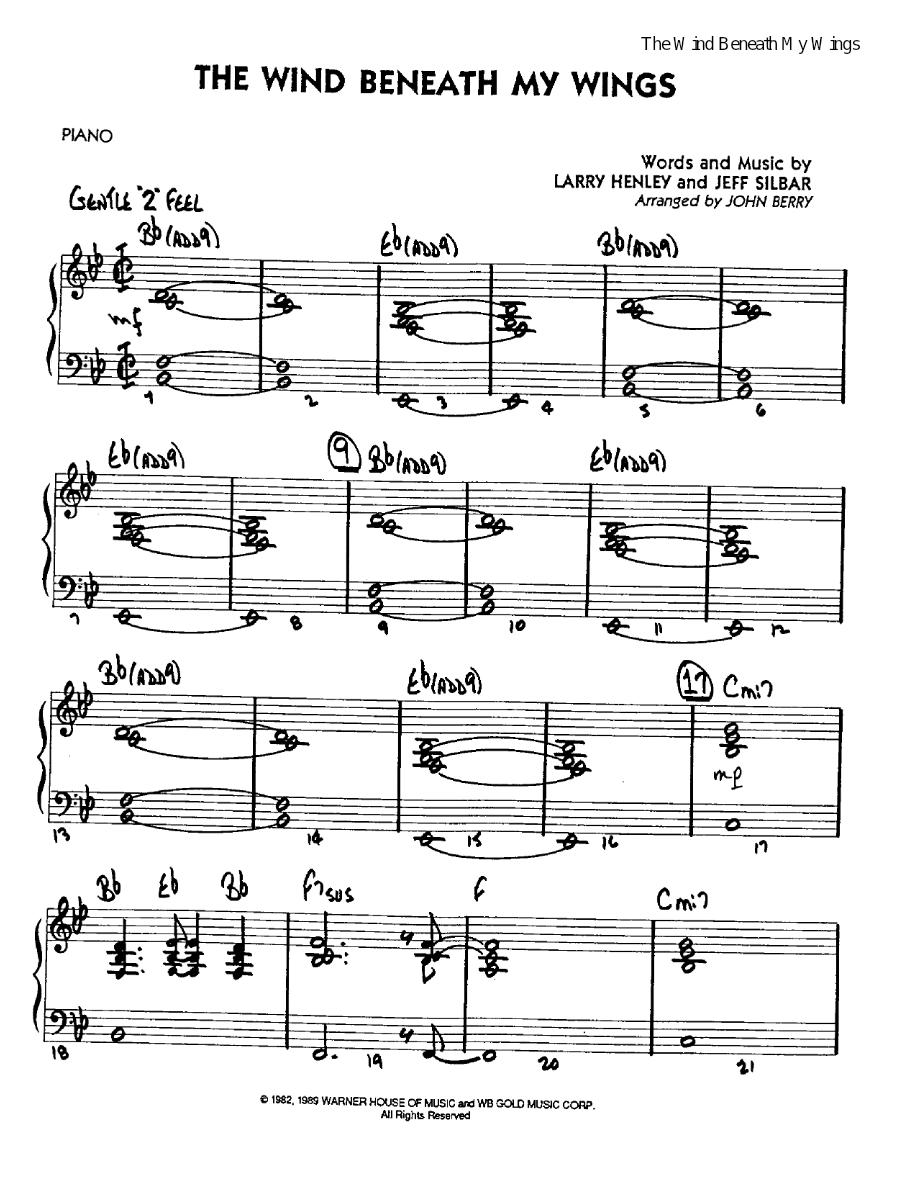
The Wind Beneath My Wings (J.Berry) sheet music preview

The Wind Beneath My Wings (J.Berry)

Composed by Larry Henley

Arranged by John Berry

  • Ensemble: Big Band
  • Pages: 36
  • Instruments (17): Piano, Trumpet 1, Trumpet 2, Trumpet 3, Trumpet 4, Alto Sax 1, Alto Sax 2, Tenor Sax 1, Tenor Sax 2, Baritone Sax, Trombone 1, Trombone 2, Trombone 3, Trombone 4, Guitar, Bass, Drums
  • Difficulty: medium
  • Content: Individual Parts
  • Format: PDF Download (Instant)
  • Price: $24.99

Larry Henley and Jeff Silbar’s timeless anthem "The Wind Beneath My Wings" transcends its pop and country origins to find a sophisticated, expressive home in the jazz idiom through this masterful big band setting. Originally penned in 1982 and immortalized by Bette Midler’s blockbuster 1988 recording—which swept the Grammy Awards for Record and Song of the Year—the composition possesses a soaring, cinematic melodic contour that lends itself remarkably well to the rich tonal palette of a standard jazz orchestra. While historically rooted in the late-century adult contemporary tradition, this jazz adaptation reimagines the iconic tune through lush harmonic extensions, subtle chord substitutions, and a dynamic architectural design that elevates the material into a deeply moving instrumental feature. Crafted as a sweeping, emotive ballad with an underlying flowing pulse, this arrangement unfolds in a comfortable, expressive tempo that prioritizes lyrical phrasing over technical flash. The emotional trajectory shifts masterfully from intimate, reflective opening statements to a powerful, full-ensemble climax. John Berry, renowned for his idiomatic and accessible writing for jazz ensembles, approaches the score with a meticulous balance of rich brass voicings and warm, rolling saxophone solis. The arrangement avoids heavy-handed sentimentality, instead utilizing sophisticated modern jazz harmonies—such as suspended chords, minor-major seventh colors, and clever passing tones—to infuse the familiar melody with unexpected harmonic depth and sophisticated coloration. The narrative of the arrangement is shared collaboratively across the ensemble, beginning with a delicate piano introduction that sets a contemplative, rubato-leaning mood before settling into a steady, supportive ballad tempo. The lead trumpet and alto saxophone sections frequently trade or double the primary thematic material, supported by lush, cascading reed countermelodies. While there is no extended improvised solo section designed to derail the pacing, the chart features strategic cadential interludes and a soaring shout chorus that builds organically, allowing the lead trumpeter and the entire brass section to showcase tonal control and dynamic range. The primary technical demands lie not in velocity, but in breath control, intonation across extended chords, and maintaining a cohesive, unified ensemble blend during wide dynamic swells. Advanced high school ensembles, collegiate jazz orchestras, and professional community big bands will find this chart an ideal centerpiece for a formal concert program or festival performance. It offers a masterclass in dynamic contrast, ensemble listening, and lyrical interpretation. Directors will appreciate how the chart teaches students the art of playing softly with intense core sound, making it a rewarding pedagogical tool as well as a guaranteed emotional highlight for any audience. Achieving a successful performance of this arrangement requires prioritizing breath support, lyrical phrasing, and precise intonation over volume. The tempo should remain steady and relaxed, avoiding any tendency to rush the eighth-note subdivisions during transitional phrases. The primary technical challenge rests in the ensemble's ability to balance rich, extended upper-structure chords without letting the brass overpower the delicate woodwind counterlines. Conductors should emphasize a smooth, connected articulation style; use minimal tongue on sustained notes to ensure a warm, vocal-like quality across all sections. The rhythm section plays a pivotal role in maintaining the underlying momentum without sounding heavy-handed. The pianist should approach the chordal accompaniments with a light, impressionistic touch, utilizing sparse voicings that leave room for the horns. The drummer must maintain a subtle, whispering brush pattern on the snare, using cymbal swells sparingly to enhance the emotional peaks of the chart without disrupting the ballad feel. Pay close attention to the dynamic markings leading into the climax; withholding volume early on ensures the final shout chorus achieves maximum dramatic impact. Q: What instruments and parts are included in this big band arrangement? A: The instrumentation comprises a standard 17-piece big band setup, including full rhythm section (piano, bass, drums) and a horn section featuring four trumpets and four trombones (or three tenors and one bass trombone) alongside five saxophones (two altos, two tenors, one baritone). Q: What is the difficulty level of this chart? A: This arrangement is graded as medium or intermediate-advanced, making it highly accessible for accomplished high school bands while offering enough harmonic and expressive depth for collegiate and professional ensembles. Q: What is the musical style and historical context of this piece? A: It is a jazz ballad adaptation of Larry Henley and Jeff Silbar’s iconic pop-country masterpiece, famously recorded by Bette Midler, reimagined here with contemporary jazz harmonies and lush big band orchestration. Q: What makes John Berry’s arrangement unique? A: Berry transforms a familiar vocal pop standard into a sophisticated instrumental feature by employing rich harmonic extensions, clever dynamic contouring, and a soaring climax that avoids heavy-handed sentimentality. Q: What is the performance duration and tempo framework of the arrangement? A: The arrangement is structured as a expressive ballad performed at a relaxed, flowing tempo of approximately 68 to 72 beats per minute, with a standard performance duration of roughly 3.5 to 4 minutes.

Questions and answers

What is included in the The Wind Beneath My Wings (J.Berry) PDF?
The verified current file contains individual parts across 36 pages.
How many instruments or parts are listed for The Wind Beneath My Wings (J.Berry)?
The verified instrumentation list contains 17 entries for this Big Band arrangement.
Who is credited for The Wind Beneath My Wings (J.Berry)?
Composer: Larry Henley. Arranger: John Berry.
What difficulty is listed for The Wind Beneath My Wings (J.Berry)?
The verified difficulty level is medium.
Can I preview The Wind Beneath My Wings (J.Berry) before buying?
Yes. The product page provides a preview generated from the current PDF file.
How is The Wind Beneath My Wings (J.Berry) delivered?
After successful payment, the digital PDF is made available for download. The displayed price is $24.99.

Musicians Also Search For

The Wind Beneath My Wings John Berry PDFThe Wind Beneath My Wings John Berry sheet musicThe Wind Beneath My Wings arranged by John BerryJohn Berry big band chartsJohn Berry jazz arrangements PDFThe Wind Beneath My Wings Larry Henley sheet musicThe Wind Beneath My Wings Larry Henley big band arrangementsLarry Henley big band chartsThe Wind Beneath My Wings big band arrangementsThe Wind Beneath My Wings big band PDF downloadThe Wind Beneath My Wings jazz sheet musicbig band sheet music downloadThe Wind Beneath My Wings individual parts downloadThe Wind Beneath My Wings sheet music PDFbuy The Wind Beneath My Wings sheet musicdownload The Wind Beneath My Wings PDFThe Wind Beneath My Wings jazz chartsbest John Berry big band arrangementsLarry Henley arranged by John BerryThe Wind Beneath My Wings printable sheet musicbig band repertoire PDF

All arrangements by John Berry All Larry Henley sheet music