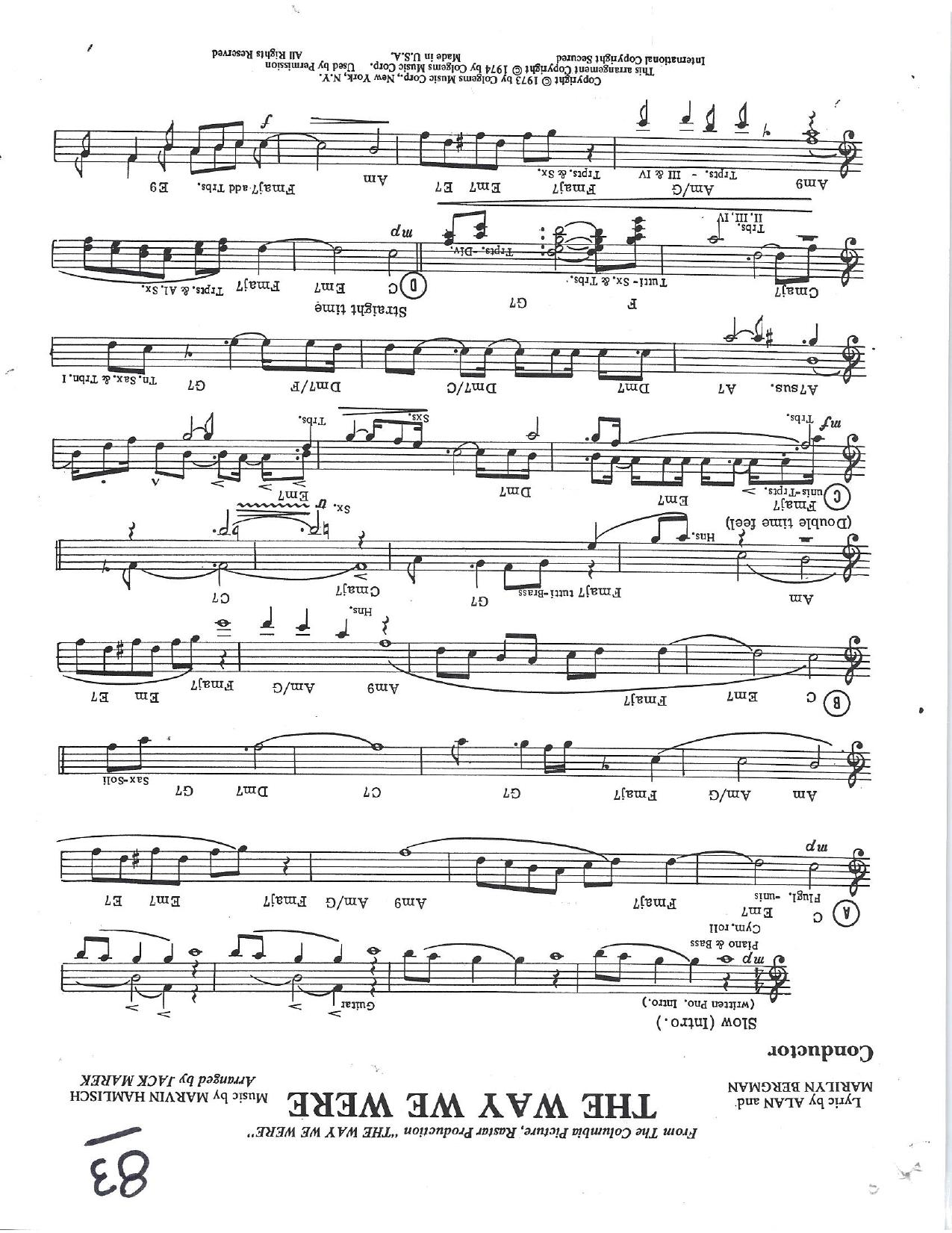
The Way We Were (J.Marek)
Composed by Marvin Hamlisch
Arranged by J.Marek
- Ensemble: Big Band
- Style: Jazz Standard
- Pages: 23
- Instruments (17): 1st Alto Saxophone, 3rd Alto Saxophone, 2nd Tenor Saxophone, 4th Tenor Saxophone, 5th Baritone Saxophone, 1st Trumpet, 2nd Trumpet, 3rd Trumpet, 4th Trumpet, 1st Trombone, 2nd Trombone, 3rd Trombone, 4th Trombone, Drums, Piano, Guitar, Bass
- Difficulty: medium
- Content: Individual Parts
- Format: PDF Download (Instant)
- Price: $24.99
Marvin Hamlisch’s timeless cinematic ballad "The Way We Were," originally immortalized by Barbra Streisand’s iconic 1973 vocal recording and subsequent Academy Award-winning film score, stands as a towering monument of 1970s pop-standard composition. While born in the realm of cinematic tearjerkers, the song's sophisticated harmonic framework—characterized by sweeping major-minor shifts, poignant downward chord progressions, and an inherently nostalgic melody—made it an immediate target for jazz interpreters. Over the decades, instrumentalists from Bill Evans to Woody Herman have mined its rich emotional terrain, transforming it from a Hollywood hit into a sophisticated vehicle for expressive jazz harmonization and lyrical improvisation. In this masterful big band setting by arranger J.Marek, the composition is re-imagined as a lush, deeply reflective jazz ballad featuring a rubato-infused opening that gradually settles into a spacious, flowing 12/8 or slow 4/4 swing feel. The mood is one of profound introspection and nostalgic warmth, evoking the bittersweet haze of memory through rich, extended chord voicings in the brass and cascading woodwind counterlines. Marek avoids cheap sentimentality, instead leveraging modern big band colorations—such as stacked fourths, subtle flugelhorn enhancements, and floating saxophone solis—to elevate the familiar melody into a sophisticated, art-house concert piece. The arrangement opens with a delicate rubato statement of the theme carried primarily by the lead alto saxophone and flugelhorns, before the rhythm section gently establishes a pulsing, breath-like groove. A standout feature of Marek's chart is a gorgeous, harmonically dense saxophone soli that showcases the section's blend across the 5-part voicing (Alto 1, Alto 3, Tenor 2, Tenor 4, Baritone 5), demanding exceptional intonation, breath control, and dynamic sensitivity. An expressive, open solo section allows a featured tenor saxophone or trumpet player to stretch out over a lush, revolving chord matrix before a dramatic, swelling re-transition leads back to the final ensemble statement. Advanced high school ensembles with mature sections, as well as collegiate and professional community big bands, will find this arrangement an ideal centerpiece for a concert program requiring emotional depth rather than sheer high-note pyrotechnics. The primary technical challenges lie not in fast tempos or extreme altissimo ranges, but in maintaining pitch center during sustained, complex chord clusters and sustaining a long musical line through rubato transitions. For conductors seeking to showcase their lead players' tone quality, section blend, and phrasing maturity, this J.Marek chart offers an extraordinarily rewarding, elegant journey through one of the twentieth century's most enduring melodies. Success with this arrangement hinges almost entirely on the ensemble’s collective breath support, dynamic control, and patience with rubato pacing. The conductor must act as a rubato conductor during the opening and closing stretches, ensuring the ensemble breathes as one organism rather than relying strictly on a rigid click. Balance is paramount: the stacked upper extensions in the brass must never overpower the lead alto saxophone or the designated soloist during the statement of the melody. Pay careful attention to intonation on the minor-seventh and altered dominant chords, particularly in the lower brass and saxophones during the transitional modulations. Mutes are generally kept out of this chart to preserve a warm, open, acoustic warmth, though optional cup mutes can be utilized in the trumpets for specific textural contrast if desired. Rehearsals should focus heavily on the inner-voice movement of the saxophones during the soli section, ensuring that every chromatic passing tone speaks clearly without sticking out of the ensemble blend. Q: What instruments and parts are included in this big band arrangement? A: This 17-instrument arrangement includes a complete standard big band instrumentation featuring Alto Saxophone 1, Alto Saxophone 3, Tenor Saxophone 2, Tenor Saxophone 4, and Baritone Saxophone 5, alongside full brass and rhythm sections, spanning 23 pages and incorporating a comprehensive conductor score. Q: What is the difficulty level of J.Marek's setting of "The Way We Were"? A: This chart is graded as advanced (suitable for top-tier high school, collegiate, and professional community big bands), primarily due to its demand for sophisticated intonation, dynamic control, and sustained lyrical phrasing rather than fast-tempo technical execution. Q: What is the musical style and historical background of this piece? A: Conceived as a jazz standard, this arrangement reinterprets Marvin Hamlisch's 1973 cinematic masterpiece, shifting the iconic pop ballad into a lush, harmonically rich big band ballad tradition reminiscent of contemporary concert jazz writing. Q: What makes J.Marek's arrangement uniquely suited for a concert program? A: The chart stands out through its modern extended jazz harmonies, an intricate 5-part saxophone soli, and an open solo section that allows a featured instrumentalist to improvise over a sophisticated, emotionally resonant harmonic backdrop. Q: What is the recommended performance duration and tempo feel for this arrangement? A: The piece is performed at a slow, expressive tempo—primarily featuring a spacious, floating ballad feel with rubato sections—resulting in a total performance duration of approximately 4 to 5 minutes depending on the length of the improvised solo.
Questions and answers
- What is included in the The Way We Were (J.Marek) PDF?
- The verified current file contains a conductor score and individual parts across 23 pages.
- How many instruments or parts are listed for The Way We Were (J.Marek)?
- The verified instrumentation list contains 17 entries for this Big Band arrangement.
- Who is credited for The Way We Were (J.Marek)?
- Composer: Marvin Hamlisch. Arranger: J.Marek.
- What difficulty is listed for The Way We Were (J.Marek)?
- The verified difficulty level is medium.
- What style is listed for The Way We Were (J.Marek)?
- The catalog lists the style as Jazz Standard.
- Can I preview The Way We Were (J.Marek) before buying?
- Yes. The product page provides a preview generated from the current PDF file.
- How is The Way We Were (J.Marek) delivered?
- After successful payment, the digital PDF is made available for download. The displayed price is $24.99.
Musicians Also Search For
The Way We Were J.Marek PDF • The Way We Were J.Marek sheet music • The Way We Were arranged by J.Marek • J.Marek big band charts • J.Marek jazz arrangements PDF • The Way We Were Marvin Hamlisch sheet music • The Way We Were Marvin Hamlisch big band arrangements • Marvin Hamlisch big band charts • The Way We Were big band arrangements • The Way We Were big band PDF download • The Way We Were jazz sheet music • big band sheet music download • The Way We Were conductor score PDF • The Way We Were individual parts download • The Way We Were sheet music PDF • The Way We Were Jazz Standard charts • Jazz Standard big band arrangements • buy The Way We Were sheet music • download The Way We Were PDF • The Way We Were jazz charts • best J.Marek big band arrangements • Marvin Hamlisch arranged by J.Marek • The Way We Were printable sheet music • big band repertoire PDF