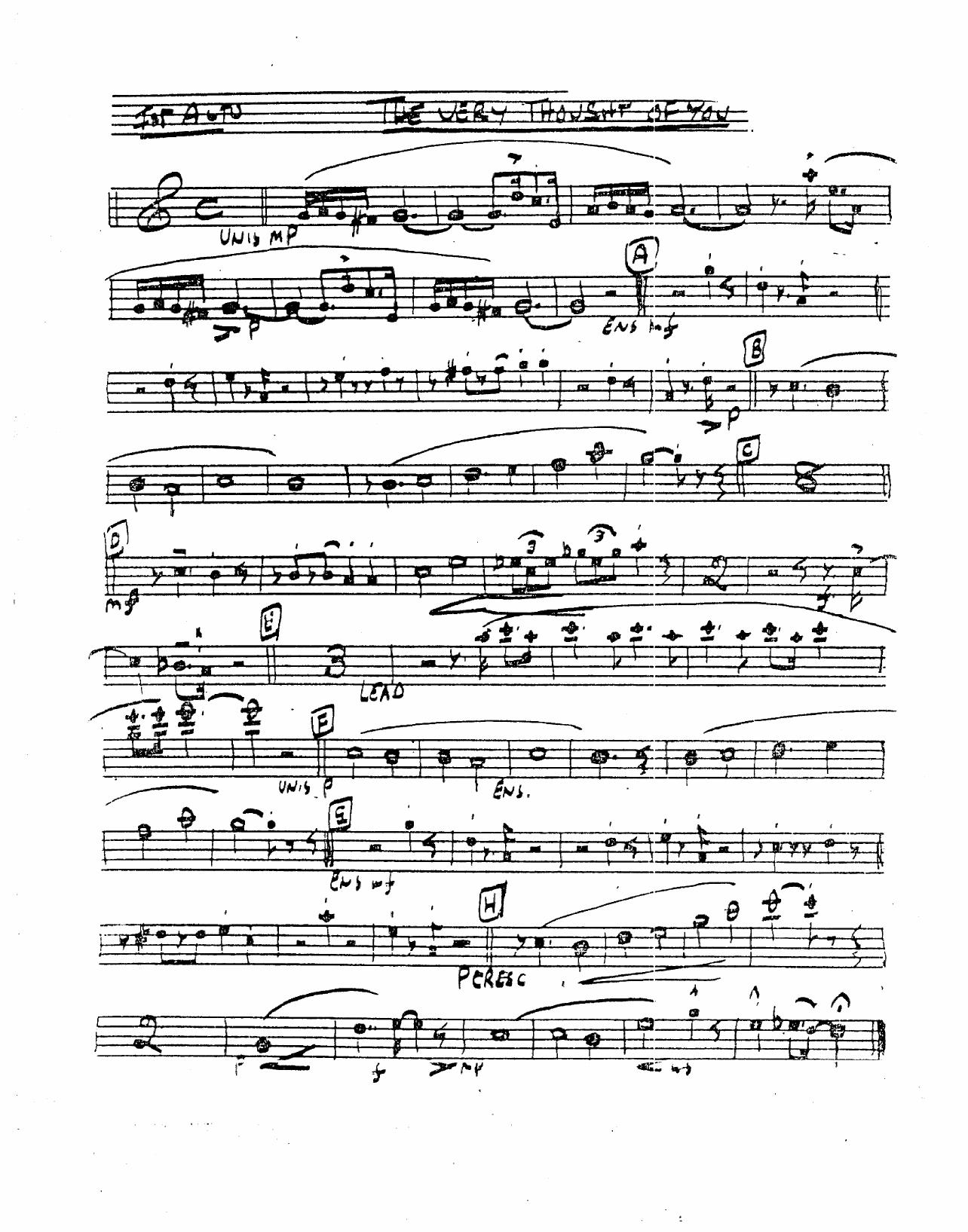
The Very Thought Of You (J.Farley) E.Fitzgerald (T.Saville)
Composed by Ray Noble
Arranged by John Farley
- Ensemble: Big Band
- Pages: 16
- Instruments (16): 1st Alto Saxophone, 2nd Alto Saxophone, 1st Tenor Saxophone, 2nd Tenor Saxophone, Baritone Saxophone, 1st Trumpet, 2nd Trumpet, 3rd Trumpet, 4th Trumpet, 1st Trombone, 2nd Trombone, 3rd Trombone, 4th Trombone, Drums, Bass, Piano/Guitar
- Difficulty: easy
- Content: Individual Parts
- Format: PDF Download (Instant)
- Price: $24.99
Ray Noble’s timeless 1934 composition "The Very Thought of You" occupies a revered place in the Great American Songbook, forever immortalized by the sublime, breathy vocal interpretations of jazz royalty like Ella Fitzgerald. Capturing the quintessential elegance of the mid-century vocal jazz tradition, the tune balances romantic yearning with sophisticated harmonic movement. While countless artists have approached this standard over the decades, the blueprint established by the Ella Fitzgerald vocal recordings remains the gold standard for lush, string-infused, and emotionally resonant ballad arranging. It represents an era where orchestral jazz and intimate vocal delivery intersected to create pure, unadulterated melancholy and romance. John Farley’s masterwork big band arrangement translates the sophisticated intimacy of the Fitzgerald-associated vocal style into a breathtaking instrumental feature. Crafted as a sublime slow ballad in 4/4 time, the chart unfolds with a warm, enveloping harmonic palette characterized by rich, extended chord voicings, lush saxophone solis, and subtle brass countermelodies. The mood shifts delicately between tender vulnerability and sweeping cinematic grandeur. Farley avoids predictable ballad tropes by weaving sophisticated chord extensions—major seventh, minor ninths, and altered dominants—through the reed section, creating a dense, velvet texture that immediately envelops the listener in a melancholic yet comforting atmosphere. The melodic narrative is primarily carried by the lead alto saxophone, which treats the melody with vocal-like phrasing, demanding supreme breath control, expressive vibrato, and a mature sense of rubato within the overarching time-feel. Featured solo space allows a designated instrumentalist—ideally a sensitive tenor saxophonist or trumpet player—to step forward and improvise over a lush, harmonically rich background pad. Technical challenges in this chart do not stem from fast execution or complex rhythmic gymnastics, but rather from the rigorous demands of intonation, balance, and sustained control at slow tempos. Maintaining a steady, pulsing macro-beat beneath the rubato surface while executing pristine ensemble blend is the primary hurdle for any section. Advanced high school ensembles, collegiate jazz orchestras, and professional community big bands will find this chart an exceptional vehicle for developing and showcasing maturity, listening skills, and stylistic restraint. Because it relies heavily on dynamic nuance, tone color, and emotional restraint rather than sheer volume or speed, it serves as an invaluable pedagogical and concert tool. Performing this arrangement rewards audiences with a deeply moving, sophisticated jazz experience that highlights the expressive capability of the modern big band far beyond standard up-tempo burners. Conductors should approach John Farley’s arrangement with a focus on breath support, horizontal phrasing, and meticulous intonation. Set the tempo as a lingering, expressive slow ballad (around 68–72 BPM), ensuring the rhythm section maintains an ultra-subtle, pulsing heartbeat without ever rushing the subdivision. The primary technical challenge lies in the sustained, exposed horn voicings; directors must demand absolute blend and balance across the sections, particularly during chord shifts where inner voices move chromatically. Rehearsal should begin with section-only work to lock in intonation on the dense extended chords before integrating the full ensemble. Saxophones should focus on a warm, homogeneous tone with controlled vibrato that mirrors a vocal delivery. Brass players must exercise extreme restraint, utilizing soft, velvety mutes where indicated and ensuring that all background figures remain strictly subordinate to the lead melodic voices. Pay close attention to dynamic crescendos and decrescendos, as the emotional arc of the chart depends entirely on these seamless transitional swells. Q: What instruments and parts are included in this big band arrangement? A: The arrangement is scored for a standard 16-instrument big band lineup, consisting of 5 saxophones (Alto 1, Alto 2, Tenor 1, Tenor 2, Baritone), 4 trumpets, 4 trombones, and a standard 3-piece rhythm section (piano, bass, drums), spanning 16 comprehensive pages of score and parts. Q: What is the difficulty level of this chart? A: This arrangement is graded as intermediate-advanced (suitable for advanced high school, collegiate, and professional big bands), where the primary challenges are intonation, dynamic control, and sustained expressive phrasing at a slow ballad tempo rather than technical velocity. Q: What is the historical and stylistic context of this piece? A: Based on Ray Noble’s 1934 standard famously interpreted by Ella Fitzgerald, this chart style embodies the golden era of vocal jazz ballads, focusing on lush harmonic textures, romantic sentiment, and sophisticated melodic interpretation. Q: What makes John Farley’s arrangement unique? A: Farley uniquely adapts the rich, string-laden intimacy of classic vocal recordings into an instrumental big band format, utilizing dense, extended saxophone voicings and subtle harmonic shifts that elevate the standard beyond a traditional head arrangement. Q: What is the performance duration and tempo feel of this arrangement? A: The piece is styled as a lush, expressive slow ballad in 4/4 time, with a suggested metronome marking around 68 to 72 BPM, resulting in a performance duration of approximately 4 to 5 minutes depending on the length of the improvised solo.
Questions and answers
- What is included in the The Very Thought Of You (J.Farley) E.Fitzgerald (T.Saville) PDF?
- The verified current file contains individual parts across 16 pages.
- How many instruments or parts are listed for The Very Thought Of You (J.Farley) E.Fitzgerald (T.Saville)?
- The verified instrumentation list contains 16 entries for this Big Band arrangement.
- Who is credited for The Very Thought Of You (J.Farley) E.Fitzgerald (T.Saville)?
- Composer: Ray Noble. Arranger: John Farley.
- What difficulty is listed for The Very Thought Of You (J.Farley) E.Fitzgerald (T.Saville)?
- The verified difficulty level is easy.
- Can I preview The Very Thought Of You (J.Farley) E.Fitzgerald (T.Saville) before buying?
- Yes. The product page provides a preview generated from the current PDF file.
- How is The Very Thought Of You (J.Farley) E.Fitzgerald (T.Saville) delivered?
- After successful payment, the digital PDF is made available for download. The displayed price is $24.99.
Musicians Also Search For
The Very Thought Of You John Farley PDF • The Very Thought Of You John Farley sheet music • The Very Thought Of You arranged by John Farley • John Farley big band charts • John Farley jazz arrangements PDF • The Very Thought Of You Ray Noble sheet music • The Very Thought Of You Ray Noble big band arrangements • Ray Noble big band charts • The Very Thought Of You big band arrangements • The Very Thought Of You big band PDF download • The Very Thought Of You jazz sheet music • big band sheet music download • The Very Thought Of You individual parts download • The Very Thought Of You sheet music PDF • buy The Very Thought Of You sheet music • download The Very Thought Of You PDF • The Very Thought Of You jazz charts • best John Farley big band arrangements • Ray Noble arranged by John Farley • The Very Thought Of You printable sheet music • big band repertoire PDF