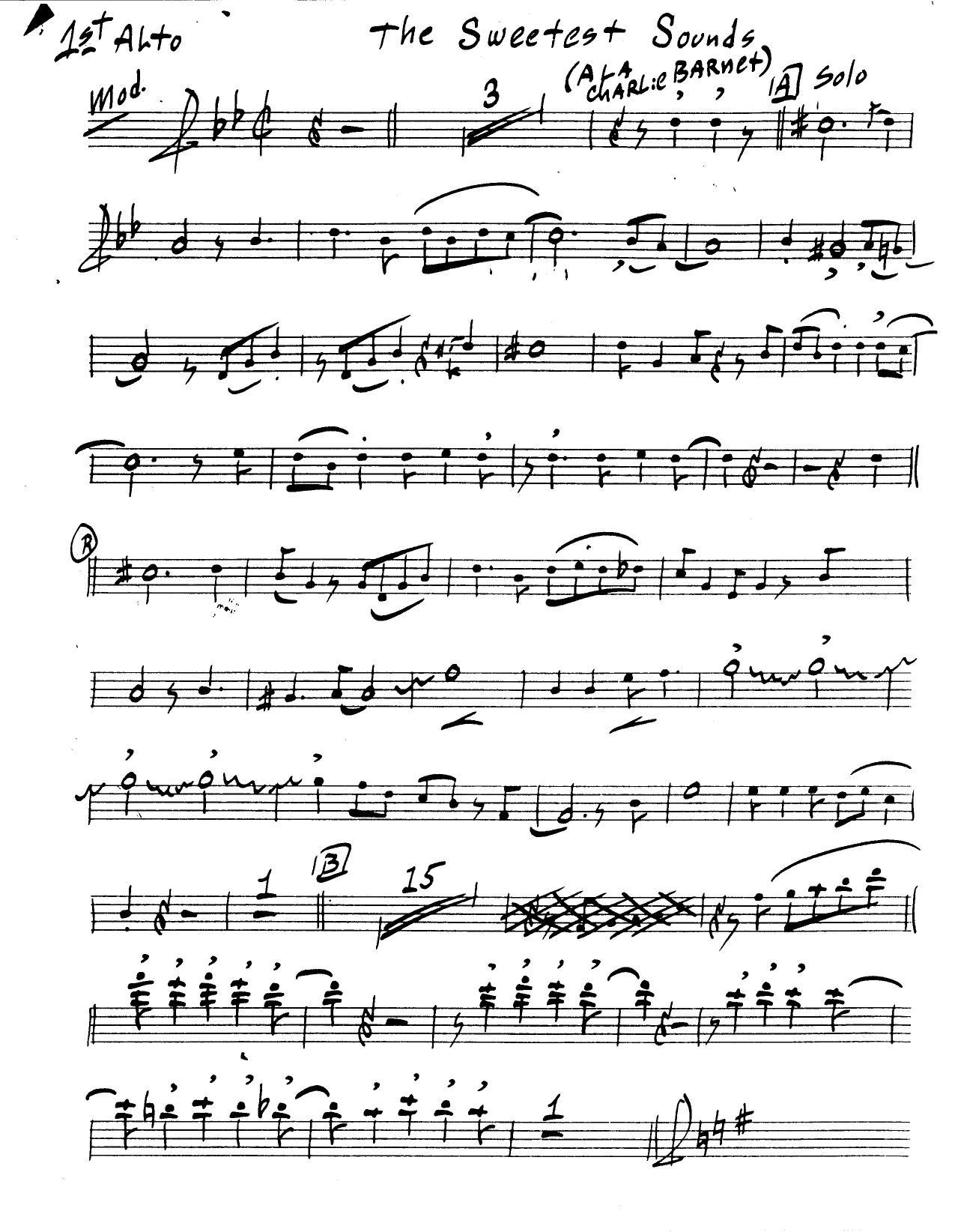
The Sweetest Sounds (C.Barnet) sheet music preview

The Sweetest Sounds (C.Barnet)

Composed by Richard Rodgers

Arranged by C.Barnet

  • Ensemble: Big Band
  • Style: Jazz Standard
  • Pages: 33
  • Instruments (17): 1st Alto Saxophone, 3rd Alto Saxophone, 2nd Tenor Saxophone, 4th Tenor Saxophone, Baritone Saxophone, 1st Trumpet, 2nd Trumpet, 3rd Trumpet, 4th Trumpet, 1st Trombone, 2nd Trombone, 3rd Trombone, 4th Trombone, Piano, Guitar, Bass, Drums
  • Difficulty: medium
  • Content: Individual Parts
  • Format: PDF Download (Instant)
  • Price: $24.99

Richard Rodgers originally penned "The Sweetest Sounds" for his 1962 Broadway musical *No Strings*, capturing a lush, romantic sentiment that quickly caught the attention of jazz instrumentalists and vocalists alike. While the tune belongs to the Great American Songbook, its journey into the jazz idiom transformed it from a traditional theater ballad into a vehicle for sophisticated harmonic exploration and flowing swing interpretations. Mid-century jazz orchestras embraced its memorable, upward-stepping intervals and rich underlying chord changes, turning it into a staple for ensembles looking to blend lyrical warmth with subtle rhythmic drive. In this masterful treatment, the chart unfolds with a sophisticated medium-swing groove that balances relaxed elegance with driving momentum. The emotional landscape shifts gracefully between introspective, tender melodic statements and vibrant, harmonically rich ensemble passages. Rather than rushing into a heavy-handed delivery, the arrangement builds its energy organically, establishing an inviting, sophisticated mood reminiscent of classic late-night dance halls and sophisticated jazz club sessions. The 4/4 meter swings effortlessly, giving the rhythm section plenty of room to lay down a buoyant, transparent foundation underneath the horn sections. The distinctive genius of this layout lies in its clever use of texture and voicing, showcasing rich saxophone soli writing and tightly knit brass counterlines that elevate Rodgers’ original melody. Dynamic contrast serves as a primary structural tool, moving seamlessly from intimate, breathy woodwind combinations to full-ensemble shout choruses that feature extended harmonies and clever chromatic passing tones. The woodwinds—anchored by a dynamic reed section spanning multiple altos, tenors, and baritone—frequently carry the thematic weight, utilizing lush parallel voicings that highlight the arranger's ear for color. Featured solo space allows individual improvisers to stretch out over standard changes, while the surrounding ensemble writing provides intelligent, reactive background figures that never crowd the soloist. Advanced high school, collegiate, and professional big bands will find this arrangement an ideal vehicle for developing sectional balance, intonation, and stylistic maturity. The technical demands sit comfortably within the intermediate-to-advanced realm, requiring precise articulation, controlled vibrato, and a strong internal sense of swing rather than sheer velocity. Directors will appreciate how naturally the chart rehearses, rewarding careful attention to dynamic markings and phrasing nuances. It stands out as a polished, rewarding concert or festival piece that offers audiences a fresh, swinging perspective on a timeless Broadway melody. Achieving the ideal execution of "The Sweetest Sounds" requires a disciplined approach to the medium-swing tempo, ensuring the rhythm section maintains a light, feather-light ride cymbal pulse without rushing the forward motion. Conductors should emphasize relaxed, conversational phrasing in the brass and reed sections, avoiding heavy accents on beats one and three. The primary technical challenge lies in balancing the thick, extended harmonies during the lush soli sections; players must lock in their intonation, particularly when the arrangement utilizes upper-structure chord extensions. Saxophones should focus on a seamless blend during unison and harmony passages, while the brass must use controlled, warm tones rather than forced volume during peak dynamic moments. Rehearsal should begin by isolating the rhythm section to establish the groove independently before layering in the horns. Pay close attention to subtle dynamic shifts and release lengths to capture the sophisticated, late-night character unique to this jazz standard interpretation. Q: What instruments and parts are included in this big band arrangement? A: The 19-instrument instrumentation includes a standard big band setup featuring Alto Saxophone 1, Alto Saxophone 2, Alto Saxophone 3, Baritone Saxophone, plus corresponding trumpet, trombone, and full rhythm section parts spanning 33 total pages of music. Q: What is the difficulty level of this chart? A: This arrangement is graded as intermediate-to-advanced, making it exceptionally well-suited for college ensembles, advanced high school jazz bands, and professional community big bands seeking a sophisticated challenge. Q: What is the historical style and context of this piece? A: Originating from Richard Rodgers' 1962 Broadway musical *No Strings*, this chart frames the composition as a classic jazz standard, utilizing a sophisticated medium-swing feel rooted in the mid-century big band tradition. Q: What makes this specific arrangement unique? A: It stands out through its lush saxophone soli sections, clever harmonic extensions, and seamless transition between intimate lyrical statements and rich, full-ensemble shout choruses. Q: What is the performance duration and tempo feel of the arrangement? A: The piece is built around a relaxed, driving medium-swing tempo in 4/4 time, typically clocking in at a standard performance duration of around 3 to 4 minutes depending on solo extensions.

Questions and answers

What is included in the The Sweetest Sounds (C.Barnet) PDF?
The verified current file contains individual parts across 33 pages.
How many instruments or parts are listed for The Sweetest Sounds (C.Barnet)?
The verified instrumentation list contains 17 entries for this Big Band arrangement.
Who is credited for The Sweetest Sounds (C.Barnet)?
Composer: Richard Rodgers. Arranger: C.Barnet.
What difficulty is listed for The Sweetest Sounds (C.Barnet)?
The verified difficulty level is medium.
What style is listed for The Sweetest Sounds (C.Barnet)?
The catalog lists the style as Jazz Standard.
Can I preview The Sweetest Sounds (C.Barnet) before buying?
Yes. The product page provides a preview generated from the current PDF file.
How is The Sweetest Sounds (C.Barnet) delivered?
After successful payment, the digital PDF is made available for download. The displayed price is $24.99.

Musicians Also Search For

The Sweetest Sounds C.Barnet PDFThe Sweetest Sounds C.Barnet sheet musicThe Sweetest Sounds arranged by C.BarnetC.Barnet big band chartsC.Barnet jazz arrangements PDFThe Sweetest Sounds Richard Rodgers sheet musicThe Sweetest Sounds Richard Rodgers big band arrangementsRichard Rodgers big band chartsThe Sweetest Sounds big band arrangementsThe Sweetest Sounds big band PDF downloadThe Sweetest Sounds jazz sheet musicbig band sheet music downloadThe Sweetest Sounds individual parts downloadThe Sweetest Sounds sheet music PDFThe Sweetest Sounds Jazz Standard chartsJazz Standard big band arrangementsbuy The Sweetest Sounds sheet musicdownload The Sweetest Sounds PDFThe Sweetest Sounds jazz chartsbest C.Barnet big band arrangementsRichard Rodgers arranged by C.BarnetThe Sweetest Sounds printable sheet musicbig band repertoire PDF

All arrangements by C.Barnet All Richard Rodgers sheet music