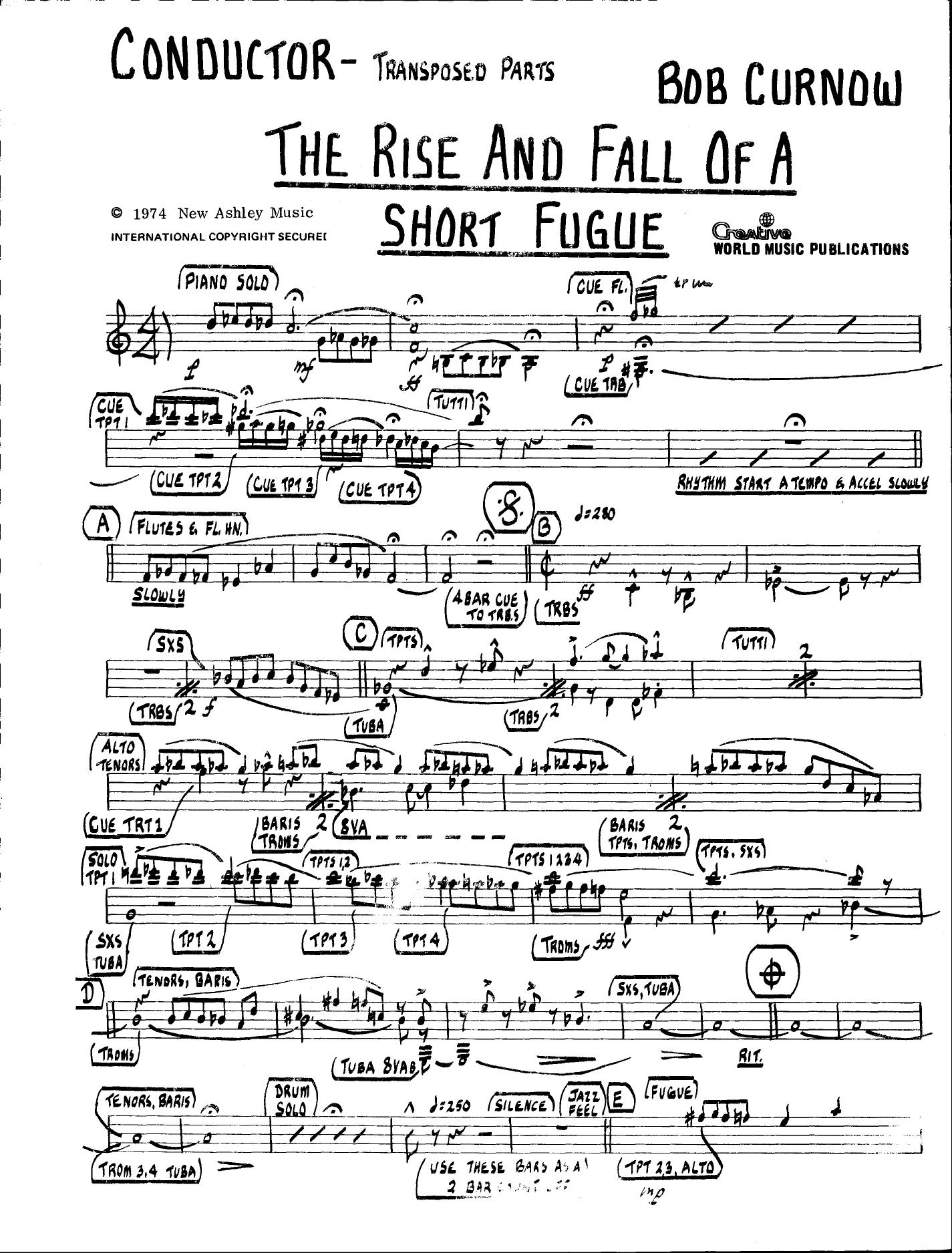
The Rise And Fall Of A Short Fugue (B.Curnow) sheet music preview

The Rise And Fall Of A Short Fugue (B.Curnow)

Composed by Bob Curnow

Arranged by Bob Curnow

  • Ensemble: Big Band
  • Pages: 48
  • Instruments (21): Conductor, 1st Alto Sax, 2nd Alto Sax, 1st Tenor Sax, 2nd Tenor Sax, 4th Tenor Sax, 1st Baritone Sax, 2nd Baritone Sax, 1st Trumpet, 2nd Trumpet, 3rd Trumpet, 4th Trumpet, 5th Trumpet, 1st Trombone, 2nd Trombone, 3rd Trombone, 4th Trombone, Tuba, Bass, Drums, Piano
  • Difficulty: medium
  • Content: Individual Parts
  • Format: PDF Download (Instant)
  • Price: $24.99

Originally composed and recorded for the landmark 1974 album *Stan Kenton Plays Chicago*, "The Rise And Fall Of A Short Fugue" represents the sophisticated, forward-thinking era of modern progressive big band jazz. Stan Kenton specifically commissioned Bob Curnow to write an original work that could be interpreted dynamically and differently during every performance. Standing out as a rare, highly inventive original composition within an album largely dedicated to contemporary pop-rock covers, the chart blends rigorous classical contrapuntal forms with a distinctly aggressive, modern big band attitude. Built upon an intriguing "tone row" style jazz line, the musical character shifts fluidly between strict structural counterpoint and expansive, free-form improvisational expanses. The piece opens with driving tension and cerebral precision, steadily evolving into an intense sonic landscape characterized by dense chromatic harmonies, shifting textures, and high-octane ensemble power. The emotional arc ranges from academic introspection to sheer, roaring exhilaration, demanding intense focus and profound dynamic control from every section of the orchestra. Curnow’s signature arranging approach shines through his masterful handling of complex voice-leading, intricate polyphony, and modern harmonic extensions reminiscent of the classic Kenton school of writers. Rather than treating the fugal subject as a rigid academic exercise, Curnow weaves the theme dynamically through the ensemble, utilizing interlocking woodwind lines and block-voiced brass explosions that challenge traditional jazz boundaries. The transitions between the tightly wound contrapuntal sections and the wide-open, free-form blowing spaces showcase a brilliant structural architecture. Throughout the 48-page publication—which includes the complete conductor score and 19 individual instrumental parts—responsibility for the thematic material is shared fluidly across the entire ensemble. The chart features demanding solo spaces designed to test advanced improvisers, while the rhythm section must maintain an unyielding, elastic groove beneath shifting meters and complex metric modulations. Because of its demanding technical hurdles, intricate ensemble interplay, and advanced harmonic language, this arrangement is ideally suited for elite university jazz ensembles, professional repertory bands, and advanced community big bands looking to push their technical and artistic limits. Navigating "The Rise And Fall Of A Short Fugue" requires absolute precision in both execution and stylistic interpretation. Conductor and ensemble alike must treat the foundational fugal lines with pristine articulation, ensuring that every voice in the counterpoint remains clearly audible before opening up into the freer, more expressive sections. - **Tempo & Feel:** Establish a rock-solid, driving pulse from the outset. While the piece explores abstract harmonic territory, rhythmic stability is critical during the transition from strict contrapuntal statements into free-form expanses. - **Technical Challenges:** The primary hurdle lies in the execution of the chromatic, tone-row-inspired thematic material across all horn sections. Saxophones and brass must practice their interlocking lines slowly with a metronome, matching vibrato and articulation styles meticulously. - **Dynamics & Articulation:** Balance is paramount; inner voices carrying sub-motifs must project through dense brass clusters without forcing tone quality. Pay close attention to sudden dynamic shifts, utilizing clean, clipped staccatos and controlled crescendos to outline the "rise and fall" narrative. - **Rehearsal Strategy:** Isolate the contrapuntal sections first, having sections rehearse their fugue entries independently before integrating the rhythm section. Ensure the drummer maintains a subtle yet supportive dialogue that anchors the ensemble during unmeasured or open-feeling transitional passages. Q: What instruments and parts are included in this publication? A: This arrangement includes 19 individual instrumental parts and a full conductor score, spanning a total of 48 pages to accommodate a standard contemporary big band instrumentation. Q: What is the difficulty level of this arrangement? A: This piece is graded as advanced (Grade 5/6), making it appropriate for skilled university ensembles, professional big bands, and advanced community jazz orchestras. Q: What is the style and historical context of the piece? A: Composed by Bob Curnow, it was originally recorded by the Stan Kenton Orchestra on their 1974 album *Stan Kenton Plays Chicago* as a unique exploration of classical fugal counterpoint merged with modern progressive jazz. Q: What makes this specific arrangement unique? A: It uniquely fuses a strict, tone-row-based fugal style with wide-open free-form jazz sections, offering a rare blend of classical architectural rigor and aggressive big band improvisation. Q: What is the performance duration and tempo approach? A: While performance duration can vary based on the length of open solo sections, the piece requires a sustained, driving tempo feel that anchors its complex metric and harmonic shifts.

Questions and answers

What is included in the The Rise And Fall Of A Short Fugue (B.Curnow) PDF?
The verified current file contains a conductor score and individual parts across 48 pages.
How many instruments or parts are listed for The Rise And Fall Of A Short Fugue (B.Curnow)?
The verified instrumentation list contains 21 entries for this Big Band arrangement.
Who is credited for The Rise And Fall Of A Short Fugue (B.Curnow)?
Composer: Bob Curnow. Arranger: Bob Curnow.
What difficulty is listed for The Rise And Fall Of A Short Fugue (B.Curnow)?
The verified difficulty level is medium.
Can I preview The Rise And Fall Of A Short Fugue (B.Curnow) before buying?
Yes. The product page provides a preview generated from the current PDF file.
How is The Rise And Fall Of A Short Fugue (B.Curnow) delivered?
After successful payment, the digital PDF is made available for download. The displayed price is $24.99.

Musicians Also Search For

The Rise And Fall Of A Short Fugue Bob Curnow PDFThe Rise And Fall Of A Short Fugue Bob Curnow sheet musicThe Rise And Fall Of A Short Fugue arranged by Bob CurnowBob Curnow big band chartsBob Curnow jazz arrangements PDFThe Rise And Fall Of A Short Fugue Bob Curnow big band arrangementsThe Rise And Fall Of A Short Fugue big band arrangementsThe Rise And Fall Of A Short Fugue big band PDF downloadThe Rise And Fall Of A Short Fugue jazz sheet musicbig band sheet music downloadThe Rise And Fall Of A Short Fugue conductor score PDFThe Rise And Fall Of A Short Fugue individual parts downloadThe Rise And Fall Of A Short Fugue sheet music PDFbuy The Rise And Fall Of A Short Fugue sheet musicdownload The Rise And Fall Of A Short Fugue PDFThe Rise And Fall Of A Short Fugue jazz chartsbest Bob Curnow big band arrangementsThe Rise And Fall Of A Short Fugue printable sheet musicbig band repertoire PDF

All arrangements by Bob Curnow All Bob Curnow sheet music