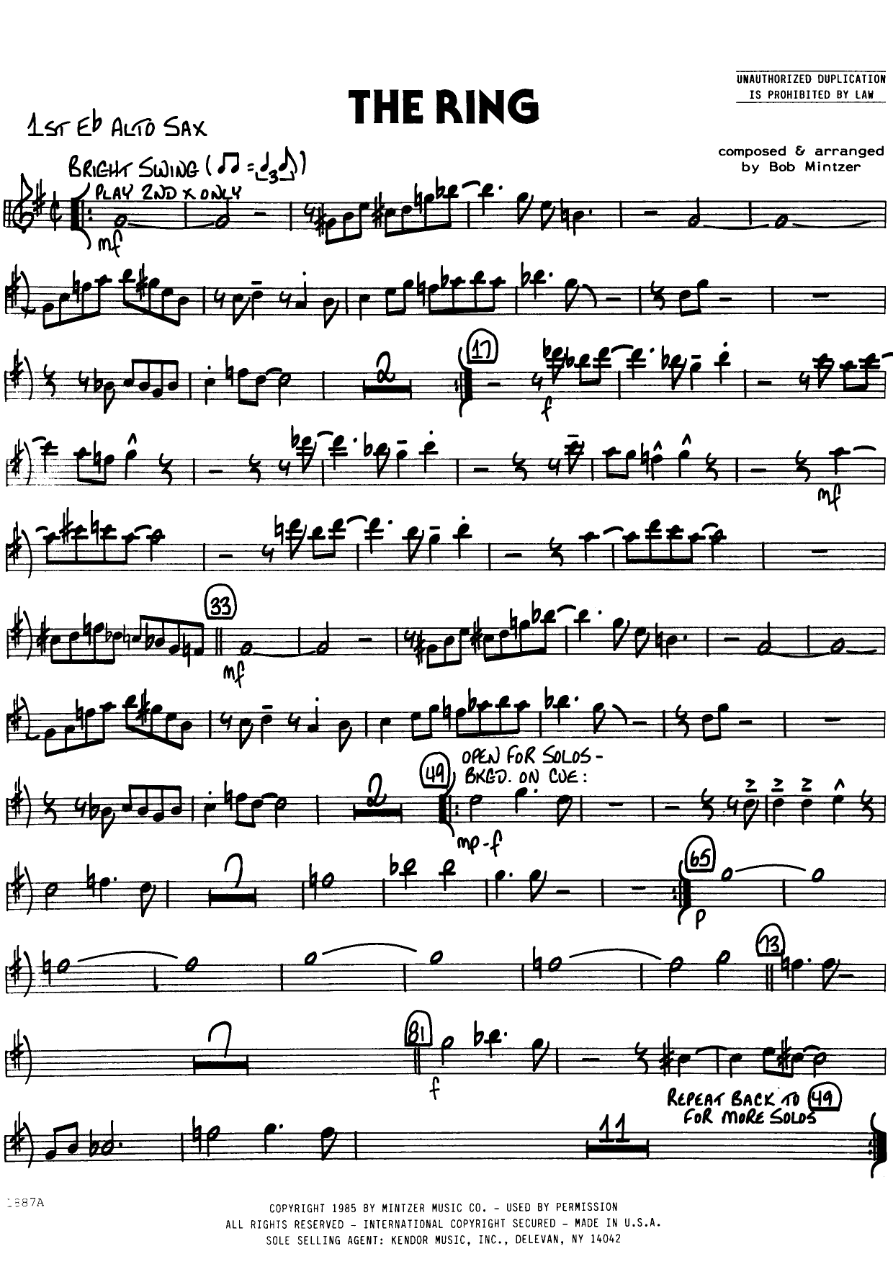
The Ring (B.Mintzer) sheet music preview

The Ring (B.Mintzer)

Composed by Bob Mintzer

Arranged by Bob Mintzer

  • Ensemble: Big Band
  • Style: Jazz Standard
  • Pages: 33
  • Instruments (16): 1st Eb Alto Sax, 2nd Eb Alto Sax, 1st Bb Tenor Sax, 2nd Bb Tenor Sax, Eb Baritone Sax, 1st Bb Trumpet, 2nd Bb Trumpet, 3rd Bb Trumpet, 4th Bb Trumpet, 1st Trombone, 2nd Trombone, 3rd Trombone, 4th Trombone, Piano, Bass, Drums
  • Difficulty: medium
  • Content: Individual Parts
  • Format: PDF Download (Instant)
  • Price: $24.99

"The Ring," a compelling original composition by the prolific saxophonist, composer, and arranger Bob Mintzer, stands as a testament to contemporary big band writing, firmly rooted in the post-bop tradition. While not a traditional "jazz standard" in the sense of a tune from the Great American Songbook, Mintzer's compositions, including "The Ring," have become modern standards within the big band repertoire, frequently performed and studied by ensembles worldwide. Composed and recorded by Mintzer, this piece exemplifies the sophisticated harmonic and rhythmic language that defined much of the jazz landscape from the late 20th century into the present day. It embodies the evolution of big band jazz, moving beyond the swing era into a more complex, yet always grooving, contemporary sound. Musically, "The Ring" typically unfolds with a medium-up swing feel, often settling into a comfortable yet energetic tempo around 160-180 BPM in 4/4 time. The piece is characterized by its driving rhythmic pulse, intricate melodic lines, and rich, often dense, harmonic voicings. While the specific key can vary slightly depending on the arrangement, Mintzer frequently employs keys that allow for both accessible and challenging melodic and harmonic exploration. The mood is generally exhilarating and sophisticated, evoking a sense of forward motion and intellectual engagement, punctuated by moments of dynamic contrast and powerful ensemble statements. It’s a piece that demands precision and rhythmic acuity from every section. Bob Mintzer's approach to arranging his own compositions is always distinctive and deeply informed by his experience as a performer and bandleader. In "The Ring," expect his signature blend of tight, driving ensemble figures, often featuring complex contrapuntal lines and extended harmonies that push the boundaries of traditional big band voicings. Soli sections are meticulously crafted, showcasing the saxophone section's agility and blend, while brass sections contribute powerful, often angular, statements. Mintzer's arrangements frequently feature a dynamic interplay between sections, building tension and release through carefully orchestrated shout choruses and sudden shifts in texture. His writing is known for its clarity, even amidst complexity, ensuring that each part contributes meaningfully to the overall tapestry of sound. Performance of "The Ring" typically features the melody introduced by the saxophone section, often doubled or reinforced by brass, establishing the piece's primary thematic material. There are usually ample opportunities for featured solos, most commonly for tenor saxophone and trumpet, allowing soloists to navigate Mintzer's sophisticated chord changes. Technical challenges include navigating fast, intricate melodic passages, maintaining precise rhythmic alignment within complex ensemble figures, and executing dynamic contrasts effectively. The rewarding aspect lies in the sheer power and intellectual satisfaction of performing a well-crafted, contemporary big band chart that truly grooves. This arrangement is ideally suited for college-level big bands, advanced community ensembles, and professional groups capable of tackling challenging rhythmic and harmonic material with precision and stylistic authenticity. High school bands with exceptionally strong sections and a dedicated director might attempt it, but it generally requires a higher level of individual musicianship and ensemble cohesion. Conductors should emphasize rhythmic precision and articulation from the outset, particularly in the intricate ensemble passages and soli sections. The medium-up swing feel requires a consistent, driving pulse without rushing, with particular attention to the eighth-note subdivision. Brass players should focus on clean attacks and releases, especially in unison or octave lines, while the saxophone section must strive for impeccable blend and balance in the often-complex soli voicings. There are no specific extended techniques like plunger mutes or falls noted in the typical performance of "The Ring," but dynamic shaping is crucial for building tension and release. Rehearsal time should be dedicated to isolating challenging rhythmic figures, ensuring all sections are locked into the groove, and carefully balancing the layered harmonies. Encourage soloists to deeply understand the underlying harmonic structure to improvise effectively over Mintzer's sophisticated changes. Q: What instruments and parts are included in this arrangement of "The Ring"? A: This arrangement is scored for a standard 16-instrument big band, including Alto Saxophone 1, Alto Saxophone 2, Tenor Saxophone 1, Tenor Saxophone 2, Baritone Saxophone, Trumpet 1, Trumpet 2, Trumpet 3, Trumpet 4, Trombone 1, Trombone 2, Trombone 3, Bass Trombone, Piano, Bass, and Drums. Q: What is the difficulty level of this arrangement? A: This arrangement is considered advanced, suitable for college-level big bands, advanced community ensembles, and professional groups. It requires strong individual musicianship, precise rhythmic execution, and a solid understanding of contemporary jazz harmony. Q: What is the musical style and historical context of "The Ring"? A: "The Ring" is an original composition by Bob Mintzer, falling into the contemporary jazz big band style. It reflects the post-bop era's harmonic and rhythmic complexity, showcasing Mintzer's distinctive voice as a composer and arranger within the modern big band tradition. Q: What makes Bob Mintzer's arrangement of "The Ring" unique? A: Mintzer's arrangement is characterized by its intricate melodic lines, sophisticated harmonic voicings, driving rhythmic energy, and expertly crafted soli sections. It features his signature blend of contemporary jazz language with powerful, tightly-voiced ensemble writing. Q: What is the typical performance duration and tempo for "The Ring"? A: While variable depending on solos, "The Ring" typically has a performance duration of approximately 5-7 minutes. It is usually performed at a medium-up swing tempo, often in the range of 160-180 beats per minute.

Questions and answers

What is included in the The Ring (B.Mintzer) PDF?
The verified current file contains individual parts across 33 pages.
How many instruments or parts are listed for The Ring (B.Mintzer)?
The verified instrumentation list contains 16 entries for this Big Band arrangement.
Who is credited for The Ring (B.Mintzer)?
Composer: Bob Mintzer. Arranger: Bob Mintzer.
What difficulty is listed for The Ring (B.Mintzer)?
The verified difficulty level is medium.
What style is listed for The Ring (B.Mintzer)?
The catalog lists the style as Jazz Standard.
Can I preview The Ring (B.Mintzer) before buying?
Yes. The product page provides a preview generated from the current PDF file.
How is The Ring (B.Mintzer) delivered?
After successful payment, the digital PDF is made available for download. The displayed price is $24.99.

Musicians Also Search For

The Ring Bob Mintzer PDFThe Ring Bob Mintzer sheet musicThe Ring arranged by Bob MintzerBob Mintzer big band chartsBob Mintzer jazz arrangements PDFThe Ring Bob Mintzer big band arrangementsThe Ring big band arrangementsThe Ring big band PDF downloadThe Ring jazz sheet musicbig band sheet music downloadThe Ring individual parts downloadThe Ring sheet music PDFThe Ring Jazz Standard chartsJazz Standard big band arrangementsbuy The Ring sheet musicdownload The Ring PDFThe Ring jazz chartsbest Bob Mintzer big band arrangementsThe Ring printable sheet musicbig band repertoire PDF

All arrangements by Bob Mintzer All Bob Mintzer sheet music