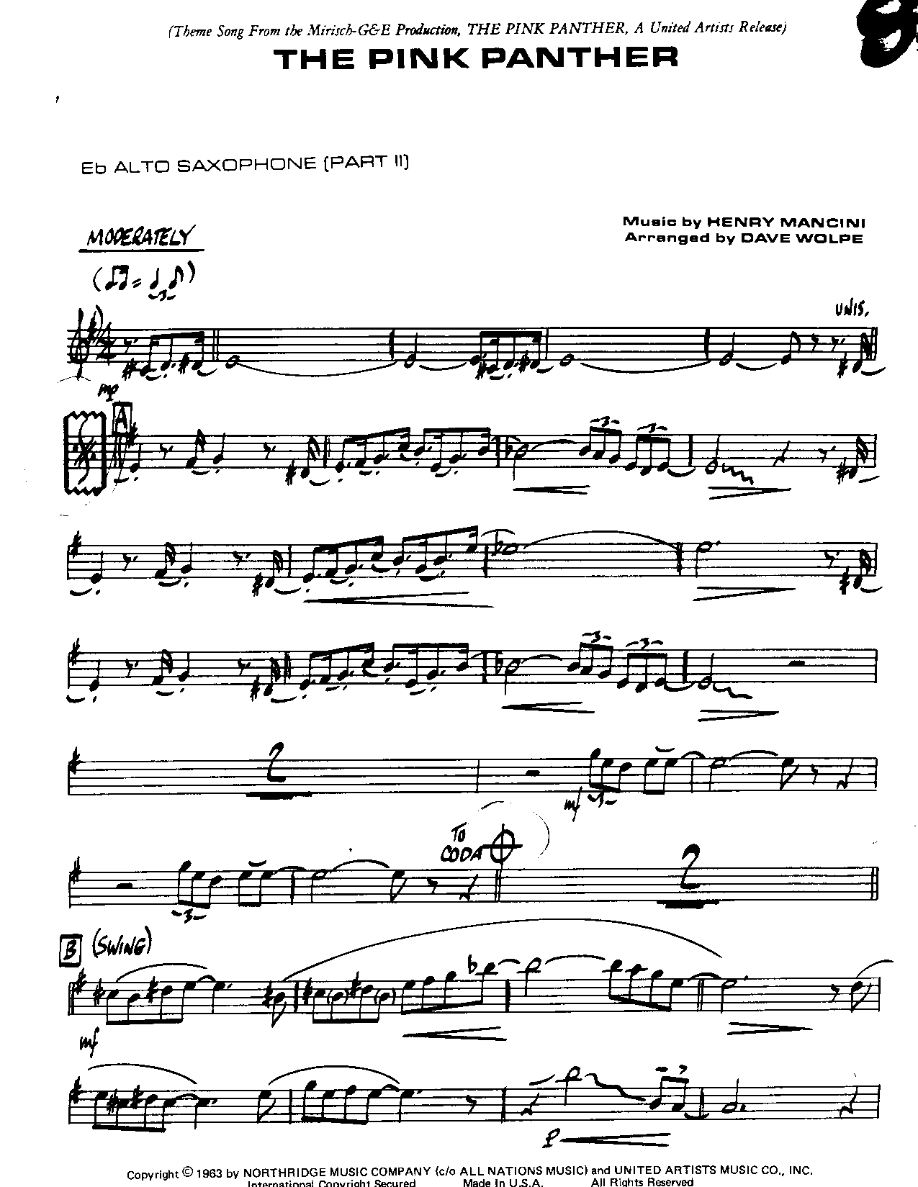
The Pink Panther (D.Wolpe)
Composed by Henry Mancini
Arranged by Dave Wolpe
- Ensemble: Small Ensemble
- Style: Film Music
- Pages: 17
- Instruments (7): Eb Alto Saxophone (Part II), Bb Tenor Saxophone (Part III), Bb Trumpet (Part I), Trombone (Part IV), Piano, Bass, Drums
- Difficulty: easy
- Content: Individual Parts
- Format: PDF Download (Instant)
- Price: $12.99
Henry Mancini’s iconic "The Pink Panther Theme," composed for the 1963 film of the same name, stands as a timeless masterpiece of film music and a widely recognized jazz standard. This piece, which earned an Academy Award nomination for Best Original Score and a Grammy Award, is instantly identifiable by its slinky, sophisticated melody and cool, understated groove. It embodies the smooth, lounge-jazz aesthetic prevalent in the early 1960s, a sound that Mancini himself largely popularized through his extensive film and television work. The original recording featured the distinctive tenor saxophone of Plas Johnson, whose performance became synonymous with the theme's playful yet mysterious character. The composition is rooted in a minor key, often E minor or D minor, and is characterized by its memorable ostinato bass line, chromatic embellishments, and a pervasive syncopated rhythm that drives its medium swing feel. Dave Wolpe’s arrangement of "The Pink Panther" for small ensemble masterfully captures the essence of Mancini’s original while adapting it for a versatile jazz ensemble setting. Wolpe, a prolific and highly respected arranger known for his ability to craft charts that are both accessible and musically rich, retains the signature medium swing tempo and the original's cool, slightly mischievous mood. His approach often involves clear melodic statements, well-voiced harmonies, and strategically placed ensemble sections that build excitement without overcomplicating the material. This arrangement features the instantly recognizable melody carried primarily by the saxophone section, often with a lead alto or tenor saxophone taking the initial statement, evoking the original's iconic solo. This arrangement is designed to be rewarding for musicians while presenting manageable technical challenges. Wolpe's charts are celebrated for their thoughtful construction, which allows bands to sound professional and polished. Expect well-crafted soli sections for the saxophones and brass, providing opportunities for each section to shine. While there are no extended open solo sections, the arrangement often incorporates improvised fills or short, written solos that maintain the piece's flow and character. The primary challenge lies in maintaining the precise, laid-back swing feel and executing the dynamic nuances that contribute to the piece's cool demeanor. The arrangement's clarity and engaging musical moments make it a joy to perform, allowing musicians to immerse themselves in its classic film noir atmosphere. This small ensemble arrangement is particularly suitable for high school, college, and community jazz ensembles. Its Grade 3 (Medium) difficulty rating indicates that it offers enough musical substance to engage developing musicians while remaining within their technical grasp. The clear voicings and rhythmic consistency typical of Wolpe’s work provide an excellent learning opportunity for understanding ensemble balance, blend, and articulation in a jazz context. Bands will find it an excellent addition to their repertoire for concerts, festivals, or any performance requiring a touch of classic Hollywood cool. Conductors should emphasize a consistent, laid-back medium swing feel from the rhythm section, ensuring the bass line maintains its characteristic ostinato pattern and the drums provide a subtle, driving pulse. Articulation is key; encourage saxophones to play the melody with a smooth, slightly detached legato, while brass accents should be crisp but not overly aggressive. Dynamic contrast is crucial to conveying the piece's mysterious and playful mood, so rehearse crescendos and diminuendos carefully, particularly in the ensemble sections. The iconic main melody should be played with a sense of understated cool, avoiding excessive vibrato. While no special techniques like plunger mutes are explicitly required, a tasteful use of falls or scoops, especially in the brass, can enhance the jazz idiom. Rehearsal time should focus on rhythmic precision in the syncopated figures and achieving a unified ensemble sound, especially during the sax soli and brass shout chorus passages. Q: What instruments are included in this arrangement? A: This arrangement is for a standard jazz small ensemble, typically including five saxophones (2 altos, 2 tenors, 1 baritone), four trumpets, four trombones (including bass trombone), and a rhythm section (piano, bass, drums, guitar). Q: What is the difficulty level of this arrangement? A: This arrangement is rated Grade 3 (Medium), making it appropriate for high school, college, and community jazz ensembles. It presents engaging musical challenges without being overly technical. Q: What musical style and historical context does this arrangement represent? A: This arrangement is in the Film Music style, specifically drawing from the cool jazz and lounge aesthetic popularized by Henry Mancini in the early 1960s. It captures the sophisticated and slightly mysterious mood of the original "Pink Panther Theme." Q: What makes Dave Wolpe's arrangement of "The Pink Panther" unique? A: Dave Wolpe's arrangement is known for its faithful adaptation of Mancini's original, featuring well-voiced ensemble sections, clear melodic statements, and a focus on maintaining the iconic medium swing feel and mood. It provides a polished, accessible version for jazz ensembles. Q: What is the typical performance duration or tempo for this piece? A: The piece is typically performed at a medium swing tempo, around 118 BPM, and its duration generally falls within the 2:30 to 3:00 minute range, consistent with the original recording.
Questions and answers
- What is included in the The Pink Panther (D.Wolpe) PDF?
- The verified current file contains individual parts across 17 pages.
- How many instruments or parts are listed for The Pink Panther (D.Wolpe)?
- The verified instrumentation list contains 7 entries for this Small Ensemble arrangement.
- Who is credited for The Pink Panther (D.Wolpe)?
- Composer: Henry Mancini. Arranger: Dave Wolpe.
- What difficulty is listed for The Pink Panther (D.Wolpe)?
- The verified difficulty level is easy.
- What style is listed for The Pink Panther (D.Wolpe)?
- The catalog lists the style as Film Music.
- Can I preview The Pink Panther (D.Wolpe) before buying?
- Yes. The product page provides a preview generated from the current PDF file.
- How is The Pink Panther (D.Wolpe) delivered?
- After successful payment, the digital PDF is made available for download. The displayed price is $12.99.
Musicians Also Search For
The Pink Panther Dave Wolpe PDF • The Pink Panther Dave Wolpe sheet music • The Pink Panther arranged by Dave Wolpe • Dave Wolpe small ensemble charts • Dave Wolpe jazz arrangements PDF • The Pink Panther Henry Mancini sheet music • The Pink Panther Henry Mancini small ensemble arrangements • Henry Mancini small ensemble charts • The Pink Panther small ensemble arrangements • The Pink Panther small ensemble PDF download • The Pink Panther jazz sheet music • small ensemble sheet music download • The Pink Panther individual parts download • The Pink Panther sheet music PDF • The Pink Panther Film Music charts • Film Music small ensemble arrangements • buy The Pink Panther sheet music • download The Pink Panther PDF • The Pink Panther jazz charts • best Dave Wolpe small ensemble arrangements • Henry Mancini arranged by Dave Wolpe • The Pink Panther printable sheet music • small ensemble repertoire PDF