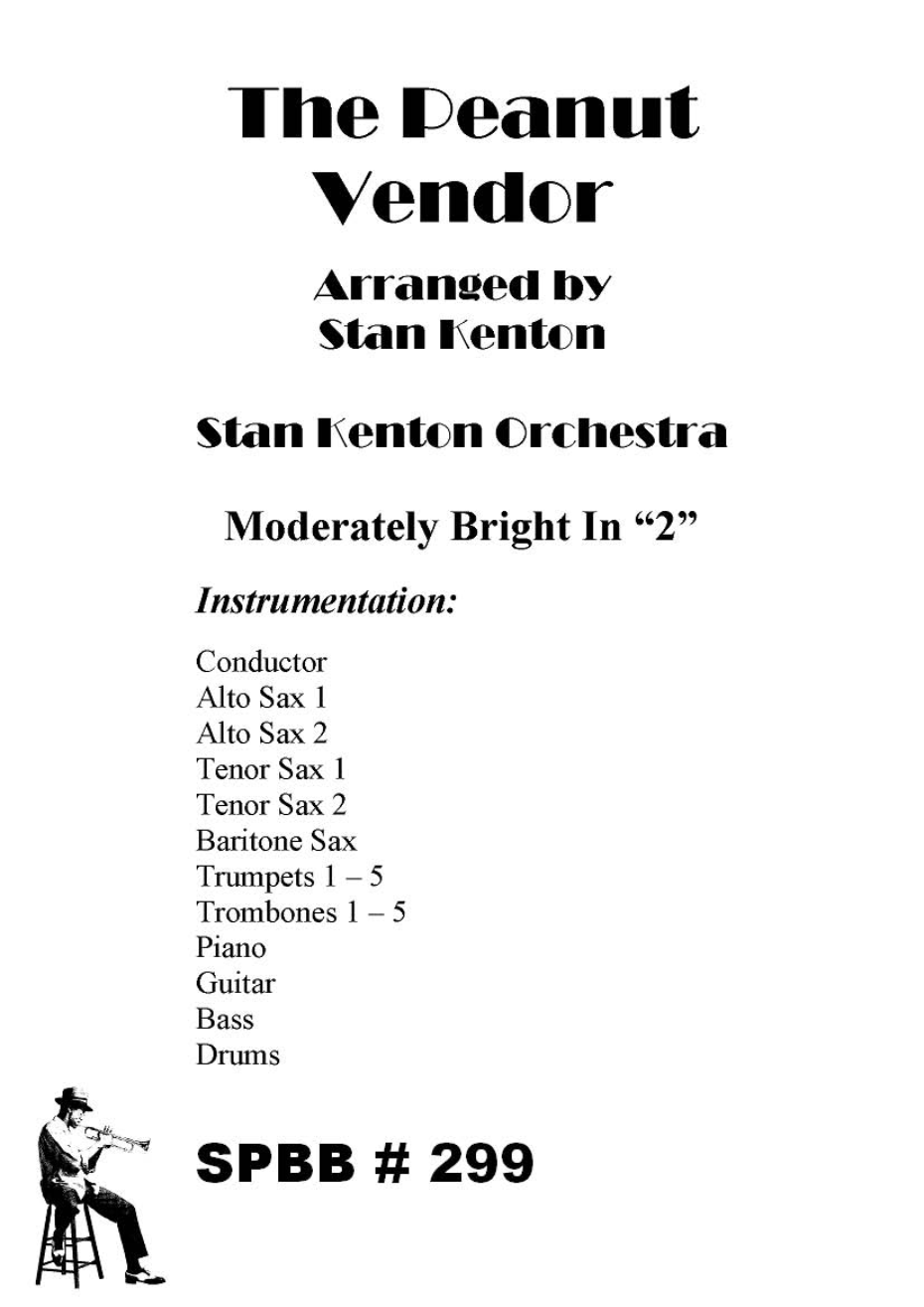
The Peanut Vendor (S.Kenton)
Composed by Stan Kenton
Arranged by Stan Kenton
- Ensemble: Big Band
- Pages: 54
- Instruments (20): Conductor, 1st Eb Alto Saxophone, 2nd Eb Alto Saxophone, 1st Bb Tenor Saxophone, 2nd Bb Tenor Saxophone, Eb Baritone Saxophone, 1st Bb Trumpet, 2nd Bb Trumpet, 3rd Bb Trumpet, 4th Bb Trumpet, 5th Bb Trumpet, 1st Trombone, 2nd Trombone, 3rd Trombone, 4th Trombone, Bass Trombone, Piano, Guitar, Bass, Drums
- Difficulty: advanced
- Content: Individual Parts
- Format: PDF Download (Instant)
- Price: $24.99
Moises Simons’ classic Cuban tune "The Peanut Vendor" ("El Manisero") underwent a radical transformation when Stan Kenton and his innovative orchestra re-imagined it as an explosive, high-octane modern jazz powerhouse. First popularized during the 1930s rumba craze, the melody found new life in the Kenton library through a series of iconic arrangements that fused Afro-Cuban percussion concepts with the colossal, brass-heavy vocabulary of progressive jazz. This enduring chart stands as a monument to the modernist big band movement of the mid-20th century, capturing the restless experimentation and sheer sonic architecture that defined the Kenton sound. Driven by an infectious, relentless Afro-Cuban clave and driving Latin-jazz groove, this chart operates at a brisk, high-energy tempo that demands absolute rhythmic precision from every section. The mood is electric, theatrical, and intense, moving seamlessly from tense, simmering rhythmic vamp sections to thunderous, wall-of-sound climaxes. The harmonic language is rich with extended and altered dominants, signature Kenton polychords, and dense vertical voicings that maximize the tension and release inherent in the melody. It evokes an atmosphere of high-stakes theatricality and visceral excitement, pushing the ensemble to play with maximum projection and unwavering pulse. Kenton’s signature approach is stamped all over the arrangement through his utilization of massive brass block voicings, aggressive dynamic contrasts, and a towering, tectonic shout chorus that redefines big band power. Rather than relying on a traditional lightweight Latin feel, this treatment treats the rhythm with the weight and aggression of modern orchestral jazz. The saxophones weave angular, interlocking counterlines beneath the brass declarations, while the rhythm section—anchored by an assertive auxiliary percussion setup—drives the syncopated figures forward. Solos emerge from the texture as extensions of the arrangement's overarching dramatic arc, serving as focal points for improvisers to ride the crest of the ensemble's massive momentum. Carrying the iconic, winding melody requires immaculate articulation and stylistic unity, particularly within the reed and trumpet sections. Technical challenges abound in the extreme upper register demands for the brass, rapid-fire syncopated figures shared across the ensemble, and the stamina required to sustain high-energy playing over the duration of the chart. The rewards, however, are immense: audiences are consistently captivated by the sheer kinetic force of the performance, and musicians experience the thrill of mastering one of the most demanding yet exhilarating blueprints in the progressive jazz canon. Advanced collegiate, top-tier high school, and professional big bands will find this 54-page, 9-instrument arrangement an ideal vehicle for stretching their technical boundaries. Because of its demanding brass ranges, complex metric integration, and requirement for mature stylistic cohesion, it rewards groups that possess seasoned section players and a powerhouse lead trumpet. Mastering this arrangement requires acute attention to rhythmic placement and endurance. The tempo must remain rock-solid; avoid the common trap of rushing during the dynamic crescendos. The percussion and rhythm section must lock into an unyielding Afro-Cuban groove, treating the quarter notes with an aggressive, driving intensity rather than a laid-back swing feel. Brass players should focus on controlled projection, ensuring that the high-register passages are full-toned rather than forced or pinched. Articulations must be crisp and uniform across all sections—short notes must truly speak with a dry, punchy edge, while accented lines require a heavy, deliberate tongue. Rehearsals should begin under tempo, isolating the complex cross-rhythms between the rhythm section and horns before integrating them at performance speed. Pay close attention to dynamic markings; the contrast between the hushed, suspenseful vamps and the explosive, fortissimo shout choruses is what gives this arrangement its dramatic narrative power. Q: What instruments and parts are included in this 54-page publication? A: This arrangement is scored for a 9-instrument configuration that features Alto Saxophone, Tenor Saxophone, Baritone Saxophone, Trumpet, and Trombone parts, alongside a complete rhythm section framework designed to support the Kenton big band style. Q: What is the difficulty level of this arrangement? A: This chart is intended for advanced collegiate, professional, and elite high school jazz ensembles due to its demanding brass ranges, complex syncopation, and requirement for high physical stamina. Q: What is the historical style and context of this version? A: This arrangement reimagines Moises Simons' 1930s Cuban standard through Stan Kenton's progressive jazz lens, blending traditional Afro-Cuban rhythmic elements with massive, modern orchestral big band harmonies from the mid-20th century. Q: What makes this specific Stan Kenton arrangement unique? A: It distinguishes itself through towering, dense vertical brass voicings, aggressive dynamic shifts, and a massive tectonic shout chorus that transforms a traditional Latin dance tune into a powerhouse of progressive jazz architecture. Q: What is the expected performance tempo and duration of the piece? A: The arrangement is performed at a brisk, high-energy Latin-jazz tempo that demands a relentless groove, with a total duration typically spanning between 4 to 5 minutes depending on the length of the improvised solos.
Questions and answers
- What is included in the The Peanut Vendor (S.Kenton) PDF?
- The verified current file contains a conductor score and individual parts across 54 pages.
- How many instruments or parts are listed for The Peanut Vendor (S.Kenton)?
- The verified instrumentation list contains 20 entries for this Big Band arrangement.
- Who is credited for The Peanut Vendor (S.Kenton)?
- Composer: Stan Kenton. Arranger: Stan Kenton.
- What difficulty is listed for The Peanut Vendor (S.Kenton)?
- The verified difficulty level is advanced.
- Can I preview The Peanut Vendor (S.Kenton) before buying?
- Yes. The product page provides a preview generated from the current PDF file.
- How is The Peanut Vendor (S.Kenton) delivered?
- After successful payment, the digital PDF is made available for download. The displayed price is $24.99.
Musicians Also Search For
The Peanut Vendor Stan Kenton PDF • The Peanut Vendor Stan Kenton sheet music • The Peanut Vendor arranged by Stan Kenton • Stan Kenton big band charts • Stan Kenton jazz arrangements PDF • The Peanut Vendor Stan Kenton big band arrangements • The Peanut Vendor big band arrangements • The Peanut Vendor big band PDF download • The Peanut Vendor jazz sheet music • big band sheet music download • The Peanut Vendor conductor score PDF • The Peanut Vendor individual parts download • The Peanut Vendor sheet music PDF • buy The Peanut Vendor sheet music • download The Peanut Vendor PDF • The Peanut Vendor jazz charts • best Stan Kenton big band arrangements • The Peanut Vendor printable sheet music • big band repertoire PDF