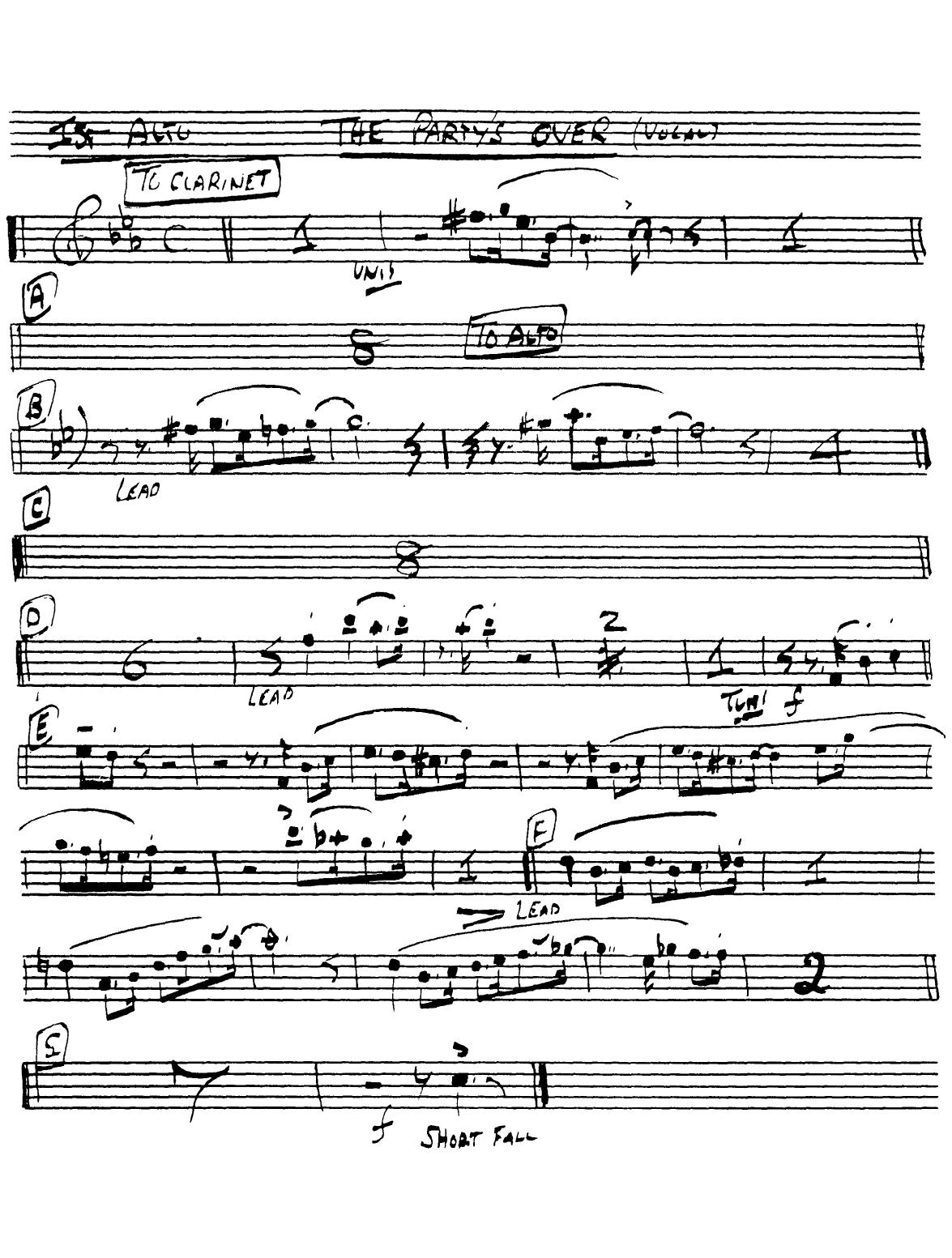
The Party's Over (J.Farley)
Composed by Jule Styne
Arranged by John Farley
- Ensemble: Big Band
- Pages: 19
- Instruments (17): 1st Alto Saxophone (doubles Clarinet), 2nd Alto Saxophone, 1st Tenor Saxophone (doubles Flute), 2nd Tenor Saxophone, Baritone Saxophone, 1st Trumpet, 2nd Trumpet, 3rd Trumpet, 4th Trumpet, 1st Trombone, 2nd Trombone, 3rd Trombone, 4th Bass Trombone, Piano, Bass, Drums, Vocal
- Difficulty: easy
- Content: Individual Parts
- Format: PDF Download (Instant)
- Price: $24.99
Jule Styne and lyricist Betty Comden originally crafted "The Party’s Over" for the 1956 Broadway musical *Bells Are Ringing*, where it was immortalized by Judy Holliday. It rapidly crossed over into the mandatory jazz and Great American Songbook canon, receiving definitive treatments from vocal giants like Sarah Vaughan, Lambert, Hendricks & Ross, and instrumental masters alike. The tune captures a poignant, bittersweet emotional landscape—that inevitable melancholy when the lights come up, the laughter fades, and the reality of solitude sets in. John Farley’s sophisticated big band interpretation transforms this theatrical lament into a deeply expressive late-night jazz ballad. Set in a relaxed, rubato-leaning 4/4 feel that settles into a spacious, deep-pocket half-time swing, the arrangement explores lush, extended harmonies and rich chord voicings. Farley utilizes dense chromatic mediants and shifting modal colors to heighten the harmonic tension, perfectly mirroring the text's underlying heartache. The mood shifts masterfully from introspective quietude to soaring, cinematic peaks without ever losing its intimate core. The 17-instrument configuration is deployed with exquisite textural variety, avoiding static block-chord writing in favor of contrapuntal lines and shifting instrumental pairings. The woodwinds open with a delicate, exposed clarinet-led voicing before handing the primary melodic weight to a smoky tenor saxophone soloist. The brass section is scored with immense sensitivity, utilizing warm flugelhorn tones and muted trumpet colors in the early choruses to preserve the nocturnal atmosphere. A towering, cascading shout chorus builds organically out of a subdued developmental bridge, showcasing Farley’s knack for dynamic pacing before dissolving back into a hushed, breath-with-the-soloist coda. Advanced high school ensembles with mature sections, collegiate jazz orchestras, and professional big bands will find this chart an exceptional vehicle for developing ensemble blend, intonation, and emotional restraint. The technical demands lie not in blazing tempos or extreme altissimo registers, but rather in the realm of stylistic maturity—sustaining long, arching phrases, maintaining immaculate balance during exposed chordal shifts, and communicating profound vulnerability. For audiences and performers alike, this arrangement offers a masterclass in mood-building and stands as a refreshing, sophisticated departure from standard up-tempo swinger setlists. Conductors should approach this chart with a focus on deep rhythmic elasticity and breath control. The tempo must feel unhurried, allowing the harmonic shifts to breathe; avoid any mechanical rigidity in the rhythm section. The primary technical challenge rests on the brass section: maintaining pristine intonation and a warm, velvety tone during high-register chord extensions at ultra-soft dynamics (ppp to mp). Saxophones should prioritize a homogeneous tone quality, especially during the quiet soli sections where individual timbres are exposed. Encourage the featured tenor soloist to lean heavily into rubato phrasing during the head, locking into a heavy, laid-back swing eighth-note feel only when the rhythm section thickens its accompaniment in the second chorus. No plunger mutes or unconventional special effects are required, but meticulous attention must be paid to subtle dynamic swells and seamless transitions between muted and open brass passages. Rehearsal time should be heavily invested in balancing the inner voices of the saxes and trombones so that the complex harmonic suspensions cut through without forcing the volume. Q: What instruments and parts are included in this 17-instrument big band arrangement? A: The instrumentation features a standard 17-piece big band lineup, including a dedicated clarinet part, alto saxophone, two tenor saxophones, baritone saxophone, standard brass writing, and a full rhythm section. Q: What is the overall difficulty level of John Farley's arrangement of "The Party's Over"? A: This chart is best suited for advanced high school, collegiate, and professional big bands due to its heavy demands on ensemble intonation, dynamic control, and stylistic maturity rather than sheer technical velocity. Q: What is the historical background and musical style of this piece? A: Originally written by Jule Styne for the 1956 Broadway production *Bells Are Ringing*, this arrangement adapts the classic standard into a lush, expressive jazz ballad with a deep-pocket half-time swing feel. Q: What makes this specific arrangement by John Farley unique? A: Farley’s chart stands out for its rich, chromatic extended harmonies, innovative woodwind voicings featuring an exposed clarinet, and a cinematic dynamic arc that builds from intimate quietude to a soaring shout chorus. Q: What is the performance duration and tempo framework of the arrangement? A: The arrangement is paced as a spacious, unhurried ballad played at a slow tempo feel in 4/4 time, typically clocking in at around 4 to 5 minutes depending on the length of the featured solo space.
Questions and answers
- What is included in the The Party's Over (J.Farley) PDF?
- The verified current file contains individual parts across 19 pages.
- How many instruments or parts are listed for The Party's Over (J.Farley)?
- The verified instrumentation list contains 17 entries for this Big Band arrangement.
- Who is credited for The Party's Over (J.Farley)?
- Composer: Jule Styne. Arranger: John Farley.
- What difficulty is listed for The Party's Over (J.Farley)?
- The verified difficulty level is easy.
- Can I preview The Party's Over (J.Farley) before buying?
- Yes. The product page provides a preview generated from the current PDF file.
- How is The Party's Over (J.Farley) delivered?
- After successful payment, the digital PDF is made available for download. The displayed price is $24.99.
Musicians Also Search For
The Party's Over John Farley PDF • The Party's Over John Farley sheet music • The Party's Over arranged by John Farley • John Farley big band charts • John Farley jazz arrangements PDF • The Party's Over Jule Styne sheet music • The Party's Over Jule Styne big band arrangements • Jule Styne big band charts • The Party's Over big band arrangements • The Party's Over big band PDF download • The Party's Over jazz sheet music • big band sheet music download • The Party's Over individual parts download • The Party's Over sheet music PDF • buy The Party's Over sheet music • download The Party's Over PDF • The Party's Over jazz charts • best John Farley big band arrangements • Jule Styne arranged by John Farley • The Party's Over printable sheet music • big band repertoire PDF