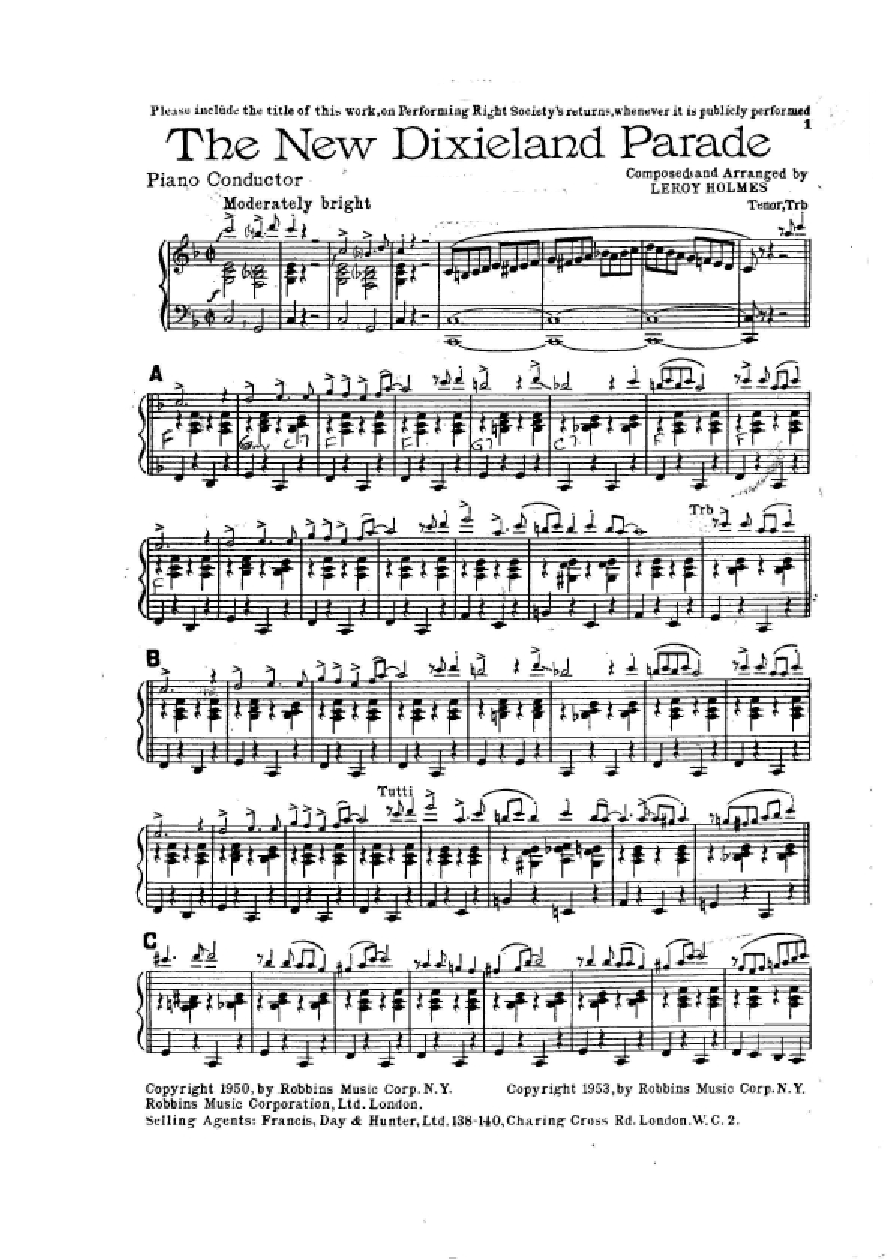
The New Dixieland Parade (L.Holmes) sheet music preview

The New Dixieland Parade (L.Holmes)

Composed by Leroy Holmes

Arranged by Leroy Holmes

  • Ensemble: Small Ensemble
  • Style: Dixieland
  • Pages: 14
  • Difficulty: easy
  • Content: Sheet Music
  • Format: PDF Download (Instant)
  • Price: $12.99

"The New Dixieland Parade," composed and arranged by the prolific Leroy Holmes, stands as a vibrant testament to the enduring appeal of traditional jazz. Dixieland, often referred to as "Traditional Jazz," originated in New Orleans around the turn of the 20th century, drawing influences from ragtime, blues, spirituals, and military marching bands. It gained widespread recognition in the 1910s and 1920s, largely popularized by groups like the Original Dixieland Jass Band, which made the first jazz recordings in 1917. Leroy Holmes, a distinguished American songwriter, composer, arranger, and conductor, was known for his versatile work across various genres, from lush orchestral arrangements to popular standards. His composition, "The New Dixieland Parade," reflects his deep understanding and appreciation for this foundational jazz style, ensuring its continued presence in contemporary repertoire. This arrangement captures the quintessential Dixieland spirit with an energetic, medium-up tempo two-beat feel, characteristic of the genre's parade-derived rhythms. The musical character is bright, celebratory, and infectious, evoking the joyous atmosphere of a New Orleans street parade. Harmonically, it adheres to the functional tonality typical of Dixieland, utilizing I-IV-V progressions with occasional secondary dominants, providing a familiar and accessible framework for improvisation. The piece is primarily in a major key, contributing to its uplifting and optimistic mood. The arrangement is designed to showcase the lively polyphony that defines Dixieland, where multiple instruments improvise simultaneously, creating a rich, layered sound that is both intricate and cohesive. Leroy Holmes's arranging approach for "The New Dixieland Parade" meticulously balances ensemble precision with the freedom of collective improvisation. While Holmes was renowned for his "lush orchestral interpretations" and "cinematic arrangements" in other contexts, here he masterfully channels the raw, spontaneous energy of Dixieland. The arrangement features a prominent "front line" of trumpet, clarinet, and trombone, each playing distinct, yet interwoven, roles. The trumpet typically carries the main melody, often with playful embellishments, while the clarinet weaves agile countermelodies in the upper register, and the trombone provides rhythmic and harmonic support with characteristic glissandi and "tailgate" figures. There are clearly delineated sections for both ensemble passages and featured solos, allowing individual musicians to shine within the collective framework. The arrangement includes dynamic shout choruses that build excitement and a strong, driving rhythmic foundation from the rhythm section, emphasizing the buoyant two-beat feel with parade-style drum patterns. Performing "The New Dixieland Parade" is a rewarding experience, offering both technical challenges and immense musical satisfaction. The collective improvisation demands keen listening and musical dialogue among the front-line players, fostering a sense of camaraderie and spontaneous creativity. Technical challenges include maintaining rhythmic precision in the two-beat feel, executing clean articulations typical of the style, and navigating the often-fast melodic lines in the clarinet and trumpet parts. The piece's inherent energy makes it an excellent choice for engaging audiences and is particularly suitable for high school, college, and community jazz ensembles looking to explore the roots of jazz. Its clear structure and authentic stylistic representation make it an invaluable educational tool and a crowd-pleasing performance piece. To capture the authentic spirit of "The New Dixieland Parade," conductors should emphasize a buoyant, driving two-beat feel, with a lightly swung eighth-note subdivision. The tempo should be medium-up, around quarter note = 180-200 BPM, to maintain the festive parade atmosphere. Key technical challenges include the collective improvisation sections for the front line (trumpet, clarinet, trombone), which require careful listening and melodic contouring to avoid clashing. Encourage players to stay within their typical Dixieland registers: trumpet on melody, clarinet weaving above, and trombone providing foundational counterpoint and glissandi. The rhythm section must establish a rock-solid two-beat foundation, with the bass or tuba articulating beats one and three clearly, and the drums incorporating press rolls and parade-derived figures. Articulation should be crisp and bright, with a focus on short, detached notes for rhythmic clarity. Special techniques, such as plunger mutes for brass and expressive falls or doits, can add authentic color. Rehearsal tips include isolating the collective improvisation sections, encouraging players to sing their lines, and focusing on dynamic contrast to build excitement through the arrangement. **Q: What instruments/parts are included in "The New Dixieland Parade" arrangement?** A: This small ensemble arrangement typically includes parts for a Dixieland front line (trumpet, clarinet, trombone) and a rhythm section (piano, bass/tuba, drums), designed to facilitate the characteristic polyphonic texture of the style. **Q: What is the difficulty level of this arrangement?** A: "The New Dixieland Parade" is an accessible arrangement, generally considered suitable for intermediate-level ensembles such as high school, college, and community jazz bands. It offers engaging challenges without being overly complex. **Q: What is the musical style and historical context of this piece?** A: This piece is firmly rooted in the Dixieland jazz style, an early form of jazz that emerged in New Orleans in the early 20th century, characterized by collective improvisation, a two-beat feel, and a festive, parade-like energy. **Q: What makes Leroy Holmes's arrangement of "The New Dixieland Parade" unique?** A: Leroy Holmes's arrangement provides a well-structured yet authentic representation of Dixieland, balancing written ensemble passages with opportunities for collective improvisation, and showcasing his ability to capture the genre's vibrant energy despite his broader arranging background. **Q: What is the typical performance duration or tempo for this arrangement?** A: The arrangement is intended for a medium-up tempo, around quarter note = 180-200 BPM, which typically results in a performance duration of approximately 3-4 minutes, depending on the number and length of improvised solos.

Musicians Also Search For

The New Dixieland Parade Leroy Holmes PDFThe New Dixieland Parade Leroy Holmes sheet musicThe New Dixieland Parade arranged by Leroy HolmesLeroy Holmes small ensemble chartsLeroy Holmes jazz arrangements PDFThe New Dixieland Parade Leroy Holmes small ensemble arrangementThe New Dixieland Parade small ensemble arrangementThe New Dixieland Parade small ensemble PDF downloadThe New Dixieland Parade jazz ensemble sheet musicsmall ensemble sheet music instant downloadThe New Dixieland Parade sheet music with partsThe New Dixieland Parade Dixieland chartDixieland small ensemble arrangementsbuy The New Dixieland Parade sheet music onlinedownload The New Dixieland Parade PDFThe New Dixieland Parade jazz chartbest Leroy Holmes small ensemble arrangementsThe New Dixieland Parade printable sheet musicsmall ensemble repertoire PDF

All arrangements by Leroy Holmes All Leroy Holmes sheet music