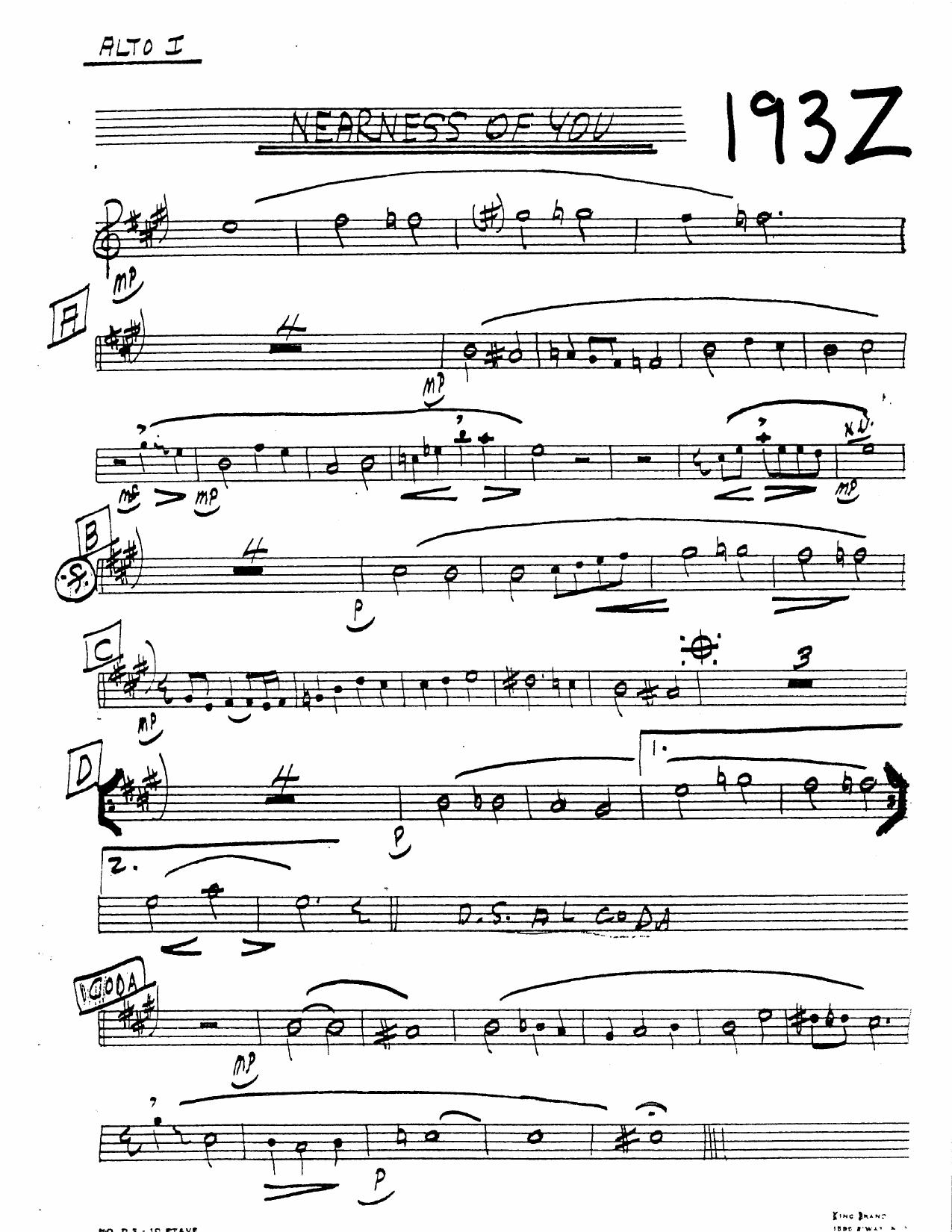
The Nearness Of You (W.Stuart)
Composed by Hoagy Carmichael
Arranged by Frank Sinatra & Nelson Riddle
- Ensemble: Big Band
- Pages: 23
- Instruments (18): Alto Saxophone 1, Alto Saxophone 2, Tenor Saxophone 1, Tenor Saxophone 2, Baritone Saxophone, Trumpet 1, Trumpet 2, Trumpet 3, Trumpet 4, Trombone 1, Trombone 2, Trombone 3, Trombone 4, Bass, Guitar, Drums, Piano, Voice
- Difficulty: medium
- Content: Individual Parts
- Format: PDF Download (Instant)
- Price: $24.99
Hoagy Carmichael and Ned Washington’s immortal 1938 ballad "The Nearness of You" achieved its definitive vocal standard status through countless interpretations, yet the legendary partnership of Frank Sinatra and arranger Nelson Riddle elevated the tune into a masterclass of lush, cinematic romance. Representing the pinnacle of the 1950s Capitol Records golden era, Riddle took Carmichael's poignant melody and reframed it within a sophisticated, twilight soundscape. This historic collaboration defined the lush vocal-jazz ballad genre, turning standard big band accompanying roles into intricate, dialogue-driven orchestrations where every brass swell and woodwind murmur serves the emotional narrative. Rooted in a slow, velvety 4/4 ballad feel, this arrangement unfolds with an exquisite, introspective melancholy. The harmonic language is rich with extended jazz chords, utilizing Riddle’s signature cascading string-like woodwind voicings adapted here for a vibrant horn section. Muted trumpets breathe softly against warm, low-register trombone cushions, creating an intimate, late-night mood. The emotional trajectory shifts seamlessly from vulnerable, sparse rubato passages to sweeping, cinematic crescendos that evoke the bittersweet ache of longing and deep affection, maintaining a delicate balance between tension and release throughout. Riddle’s distinctive approach relies heavily on coloristic orchestration rather than thick, block-chord writing. The 11-instrument ensemble is treated like a living, breathing chamber jazz orchestra. Saxes—featuring prominent parts for alto, tenor, and baritone—often weave counter-melodies around the vocal line or primary solo instrument, utilizing lush sub-tone textures in the lower registers. The arrangement avoids a traditional high-energy shout chorus, opting instead for a breathtaking developmental bridge where the harmonic center shifts subtly, allowing the woodwinds and brass to interlock in gorgeous, impressionistic voicings before resolving into a tender, whispered coda. Ensembles tackling this chart will find it a supreme test of breath control, intonation, and stylistic cohesion. While the technical fingerwork is accessible, the true challenge lies in the micro-dynamics, balance, and sustained legato phrasing required to execute Riddle’s sophisticated voicings authentically. The saxes and brass must listen deeply across sections to blend the dense chord clusters, while any featured soloist or vocalist must possess a mature sense of rubato and melodic pacing. Advanced high school, collegiate, and professional jazz ensembles will find this arrangement an invaluable addition to their repertoire. It provides an exceptional opportunity to teach students the nuances of ballad playing, dynamic control, and the historical language of the Sinatra-Riddle collaboration. Performing this piece demands emotional maturity and refined ensemble listening, rewarding both the musicians on stage and the audience with an unforgettable experience of timeless jazz elegance. Executing this arrangement successfully requires absolute mastery of ensemble balance and sustained breath support during slow-tempo passages. The conductor must establish a fluid, breathing tempo that avoids a rigid grid feel; encourage the ensemble to push and pull slightly with the phrasing, mirroring the flexibility of a master vocalist. Intonation on the dense, extended chord voicings is a primary technical challenge, particularly for the saxophone section when playing in their lower sub-tone registers and for the trombones blending soft plunger or cup mutes. Ensure that all background figures remain strictly subordinate to whoever is carrying the primary melodic line—whether that is a written soli or a featured soloist. Rehearsals should focus heavily on dynamic extremes, practicing passages at a whisper to build the physical control necessary for Riddle’s gradual, cinematic swells. Pay close attention to the transitional rubato bars, utilizing visual cues to lock the ensemble back into the established groove seamlessly without abrupt shifts. Q: What specific instruments and parts are included in this 11-instrument arrangement? A: The instrumentation features parts for an 11-piece ensemble, including Alto Saxophone, Tenor Saxophone, Baritone Saxophone, Trumpet, Trombone, and a rhythm section framework tailored to support the classic Riddle big band texture across 23 comprehensive pages. Q: What is the overall difficulty level of this chart? A: This arrangement is best suited for advanced high school, collegiate, and professional jazz ensembles due to its heavy demand for mature intonation, subtle dynamic control, and sustained legato phrasing rather than complex technical execution. Q: What is the historical style and background of this specific setting? A: This chart embodies the sophisticated 1950s Capitol Records ballad style pioneered by arranger Nelson Riddle and vocalist Frank Sinatra, transforming Hoagy Carmichael's 1938 standard into a cinematic, lushly harmonized masterpiece. Q: What makes this Nelson Riddle arrangement unique compared to standard big band ballad charts? A: Rather than relying on standard block-chord accompaniment or a traditional loud shout chorus, Riddle utilizes impressionistic woodwind-and-brass voicings, coloristic counter-melodies, and chamber-jazz intimacy to mirror the emotional subtext of the lyrics. Q: What is the recommended performance tempo and duration for this piece? A: The arrangement is performed as a slow, expressive ballad in 4/4 time, typically running between 3.5 to 4.5 minutes depending on the rubato stretching applied by the conductor and soloist.
Questions and answers
- What is included in the The Nearness Of You (W.Stuart) PDF?
- The verified current file contains individual parts across 23 pages.
- How many instruments or parts are listed for The Nearness Of You (W.Stuart)?
- The verified instrumentation list contains 18 entries for this Big Band arrangement.
- Who is credited for The Nearness Of You (W.Stuart)?
- Composer: Hoagy Carmichael. Arranger: Frank Sinatra & Nelson Riddle.
- What difficulty is listed for The Nearness Of You (W.Stuart)?
- The verified difficulty level is medium.
- Can I preview The Nearness Of You (W.Stuart) before buying?
- Yes. The product page provides a preview generated from the current PDF file.
- How is The Nearness Of You (W.Stuart) delivered?
- After successful payment, the digital PDF is made available for download. The displayed price is $24.99.
Musicians Also Search For
The Nearness Of You Frank Sinatra & Nelson Riddle PDF • The Nearness Of You Frank Sinatra & Nelson Riddle sheet music • The Nearness Of You arranged by Frank Sinatra & Nelson Riddle • Frank Sinatra & Nelson Riddle big band charts • Frank Sinatra & Nelson Riddle jazz arrangements PDF • The Nearness Of You Hoagy Carmichael sheet music • The Nearness Of You Hoagy Carmichael big band arrangements • Hoagy Carmichael big band charts • The Nearness Of You big band arrangements • The Nearness Of You big band PDF download • The Nearness Of You jazz sheet music • big band sheet music download • The Nearness Of You individual parts download • The Nearness Of You sheet music PDF • buy The Nearness Of You sheet music • download The Nearness Of You PDF • The Nearness Of You jazz charts • best Frank Sinatra & Nelson Riddle big band arrangements • Hoagy Carmichael arranged by Frank Sinatra & Nelson Riddle • The Nearness Of You printable sheet music • big band repertoire PDF