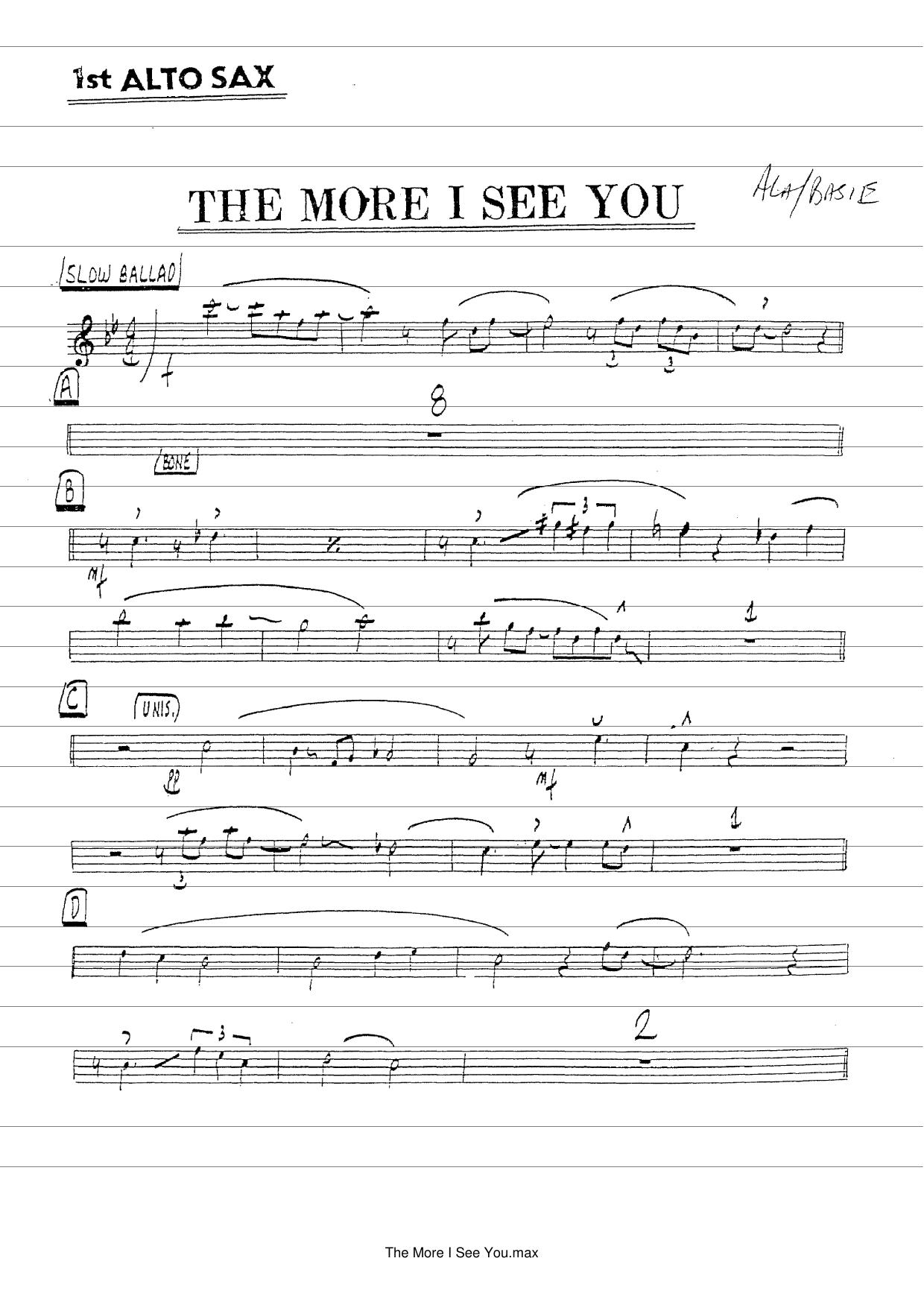
The More I See You (C.Basie)
Composed by Count Basie
Arranged by Count Basie
- Ensemble: Big Band
- Pages: 34
- Instruments (17): 1st Alto Sax, 2nd Alto Sax, 1st Tenor Sax, 2nd Tenor Sax, Baritone Sax, 1st Trumpet, 2nd Trumpet, 3rd Trumpet, 4th Trumpet, Solo Trombone, 2nd Trombone, 3rd Trombone, Bass Trombone, Drums, Bass, Guitar, Piano
- Difficulty: medium
- Content: Individual Parts
- Format: PDF Download (Instant)
- Price: $24.99
Harry Warren and Mack Gordon’s timeless standard "The More I See You" received the quintessential Kansas City treatment when filtered through the stylistic lens of the Count Basie Orchestra. Originally written for the 1945 musical film *Diamond Horseshoe*, the tune evolved into a beloved vehicle for jazz vocalists and instrumentalists alike. However, when adapted within the Basie idiom, the song sheds any overly sentimental ballad trappings, morphing instead into an elegant, understated medium-swing masterclass. This treatment encapsulates the absolute essence of the post-war swing era, capturing that peerless blend of relaxed intensity, economic phrasing, and undeniable forward momentum that defined the legendary Basie organization. Musically, this arrangement sits comfortably in a relaxed medium-swing groove, operating at a tempo that demands absolute internal time from every player in the ensemble. The mood is sophisticated, cool, and effortlessly swinging, evoking the smoky ambiance of 1950s supper clubs and historic ballrooms. Rather than relying on dense, frantic counterpoint, the emotional weight of the performance is carried by sparse, perfectly placed chord stabs from the rhythm section, crystalline piano interludes, and the signature, relaxed swagger of the horns. The dynamic arc builds organically, trading intimate, whisper-soft sectional work for rich, beautifully voiced ensemble passages that breathe with natural elasticity. Count Basie’s arranging and conceptual approach relies heavily on the principle of space—letting the notes that *aren't* played matter just as much as the ones that are. The horn writing across the 7-instrument instrumentation utilizes classic voicing techniques where the alto and tenor saxophones weave tightly knit countermelodies against the brass, while the piano anchors the groove with sparse, blues-infused comping. Rather than over-arranging the melody, the chart respects the iconic vocal line while recontextualizing it through sophisticated, yet accessible, swing harmonies. The arrangement builds toward a tasteful, unified statement rather than an overblown shout chorus, maintaining an aristocratic composure even at its highest dynamic peaks. Performing this chart successfully requires a mature sense of swing subdivision, particularly regarding the execution of eighth notes and the restraint needed to keep the tempo from rushing. The rhythm section—anchored by piano—serves as the engine, requiring a pianist who understands the art of the Basie-style comping shell rather than cluttered two-handed voicings. Horn players must master dynamic control and blend, ensuring the counterlines support rather than obscure the primary thematic material. Advanced high school, collegiate, and professional community big bands will find this arrangement an exceptional vehicle for developing stylistic authenticity, group listening, and deep groove awareness. Achieving an authentic reading of "The More I See You" in the Basie style demands rigorous attention to articulation and time feel. The primary technical challenge lies within the rhythm section: the drummer must maintain a feather-light ride cymbal pattern with a crisp hi-hat on beats two and four, avoiding any heavy-handed backbeats. The pianist should study Basie’s signature economic comping, utilizing single-note lines and sparse three-note chords rather than thick, modern extensions. Conductors should rehearse the horns with a focus on "detached" swing eighth notes, ensuring that articulation remains light and buoyant rather than heavy or clipped. Pay close attention to dynamic contrast; the quiet passages must whisper with intensity, while the louder ensemble hits should bloom naturally without forcing the tone. No specialized mutes or extreme extended techniques are required, allowing the ensemble to focus entirely on intonation, blend, and the subtle art of the back-phrased swing feel. Q: What specific instruments and parts are included in this 34-page arrangement? A: This arrangement is scored for a 7-instrument ensemble configuration consisting of Alto Saxophone, Tenor Saxophone, Trumpet, Trombone, Piano, and rhythm section components tailored to capture the compact power of a classic Basie-style horn section. Q: What is the designated difficulty level of this chart? A: This piece is best suited for advanced high school, collegiate, and professional-level ensembles due to its high demand for internal time, stylistic maturity, and refined ensemble blend rather than extreme technical fingerwork. Q: What is the historical and stylistic context of this specific version? A: This chart translates the legendary Count Basie Orchestra aesthetic—rooted in Kansas City swing, economical arranging, and relaxed rhythmic precision—onto the classic Harry Warren and Mack Gordon standard. Q: What makes this particular arrangement unique compared to standard stock big band charts? A: Instead of dense, cluttered counterpoint or modern reharmonizations, this arrangement prioritizes the signature Basie philosophy of space, featuring sparse piano comping, elegant horn voicings, and a sophisticated, unhurried swing feel. Q: What is the performance duration and tempo feel of the arrangement? A: The piece is set in a relaxed medium-swing tempo (typically around 112-120 BPM) and runs for approximately 3 to 4 minutes, making it an ideal centerpiece or mood-setter for a standard jazz ensemble set.
Questions and answers
- What is included in the The More I See You (C.Basie) PDF?
- The verified current file contains individual parts across 34 pages.
- How many instruments or parts are listed for The More I See You (C.Basie)?
- The verified instrumentation list contains 17 entries for this Big Band arrangement.
- Who is credited for The More I See You (C.Basie)?
- Composer: Count Basie. Arranger: Count Basie.
- What difficulty is listed for The More I See You (C.Basie)?
- The verified difficulty level is medium.
- Can I preview The More I See You (C.Basie) before buying?
- Yes. The product page provides a preview generated from the current PDF file.
- How is The More I See You (C.Basie) delivered?
- After successful payment, the digital PDF is made available for download. The displayed price is $24.99.
Musicians Also Search For
The More I See You Count Basie PDF • The More I See You Count Basie sheet music • The More I See You arranged by Count Basie • Count Basie big band charts • Count Basie jazz arrangements PDF • The More I See You Count Basie big band arrangements • The More I See You big band arrangements • The More I See You big band PDF download • The More I See You jazz sheet music • big band sheet music download • The More I See You individual parts download • The More I See You sheet music PDF • buy The More I See You sheet music • download The More I See You PDF • The More I See You jazz charts • best Count Basie big band arrangements • The More I See You printable sheet music • big band repertoire PDF