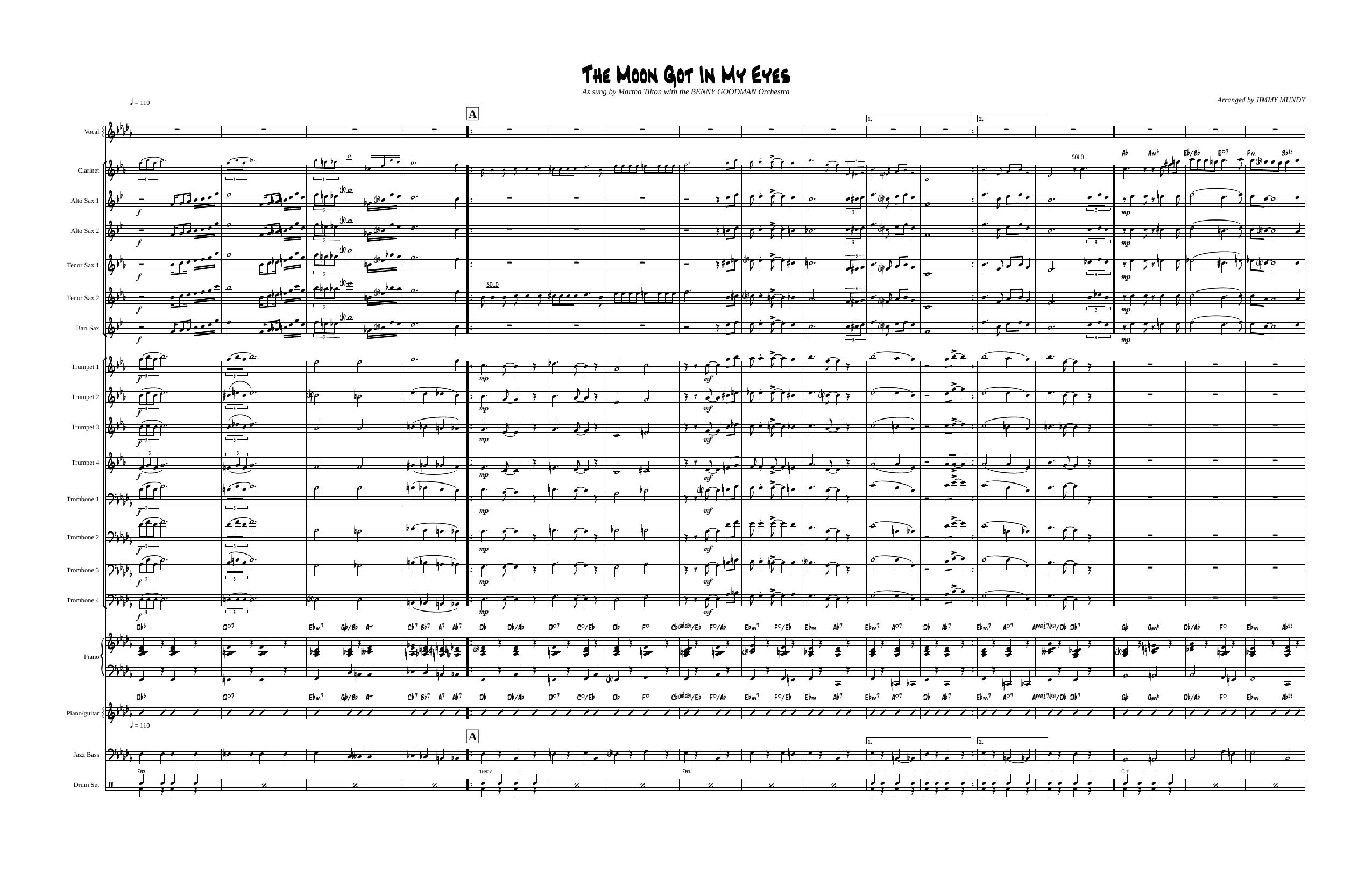
The Moon Got In My Eyes (J.Mundy) sheet music preview

The Moon Got In My Eyes (J.Mundy)

Composed by James Mundy

Arranged by Benny Goodman

  • Ensemble: Big Band
  • Pages: 48
  • Instruments (19): Vocal, Clarinet, Alto Sax 1, Alto Sax 2, Tenor Sax 1, Tenor Sax 2, Bari Sax, Trumpet 1, Trumpet 2, Trumpet 3, Trumpet 4, Trombone 1, Trombone 2, Trombone 3, Trombone 4, Piano, Piano/guitar, Bass, Drum Set
  • Difficulty: medium
  • Content: Individual Parts
  • Format: PDF Download (Instant)
  • Price: $24.99

Written during the height of the swing era, "The Moon Got In My Eyes" captures the sophisticated, dance-oriented yet intensely swinging aesthetic that defined the Benny Goodman organization in the late 1930s. Originally penned by Johnny Burke and Arthur Johnston, the tune was famously adapted and shaped into a premier big band vehicle through the arranging genius of James "Jimmy" Mundy. Mundy, whose prolific output for Goodman (including classics like "Sing, Sing, Sing" and "Solo Flight") helped cement the clarinet king's legacy, brought a distinctively energetic, brass-driven coloration to this romantic standard. The resulting chart balances lush, cinematic ballad elements with a driving, infectious pulse that exemplifies the sophisticated arranging vocabulary of the golden age of jazz. From the opening downbeat, the arrangement establishes a medium-tempo swing feel anchored in a rich, warm harmonic landscape. The mood shifts fluidly between dreamy, nocturnal introspection and jubilant, high-energy outbursts characteristic of Mundy’s writing style. The key centers and extended chord voicings utilize classic Goodman-era parallel harmonies, creating a lush wall of sound in the reed section that contrasts sharply with biting, punchy interjections from the brass. The emotional trajectory moves from a reflective, moody introduction into an uplifting, foot-tapping groove that evokes the smoky glamour of 1930s ballroom stages while maintaining a timeless musicality. Mundy’s brilliant structural design places heavy emphasis on textural variety, alternating between delicate, transparent ensemble writing and thick, harmonized block-chord solis. The melody is introduced with exquisite tenderness by the saxophone section before the arrangement opens up into dynamic counterpoint. Characteristic of Mundy’s charts, the scoring features clever sectional interplay, where the brass and reeds converse in rapid-fire call-and-response figures. While not an aggressive up-tempo burner, the chart demands immaculate time, light-footed swing articulation, and a mature sense of dynamic control. Performers will find immense satisfaction in navigating the subtle harmonic shifts and the effortless momentum that propels the arrangement toward its satisfying conclusion. Advanced high school, collegiate, and professional jazz ensembles will find this 48-page publication an invaluable addition to their repertoire. Because of its historical weight and stylistic specificities, it serves as an exceptional educational tool for teaching authentic 1930s swing phrasing, section balance, and the iconic arranging idioms of Jimmy Mundy. Working musicians will appreciate how the included full conductor score illuminates the intricate inner voices, making it a standout centerpiece for vintage-themed concerts, festival performances, or historic tribute sets. Achieving an authentic performance of this Jimmy Mundy arrangement requires meticulous attention to the stylistic nuances of the late 1930s swing era. The tempo should remain a steady, relaxed medium swing; rushing the groove will destroy the inherent elegance and danceability of the chart. Directors should emphasize precise articulation, ensuring that eighth notes are swung naturally rather than interpreted with modern bebop or heavy triplet stiffness. The primary technical challenge lies in balancing the delicate, transparent softer dynamics against the bold, brass-heavy shout sections without sacrificing tone quality. The saxophone section must prioritize intonation and blend during the intricate soli passages, while the brass players should use controlled, warm tones free of excessive edge unless specifically prompted by accented figures. Subtle use of vibrato appropriate to the period is encouraged across all wind instruments, particularly on sustained ballad-style phrases. Rehearsal should begin by isolating the rhythm section to lock in the foundational pulse, paying close attention to the Freddie Green-style acoustic guitar comping and light ride cymbal articulation. Once the groove is established, rehearse the wind sections separately to refine balance and unified phrasing before integrating the ensemble. Q: What instruments and parts are included in this publication? A: This 48-page arrangement includes a comprehensive conductor score alongside individual parts for an 8-instrument core ensemble configuration comprising Alto Saxophone, Tenor Saxophone, Trumpet, Trombone, Piano, and rhythm section components. Q: What is the difficulty level of this arrangement? A: This chart is best suited for advanced high school, collegiate, and professional jazz ensembles due to its demands for precise 1930s swing phrasing, section blend, and mature dynamic control. Q: What is the historical style and background of the piece? A: Written during the peak of the swing era, this arrangement fuses the romantic ballad traditions of the late 1930s with the signature energetic, brass-forward arranging style of Jimmy Mundy as performed by the Benny Goodman orchestra. Q: What makes this specific arrangement by Jimmy Mundy unique? A: Mundy's scoring is celebrated for its brilliant textural contrast, shifting seamlessly from lush, parallel-voiced reed solis to punchy brass call-and-response figures that give the arrangement a distinct cinematic yet swinging momentum. Q: What is the performance duration and recommended tempo feel? A: The arrangement is designed for a relaxed medium swing feel in 4/4 time, typically clocking in at around 3 to 4 minutes depending on the conductor's preferred pacing and solo expansiveness.

Questions and answers

What is included in the The Moon Got In My Eyes (J.Mundy) PDF?
The verified current file contains a conductor score and individual parts across 48 pages.
How many instruments or parts are listed for The Moon Got In My Eyes (J.Mundy)?
The verified instrumentation list contains 19 entries for this Big Band arrangement.
Who is credited for The Moon Got In My Eyes (J.Mundy)?
Composer: James Mundy. Arranger: Benny Goodman.
What difficulty is listed for The Moon Got In My Eyes (J.Mundy)?
The verified difficulty level is medium.
Can I preview The Moon Got In My Eyes (J.Mundy) before buying?
Yes. The product page provides a preview generated from the current PDF file.
How is The Moon Got In My Eyes (J.Mundy) delivered?
After successful payment, the digital PDF is made available for download. The displayed price is $24.99.

Musicians Also Search For

The Moon Got In My Eyes Benny Goodman PDFThe Moon Got In My Eyes Benny Goodman sheet musicThe Moon Got In My Eyes arranged by Benny GoodmanBenny Goodman big band chartsBenny Goodman jazz arrangements PDFThe Moon Got In My Eyes James Mundy sheet musicThe Moon Got In My Eyes James Mundy big band arrangementsJames Mundy big band chartsThe Moon Got In My Eyes big band arrangementsThe Moon Got In My Eyes big band PDF downloadThe Moon Got In My Eyes jazz sheet musicbig band sheet music downloadThe Moon Got In My Eyes conductor score PDFThe Moon Got In My Eyes individual parts downloadThe Moon Got In My Eyes sheet music PDFbuy The Moon Got In My Eyes sheet musicdownload The Moon Got In My Eyes PDFThe Moon Got In My Eyes jazz chartsbest Benny Goodman big band arrangementsJames Mundy arranged by Benny GoodmanThe Moon Got In My Eyes printable sheet musicbig band repertoire PDF

All arrangements by Benny Goodman All James Mundy sheet music