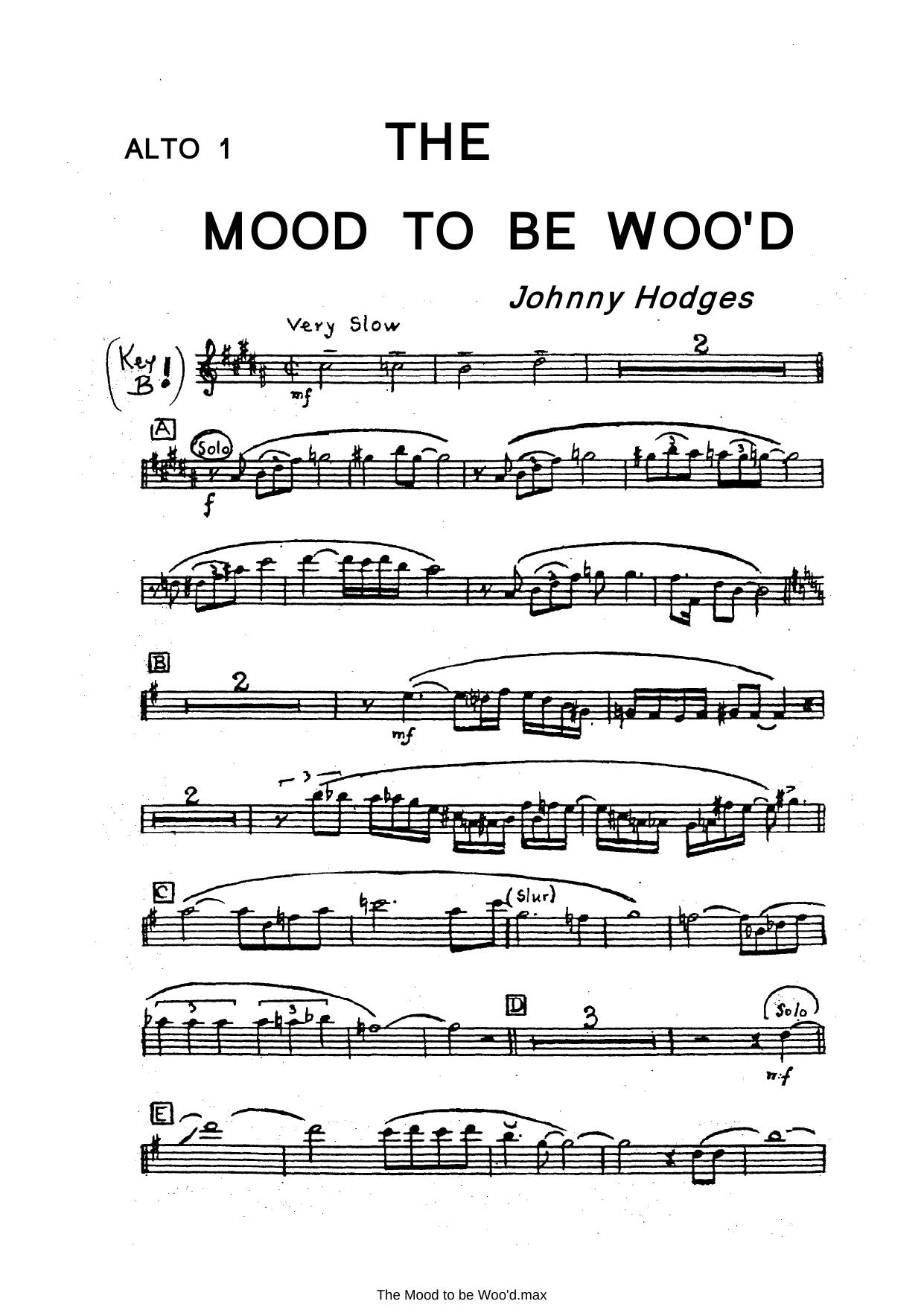
The Mood To Be Woo'd (J.Hodges)
Composed by Johnny Hodges
Arranged by Count Basie
- Ensemble: Big Band
- Pages: 30
- Instruments (16): Alto Saxophone 1, Alto Saxophone 2, Tenor Saxophone 1, Tenor Saxophone 2, Baritone Saxophone, Trumpet 1, Trumpet 2, Trumpet 3, Trumpet 4, Trombone 1, Trombone 2, Trombone 3, Trombone 4, Piano, Bass, Drums
- Difficulty: medium
- Content: Individual Parts
- Format: PDF Download (Instant)
- Price: $24.99
Johnny Hodges, the immortal alto saxophone voice of the Duke Ellington Orchestra, originally conceived "The Mood To Be Woo'd" as a showcase for his inimitable, velvety tone and lyrical sophistication. Emerging from the rich mid-century tradition of small-group and Ellingtonian swing, the composition captures the sultry, sophisticated late-night atmosphere characteristic of Hodges’s finest feature numbers. While Hodges defined the original melodic contours with his languid phrasing and signature bending vibrato, this unique treatment filters that romantic Ellington aesthetic through the unmistakable lens of the Count Basie idiom, creating a fascinating stylistic bridge between two giants of the swing era. Count Basie’s arrangement approaches the material with a masterclass in economic orchestration and relaxed, driving momentum. Rather than cluttering the texture, the chart utilizes a streamlined 7-instrument instrumentation (featuring Alto Sax, Tenor Sax, Trumpet, Trombone, and a rhythm section anchored by Piano) to achieve maximum transparency and harmonic weight. The tempo settles into a luxurious, laid-back medium-swing groove (4/4 time) that demands absolute precision in subdivision from the rhythm section. The arrangement opens with a seductive, smoky harmonic palette, where rich brass voicings wrap around the lead alto sax. As the chart unfolds, Basie’s signature call-and-response figures emerge between the horns and the piano, creating an effortless conversational flow that relies heavily on subtle dynamic shading rather than sheer volume. Featured solo space is central to the structure of the arrangement, providing a vital platform for the alto and tenor saxophones to stretch out over sophisticated blues-inflected changes. The technical challenges here are less about breakneck speed and much more about control, intonation, and stylistic authenticity. Performers must master the art of the delayed backbeat, seamless legato phrasing, and precise ensemble blend within a compact section. The harmonic language incorporates lush extended chords, major-seventh colorations, and subtle chromatic passing tones that require acute listening across the small ensemble to keep the voicings balanced and transparent. Advanced high school, collegiate, and professional ensembles will find this chart to be an exceptional vehicle for developing stylistic maturity, ensemble listening, and micro-timing within a swing context. Because it strips away the sheer mass of a traditional 17-piece big band, every player is exposed, making it a rigorous yet deeply rewarding study in chamber jazz discipline. The resulting performance offers audiences a captivating blend of Hodges' melodic romanticism and Basie’s peerless sense of rhythmic swing. Success with this arrangement hinges on capturing Count Basie’s signature laid-back, behind-the-beat swing feel. The tempo must not drag, but the eighth notes should be interpreted with a relaxed, triplet-based feel rather than a rigid double-time subdivision. Conductors should pay close attention to the dynamic markings in the brass; mutes (when applied optionally for color) and subtle plunger work can enhance the sultry, late-night mood. In rehearsal, isolate the rhythm section first to lock in the quintessential Basie piano comping style—sparse, pointed chords that drive the groove without overplaying. Horn players must practice their phrasing collectively, ensuring unified articulation on slurs and accents. Balance is critical given the 7-instrument configuration; lead players must project with a warm, round tone, while inner voices must listen down to maintain a seamless harmonic blanket beneath the soloists. Q: What instruments and parts are included in this 30-page arrangement? A: The chart is scored for a 7-instrument ensemble featuring Alto Saxophone, Tenor Saxophone, Trumpet, Trombone, and a complete rhythm section including Piano, plus full conductor and instrumental parts. Q: What is the difficulty level of this Count Basie arrangement? A: It is tailored for advanced high school, collegiate, and professional jazz ensembles due to its heavy reliance on subtle ensemble blend, micro-timing, and mature swing phrasing rather than technical velocity. Q: What is the historical style and background of "The Mood To Be Woo'd"? A: Originally associated with alto saxophonist Johnny Hodges of the Duke Ellington circle, this piece represents the sophisticated, blues-infused ballad and medium-swing tradition of the 1940s swing era, re-imagined through Count Basie's distinctive arranging aesthetic. Q: What makes this specific arrangement unique? A: It uniquely bridges the romantic, velvety alto saxophone style of Johnny Hodges with Count Basie's sparse, swinging orchestration philosophy, scaled down into a transparent 7-instrument format that highlights individual artistry. Q: What is the performance duration and tempo feel of the piece? A: The arrangement runs approximately 4 to 5 minutes and is set to a luxurious, laid-back medium-swing tempo in 4/4 time that prioritizes groove and relaxed phrasing.
Questions and answers
- What is included in the The Mood To Be Woo'd (J.Hodges) PDF?
- The verified current file contains individual parts across 30 pages.
- How many instruments or parts are listed for The Mood To Be Woo'd (J.Hodges)?
- The verified instrumentation list contains 16 entries for this Big Band arrangement.
- Who is credited for The Mood To Be Woo'd (J.Hodges)?
- Composer: Johnny Hodges. Arranger: Count Basie.
- What difficulty is listed for The Mood To Be Woo'd (J.Hodges)?
- The verified difficulty level is medium.
- Can I preview The Mood To Be Woo'd (J.Hodges) before buying?
- Yes. The product page provides a preview generated from the current PDF file.
- How is The Mood To Be Woo'd (J.Hodges) delivered?
- After successful payment, the digital PDF is made available for download. The displayed price is $24.99.
Musicians Also Search For
The Mood To Be Woo'd Count Basie PDF • The Mood To Be Woo'd Count Basie sheet music • The Mood To Be Woo'd arranged by Count Basie • Count Basie big band charts • Count Basie jazz arrangements PDF • The Mood To Be Woo'd Johnny Hodges sheet music • The Mood To Be Woo'd Johnny Hodges big band arrangements • Johnny Hodges big band charts • The Mood To Be Woo'd big band arrangements • The Mood To Be Woo'd big band PDF download • The Mood To Be Woo'd jazz sheet music • big band sheet music download • The Mood To Be Woo'd individual parts download • The Mood To Be Woo'd sheet music PDF • buy The Mood To Be Woo'd sheet music • download The Mood To Be Woo'd PDF • The Mood To Be Woo'd jazz charts • best Count Basie big band arrangements • Johnny Hodges arranged by Count Basie • The Mood To Be Woo'd printable sheet music • big band repertoire PDF