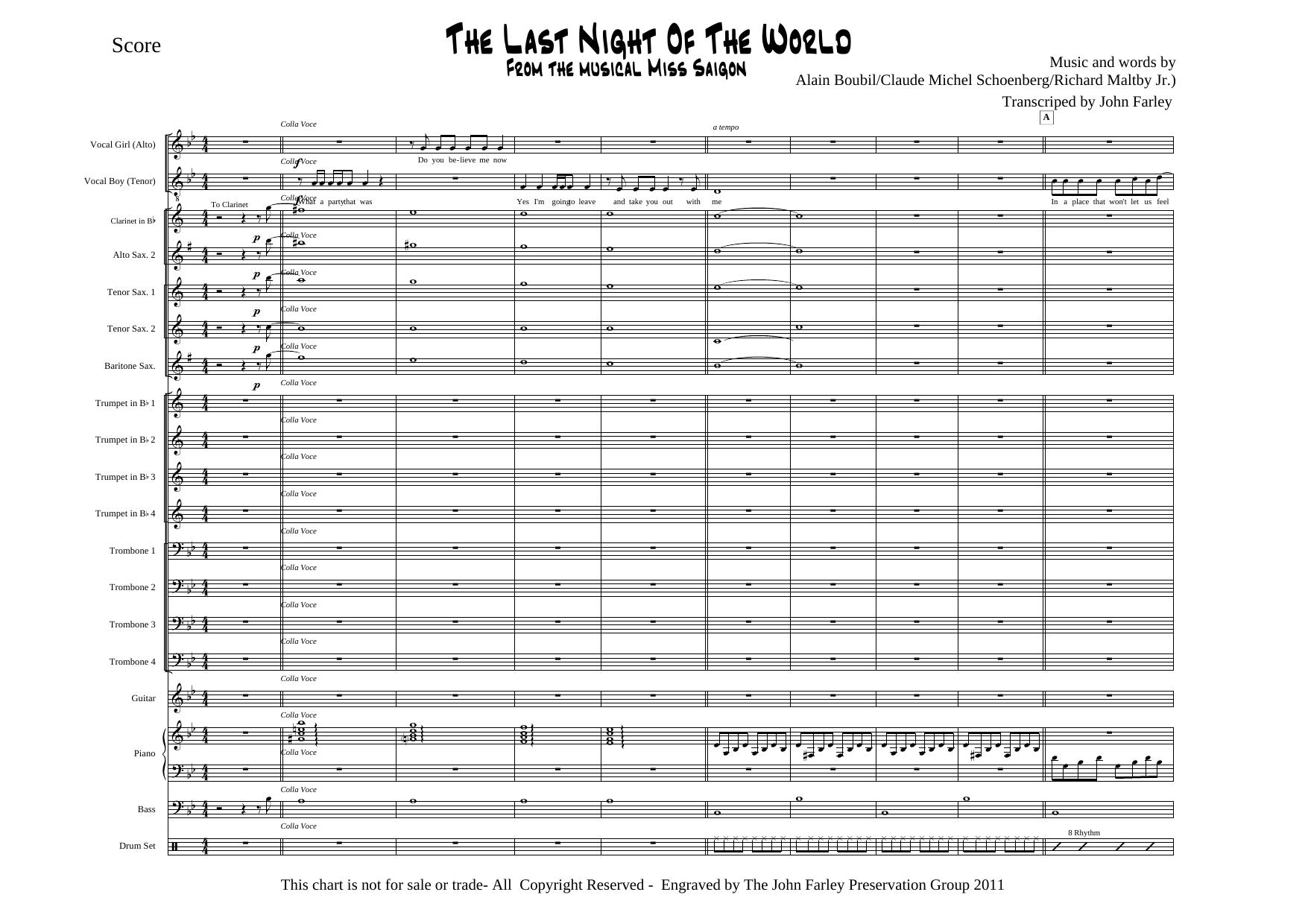
The Last Night Of The World (J.Farley) sheet music preview

The Last Night Of The World (J.Farley)

Composed by Claude-Michel Schönberg

Arranged by John Farley

  • Ensemble: Big Band
  • Pages: 54
  • Instruments (20): Vocal Girl (Alto), Vocal Boy (Tenor), Clarinet in Bb, Alto Sax. 1, Alto Sax. 2, Tenor Sax. 1, Tenor Sax. 2, Baritone Sax., Trumpet in Bb 1, Trumpet in Bb 2, Trumpet in Bb 3, Trumpet in Bb 4, Trombone 1, Trombone 2, Trombone 3, Trombone 4, Guitar, Piano, Bass, Drum Set
  • Difficulty: advanced
  • Content: Individual Parts
  • Format: PDF Download (Instant)
  • Price: $24.99

Claude-Michel Schönberg’s emotionally resonant masterpiece, originally introduced in the landmark 1989 musical *Miss Saigon*, finds a brilliant, unexpected home in the jazz idiom through this sophisticated big band adaptation. While rooted in the musical theatre tradition, the intrinsic harmonic richness and soaring lyricism of Schönberg's writing have long attracted jazz improvisers looking for expansive melodic vehicles outside the traditional Great American Songbook. This setting captures the dramatic essence of the original theater score while recontextualizing it through a modern, sophisticated jazz lens, bridging the gap between narrative-driven composition and straight-ahead big band architecture. A poignant, sweeping ballad feel defines the core character of the arrangement, opening with a rubato, atmospheric introduction before settling into a steady, undulating 12/8 contemporary jazz groove. Rich extended chord voicings—featuring lush suspended harmonies, minor-major seventh colors, and subtle chromatic inner-voice movement—evoke a profound sense of yearning and late-night introspection. The mood shifts seamlessly from fragile, intimate vulnerability to towering, brass-heavy crescendos that demand absolute dynamic control and emotional commitment from every section of the ensemble. Arranger John Farley approaches the material with a masterful balance of respect for the source melody and adventurous harmonic reinvention. Farley eschews predictable orchestration in favor of transparent, modern horn-scoring where woodwinds double and weave around the vocal line, creating a lush texture reminiscent of vintage Gil Evans collaborations. A meticulously crafted horn soli highlights the middle movement, utilizing close-position block voicings that gently slide into altered dominant resolutions. Rather than relying on a standard up-tempo shout chorus, Farley constructs an expansive, cinematic climax that builds tension through a gradual upward key modulation and layered counterpoint before dissolving back into a quiet, haunting coda. Carrying the emotional weight of the performance, the featured vocal lead anchors the arrangement, supported closely by expressive counter-lines in the alto and tenor saxophones. The instrumental solo space is thoughtfully allocated, providing an ideal feature for an expressive tenor saxophonist or flugelhorn player to stretch out over a modal, flowing harmonic plateau. Technical demands lean heavily on breath control, intonation within tight section voicings, and mature phrasing rather than sheer velocity, making it an exquisite showcase for musicality and nuance. Advanced high school groups with strong lead players, collegiate ensembles, and professional freelance big bands will find this chart an exceptional centerpiece for a concert or festival program. It offers a refreshing departure from standard swing-era repertoire, challenging musicians to engage with deep ensemble listening, rubato time-feel, and storytelling through sound. Success with this arrangement hinges on the ensemble's ability to balance rich, modern harmonic textures with extreme dynamic subtlety. The tempo should remain fluid during the opening rubato vocal entry, establishing a strict, pulsing 12/8 jazz ballad groove (around dotted quarter = 62) the moment the rhythm section enters. Conductors should pay close attention to the balance between the vocal soloist and the muted brass; the trumpet and trombone sections must employ warm cup mutes or harmon mutes (stem half-out) where indicated to blend rather than overpower the voice. Rehearsal time should be dedicated primarily to tuning the dense, extended chord structures in the saxophones and lower brass, ensuring that inner-voice movements speak clearly without abrasive accents. Emphasize a legato, vocalistic phrasing style across all horns, treating every eighth-note line with natural contours rather than rigid articulation. The climactic modulation requires careful dynamic restraint on the approach; urge the band to hold back their peak volume until the final measure of the crescendo to maximize the emotional impact of the arrangement's resolution. Q: What instruments and parts are included in this big band arrangement? A: The chart is scored for an 8-instrument ensemble format comprising a vocal lead, alto saxophone, tenor saxophone, trumpet, trombone, piano, bass, and drums, providing a full, rich sound while remaining flexible for smaller-scale instrumentation. Q: What is the difficulty level of this arrangement? A: This piece is graded as advanced (Level 4-5), primarily due to its sophisticated harmonic language, requirement for mature intonation in tight voicings, and the demand for expressive, dynamic control rather than fast technical execution. Q: What is the musical style and historical background of the piece? A: Written in a contemporary jazz ballad and 12/8 groove style, the arrangement reinterprets a sweeping theme composed by Claude-Michel Schönberg from the legendary theatrical work *Miss Saigon*, adapting it into a sophisticated modern jazz idiom. Q: What makes John Farley's arrangement unique? A: Farley distinguishes the chart through his cinematic orchestration, utilizing transparent Gil Evans-esque textures, a gorgeous close-position horn soli, and a gradual modal modulation that builds dramatic tension without resorting to a traditional upbeat shout chorus. Q: What is the performance duration and tempo framework of this arrangement? A: The performance duration is approximately 5 to 6 minutes, functioning around a flowing, expressive tempo feel centered on a relaxed 12/8 jazz ballad groove (dotted quarter = 62) with rubato introductory sections.

Questions and answers

What is included in the The Last Night Of The World (J.Farley) PDF?
The verified current file contains a conductor score and individual parts across 54 pages.
How many instruments or parts are listed for The Last Night Of The World (J.Farley)?
The verified instrumentation list contains 20 entries for this Big Band arrangement.
Who is credited for The Last Night Of The World (J.Farley)?
Composer: Claude-Michel Schönberg. Arranger: John Farley.
What difficulty is listed for The Last Night Of The World (J.Farley)?
The verified difficulty level is advanced.
Can I preview The Last Night Of The World (J.Farley) before buying?
Yes. The product page provides a preview generated from the current PDF file.
How is The Last Night Of The World (J.Farley) delivered?
After successful payment, the digital PDF is made available for download. The displayed price is $24.99.

Musicians Also Search For

The Last Night Of The World John Farley PDFThe Last Night Of The World John Farley sheet musicThe Last Night Of The World arranged by John FarleyJohn Farley big band chartsJohn Farley jazz arrangements PDFThe Last Night Of The World Claude-Michel Schönberg sheet musicThe Last Night Of The World Claude-Michel Schönberg big band arrangementsClaude-Michel Schönberg big band chartsThe Last Night Of The World big band arrangementsThe Last Night Of The World big band PDF downloadThe Last Night Of The World jazz sheet musicbig band sheet music downloadThe Last Night Of The World conductor score PDFThe Last Night Of The World individual parts downloadThe Last Night Of The World sheet music PDFbuy The Last Night Of The World sheet musicdownload The Last Night Of The World PDFThe Last Night Of The World jazz chartsbest John Farley big band arrangementsClaude-Michel Schönberg arranged by John FarleyThe Last Night Of The World printable sheet musicbig band repertoire PDF

All arrangements by John Farley All Claude-Michel Schönberg sheet music