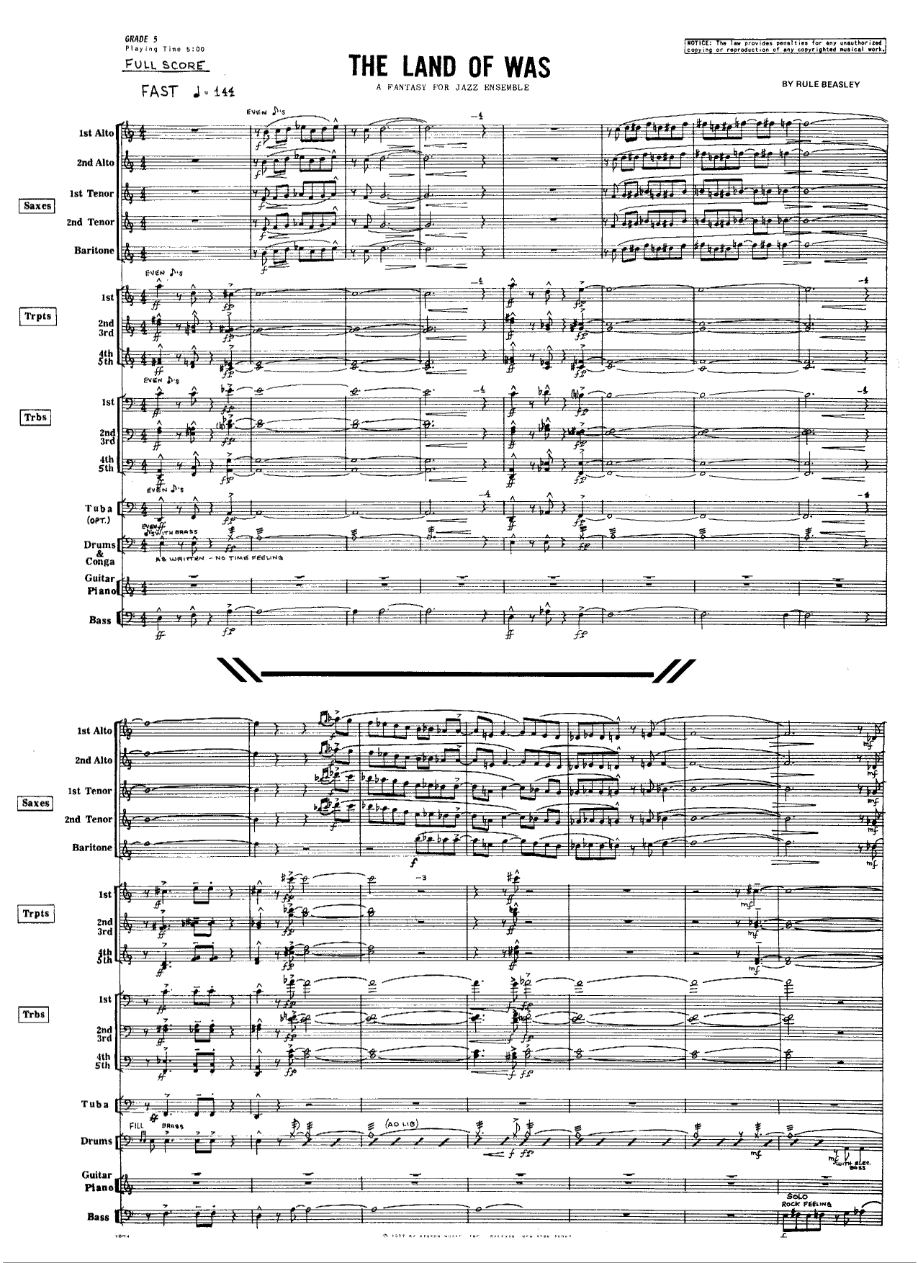
The Land Of Was (R.Beasley) sheet music preview

The Land Of Was (R.Beasley)

Composed by Rule Beasley

Arranged by Rule Beasley

  • Ensemble: Big Band
  • Style: Jazz Standard
  • Pages: 63
  • Instruments (21): 1st Eb Alto Sax, 2nd Eb Alto Sax, 1st Bb Tenor Sax, 2nd Bb Tenor Sax, Eb Baritone Sax, 1st Bb Trumpet, 2nd Bb Trumpet, 3rd Bb Trumpet, 4th Bb Trumpet, 5th Bb Trumpet, 1st Trombone, 2nd Trombone, 3rd Trombone, 4th Trombone, 5th Trombone (Bass Trb. or Tuba), Tuba (Optional), Piano, Guitar, Bass, Drums, Conga
  • Difficulty: advanced
  • Content: Individual Parts
  • Format: PDF Download (Instant)
  • Price: $24.99

Rule Beasley’s masterful big band chart of "The Land Of Was" captures the sophisticated harmonic palette and sleek, mid-century modern aesthetic characteristic of collegiate and West Coast-inflected jazz composition from the late 20th century. Rooted in the rich tradition of modern big band writing, this composition balances intricate contrapuntal lines with lush, harmonically dense ensemble blocks that evoke a sense of nostalgic reflection mixed with driving forward momentum. As both composer and arranger, Beasley possessed an intimate understanding of the jazz orchestra’s sonic architecture, crafting a work that treats the 21-piece ensemble not merely as a backing unit, but as a unified chamber orchestra capable of subtle textural shifts and explosive dynamic power. Built upon a sophisticated medium-up swing framework, "The Land Of Was" alternates between breezy, linear melodic statements and harmonically adventurous interludes. The mood shifts fluidly between bittersweet introspection and vibrant, celebratory outbursts, anchored by a resilient rhythm section groove. Beasley’s signature arranging approach relies heavily on extended tertian harmonies, sophisticated chromatic voice-leading, and clever cross-section voicing—frequently pairing flutes or muted trumpets with saxophones to create shimmering, composite timbres. The melodic weight is distributed democratically across the ensemble, though the saxophones frequently introduce the primary thematic material with litop-cool precision before the brass enters to punctuate the phrase with crisp, articulated staccatos. Performance-wise, this chart demands a high degree of section cohesion and rhythmic precision, particularly during exposed unison passages and swift modulatory transitions. Featured solo space allows improvisers to stretch out over contemporary modal changes that encourage lyrical, harmonically aware phrasing rather than purely vertical, chord-scale running. The climax builds toward a meticulously orchestrated shout chorus that showcases Beasley’s knack for vertical tension and release, driving the full ensemble to a dynamic peak before winding down to a clever, understated final chord. The interplay between the rhythm section and horns requires a sophisticated, floating time-feel that stays relaxed even at faster tempos. Advanced high school, collegiate, and professional jazz ensembles will find this comprehensive 63-page publication an exceptionally rewarding addition to their repertoire. Because of its demanding harmonic language, intricate ensemble figures, and requirement for mature stylistic interpretation, it serves as an ideal showcase piece for festival competition or formal concert programming. Directors seeking to stretch their ensemble's reading capabilities while exploring sophisticated modern big band literature will discover enduring musical value within Beasley's meticulously balanced score. Navigating "The Land Of Was" successfully requires meticulous attention to articulation, balance, and dynamic contrast across all sections. The tempo should maintain a steady, unhurried medium-up swing feel; avoid rushing the syncopated figures, as the rhythmic integrity relies heavily on a relaxed, behind-the-beat delivery from the rhythm section. Horn players must carefully balance the dense, extended chord voicings—particularly in the saxophones and muted brass—ensuring that inner voices do not get buried beneath the primary melody. Pay close attention to subtle dynamic markings, treating crescendos and decrescendos as wave-like swells rather than abrupt shifts. Rehearsals should initially focus on sectional isolation of complex rhythmic unisons before integrating the full ensemble, ensuring that all articulations (such as roof accents and short staccatos) match uniformly across the entire band. Q: What instruments and parts are included in this publication? A: This complete 21-instrument big band arrangement includes parts for 5 saxophones (Alto 1-2, Tenor 1-2, Baritone), standard brass instrumentation, a full rhythm section, and a comprehensive 63-page conductor score. Q: What is the difficulty level of this arrangement? A: This chart is best suited for advanced high school, collegiate, and professional big bands due to its sophisticated harmonic language, intricate section unisons, and demanding reading requirements. Q: What is the musical style and historical context of "The Land Of Was"? A: Composed and arranged by Rule Beasley, this piece represents the sophisticated, harmonically rich style of modern post-bop and collegiate big band composition from the late 20th-century jazz tradition. Q: What makes this specific arrangement unique? A: Beasley’s distinctive compositional approach utilizes extended tertian harmonies, clever cross-section voicing, and seamless modulations that treat the 21-piece big band like a modern chamber orchestra. Q: What is the performance duration and tempo feel of the piece? A: The arrangement is written in a sophisticated medium-up swing feel with dynamic tempo variations, offering a substantial performance length ideal for festival competition or concert programming.

Questions and answers

What is included in the The Land Of Was (R.Beasley) PDF?
The verified current file contains a conductor score and individual parts across 63 pages.
How many instruments or parts are listed for The Land Of Was (R.Beasley)?
The verified instrumentation list contains 21 entries for this Big Band arrangement.
Who is credited for The Land Of Was (R.Beasley)?
Composer: Rule Beasley. Arranger: Rule Beasley.
What difficulty is listed for The Land Of Was (R.Beasley)?
The verified difficulty level is advanced.
What style is listed for The Land Of Was (R.Beasley)?
The catalog lists the style as Jazz Standard.
Can I preview The Land Of Was (R.Beasley) before buying?
Yes. The product page provides a preview generated from the current PDF file.
How is The Land Of Was (R.Beasley) delivered?
After successful payment, the digital PDF is made available for download. The displayed price is $24.99.

Musicians Also Search For

The Land Of Was Rule Beasley PDFThe Land Of Was Rule Beasley sheet musicThe Land Of Was arranged by Rule BeasleyRule Beasley big band chartsRule Beasley jazz arrangements PDFThe Land Of Was Rule Beasley big band arrangementsThe Land Of Was big band arrangementsThe Land Of Was big band PDF downloadThe Land Of Was jazz sheet musicbig band sheet music downloadThe Land Of Was conductor score PDFThe Land Of Was individual parts downloadThe Land Of Was sheet music PDFThe Land Of Was Jazz Standard chartsJazz Standard big band arrangementsbuy The Land Of Was sheet musicdownload The Land Of Was PDFThe Land Of Was jazz chartsbest Rule Beasley big band arrangementsThe Land Of Was printable sheet musicbig band repertoire PDF

All arrangements by Rule Beasley All Rule Beasley sheet music