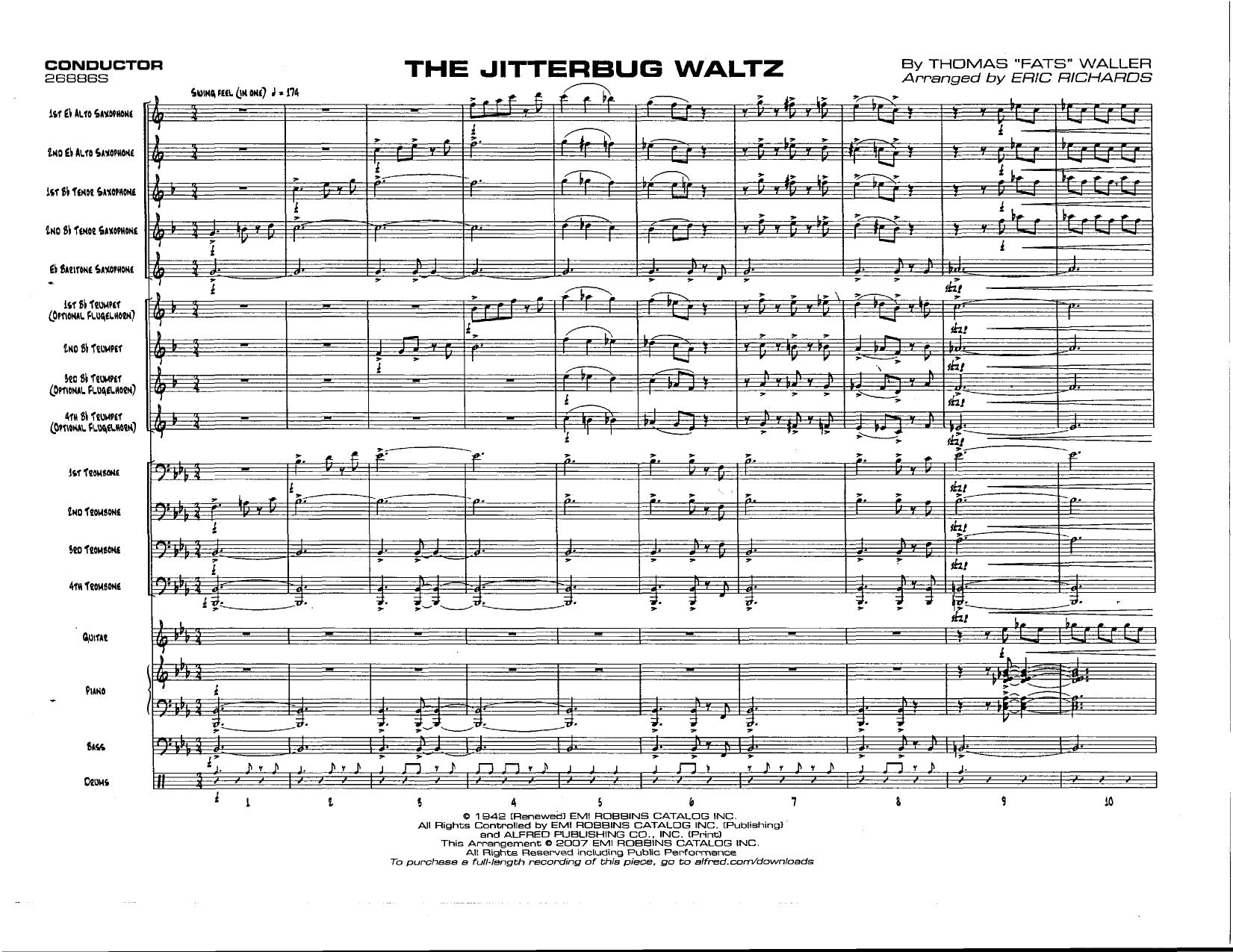
The Jitterbug Waltz (E.Richards)
Composed by Fats Waller
Arranged by Eric Richards
- Ensemble: Big Band
- Pages: 105
- Instruments (17): 1st Eb Alto Saxophone, 2nd Eb Alto Saxophone, 1st Bb Tenor Saxophone, 2nd Bb Tenor Saxophone, Eb Baritone Saxophone, 1st Bb Trumpet (Optional Flugelhorn), 2nd Bb Trumpet, 3rd Bb Trumpet (Optional Flugelhorn), 4th Bb Trumpet (Optional Flugelhorn), 1st Trombone, 2nd Trombone, 3rd Trombone, 4th Trombone, Guitar, Piano, Bass, Drums
- Difficulty: advanced
- Content: Individual Parts
- Format: PDF Download (Instant)
- Price: $24.99
Thomas "Fats" Waller first recorded "The Jitterbug Waltz" in 1942, masterfully bridging the gap between stride piano tradition and modern swing innovation. Unlike standard 4/4 swing vehicles of the era, Waller’s composition famously utilizes an infectious 3/4 waltz meter that immediately sets it apart in the Great American Songbook. This timeless classic captures the exuberant spirit of the swing era while introducing sophisticated harmonic twists that later bebop and modal pioneers would eagerly explore. Over the decades, it has evolved from a novelty stride showcase into a beloved jazz standard, interpreted by luminaries across generations. Eric Richards transforms Waller’s whimsical masterpiece into a dynamic, contemporary big band tour de force. Retaining the signature 3/4 waltz pulse, Richards infuses the score with rich, expanded modern harmonies, clever textural contrasts, and brilliant contemporary voicings. The mood shifts fluidly from playful and buoyant to sophisticated and driving, creating an expansive emotional arc. The arrangement opens with a charming, transparent introduction before blossoming into full-ensemble splendor, utilizing lush saxophone solis and crisp brass interplay that respect the tune's stride roots while propelling it firmly into the twenty-first century. Throughout the chart, melody is brilliantly distributed across the ensemble, featuring conversational exchanges between the muted brass and the woodwinds. Rich sax solis showcase the section’s intonation and blend, while designated solo space allows featured improvisers to stretch out over sophisticated changes. Technically, the chart demands precise articulation, agile fingerwork in the woodwinds, and a strong collective sense of ternary swing feel—keeping a 3/4 meter feeling genuinely jazzy rather than classical. Performers and audiences alike will find immense satisfaction in the clever reharmonizations, dynamic build-ups, and the thrilling, high-energy shout chorus that serves as the arrangement's climactic peak. Advanced high school ensembles, collegiate jazz orchestras, and professional big bands will find this chart an exceptional centerpiece for festival programs or formal concerts. The comprehensive 105-page publication includes a detailed conductor score and all 17 standard big band instrumental parts, providing the depth required for thorough rehearsal. Directors looking to challenge their rhythm section's time-feel and showcase the ensemble's dynamic range will discover that Richards' treatment of "The Jitterbug Waltz" is an unforgettable, high-yield addition to their library. Navigating Eric Richards' arrangement of "The Jitterbug Waltz" requires precision and a deep collective understanding of a jazz waltz feel. The primary technical challenge lies in maintaining a buoyant, driving 3/4 swing groove without letting the tempo drag or rush, especially during transitional passages. The rhythm section—particularly the drummer—must master the delicate balance between ride-cymbal propulsion and subtle brushwork, avoiding heavy one-drop downbeats in favor of a lighter, floating pulse. Conductors should pay close attention to dynamic contrast; the chart relies heavily on sudden subitos and smooth crescendo builds to create its dramatic narrative. Brass players should utilize cup and harmon mutes where indicated to achieve the authentic textural colors specified in the score, ensuring clean intonation across open-to-muted transitions. In rehearsal, isolate the rhythm section first to lock in the harmonic changes and the conversational vamp before layering in the horn sections. Balance is paramount during the dense contrapuntal horn lines, ensuring that inner-voice harmonies do not obscure the primary melodic delivery. Q: What instruments and parts are included in this publication? A: This comprehensive 105-page publication includes a full conductor score and 17 individual instrumental parts: Alto Saxophone 1, Alto Saxophone 2, Tenor Saxophone 1, Tenor Saxophone 2, Baritone Saxophone, 4 Trumpets (with optional mutes), 4 Trombones, Piano, Guitar, Bass, and Drums. Q: What is the difficulty level of this arrangement? A: This chart is graded as advanced, making it best suited for collegiate jazz orchestras, advanced high school big bands, and professional community ensembles with strong section players and confident soloists. Q: What is the historical style and background of this piece? A: Originally composed and recorded by stride piano legend Fats Waller in 1942, this piece is a rare and celebrated jazz waltz that blends traditional swing-era exuberance with forward-looking harmonic sophistication. Q: What makes Eric Richards' arrangement unique? A: Richards brilliantly reinterprets Waller's classic 3/4 tune using contemporary big band voicings, lush saxophone solis, intricate counterpoint, and a thrilling, high-energy shout chorus that elevates the source material. Q: What is the performance duration and recommended tempo feel? A: While performance time varies based on solo choruses, the arrangement typically runs around 4 to 5 minutes at a comfortable, swinging medium-waltz tempo that prioritizes groove and melodic clarity.
Questions and answers
- What is included in the The Jitterbug Waltz (E.Richards) PDF?
- The verified current file contains a conductor score and individual parts across 105 pages.
- How many instruments or parts are listed for The Jitterbug Waltz (E.Richards)?
- The verified instrumentation list contains 17 entries for this Big Band arrangement.
- Who is credited for The Jitterbug Waltz (E.Richards)?
- Composer: Fats Waller. Arranger: Eric Richards.
- What difficulty is listed for The Jitterbug Waltz (E.Richards)?
- The verified difficulty level is advanced.
- Can I preview The Jitterbug Waltz (E.Richards) before buying?
- Yes. The product page provides a preview generated from the current PDF file.
- How is The Jitterbug Waltz (E.Richards) delivered?
- After successful payment, the digital PDF is made available for download. The displayed price is $24.99.
Musicians Also Search For
The Jitterbug Waltz Eric Richards PDF • The Jitterbug Waltz Eric Richards sheet music • The Jitterbug Waltz arranged by Eric Richards • Eric Richards big band charts • Eric Richards jazz arrangements PDF • The Jitterbug Waltz Fats Waller sheet music • The Jitterbug Waltz Fats Waller big band arrangements • Fats Waller big band charts • The Jitterbug Waltz big band arrangements • The Jitterbug Waltz big band PDF download • The Jitterbug Waltz jazz sheet music • big band sheet music download • The Jitterbug Waltz conductor score PDF • The Jitterbug Waltz individual parts download • The Jitterbug Waltz sheet music PDF • buy The Jitterbug Waltz sheet music • download The Jitterbug Waltz PDF • The Jitterbug Waltz jazz charts • best Eric Richards big band arrangements • Fats Waller arranged by Eric Richards • The Jitterbug Waltz printable sheet music • big band repertoire PDF