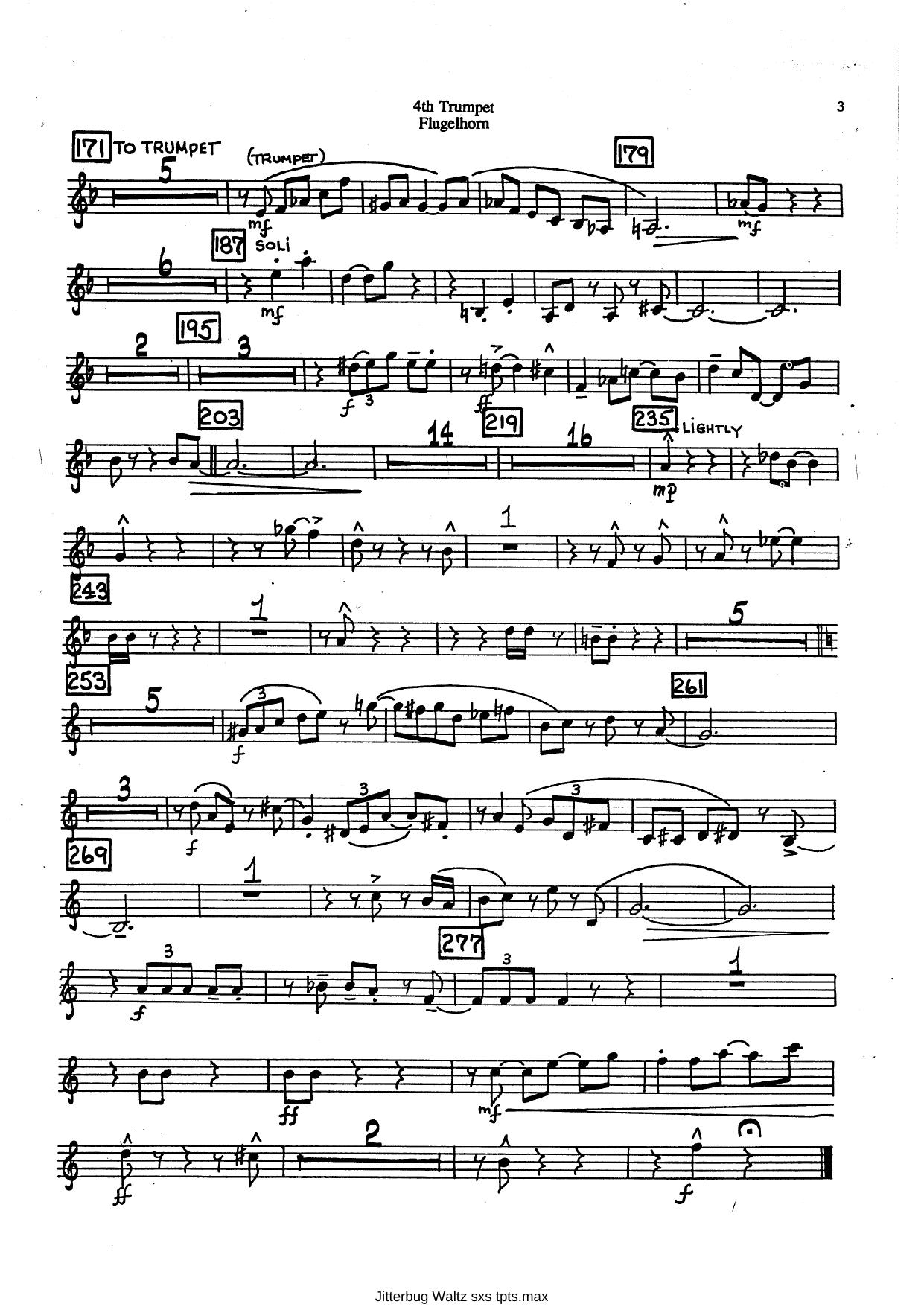
The Jitterbug Waltz (K.Berger)
Composed by Fats Waller
Arranged by K.Berger
- Ensemble: Big Band
- Style: Jazz Standard
- Pages: 44
- Instruments (16): 1st Trumpet / Flugelhorn, 2nd Trumpet, 3rd Trumpet / Flugelhorn, 4th Trumpet / Flugelhorn, Reed 1 (Alto Sax), Reed 2 (Piccolo, Clarinet), Reed 3 (Tenor Sax), Reed 4 (Soprano Sax), Reed 5 (Bass Clarinet, Baritone Sax), 1st Trombone, 2nd Trombone, 3rd Trombone (Bass), 4th Trombone (opt.), Piano, Bass, Drums
- Difficulty: medium
- Content: Individual Parts
- Format: PDF Download (Instant)
- Price: $24.99
Fats Waller’s iconic 1934 composition "The Jitterbug Waltz" stands as a towering monument of stride piano literature and a remarkably durable jazz standard. Unlike the rigid four-four march meters typical of early swing, Waller’s masterpiece brilliantly subverts expectations by utilizing a fluid three-four waltz time, capturing both the whimsical exuberance of the Harlem stride era and a sophisticated harmonic foresight that prefigured modern jazz. Originally recorded by Waller and his Rhythm, the tune has since been interpreted by modernists and traditionalists alike, cementing its status as a cornerstone for improvisers who revel in its deceptive structural simplicity and rich melodic contour. K.Berger’s sophisticated big band adaptation breathes fresh life into Waller’s waltz, transforming the intimate piano vehicle into a sweeping, textural landscape for standard 16-piece jazz orchestra. Moving gracefully between the iconic three-four lilt and moments of driving swing feel, the arrangement establishes a captivating mood that swings between playful nostalgia and lush, cinematic warmth. The score opens with an atmospheric introduction before yielding to airy, interlocking woodwind voicings that highlight the unique palette of the expanded reed section, which notably includes a versatile Reed 5 setup featuring both baritone saxophone and bass clarinet. The structural architecture of this chart showcases K.Berger’s mastery of dynamic contrast and color. The melody is initially introduced by the upper brass and alto voices before being tossed playfully across the ensemble sections, creating an evolving conversation reminiscent of classic Ellingtonian orchestration. A standout shout chorus midway through the chart pushes the dynamic envelope, expanding the harmonic language with modern extensions while remaining anchored to the tune's timeless stride roots. Featured solo space allows a designated horn player to stretch out over standard changes, backed by crisp, punctuating brass kicks and a rhythm section explicitly dialed into the elastic demands of jazz waltz phrasing. Advanced high school ensembles with strong section players, as well as college and professional big bands, will find this arrangement an ideal vehicle for developing time-feel elasticity and sophisticated blend. Because the piece requires seamless navigation of dynamic shifts, subtle dynamic shading, and a rhythmic concept that departs from standard four-four swing, it serves as both an exceptional festival showcase and a memorable centerpiece for standard concert programming, rewarding both the performers and the discerning listener. Mastering K.Berger’s setting of "The Jitterbug Waltz" requires precision regarding time feel and sectional balance. The primary challenge lies in maintaining an organic, flowing 3/4 meter without letting the rhythm feel stiff or overly academic; the rhythm section must lock into a supple, conversational groove that honors the Fats Waller stride tradition while embracing contemporary big band elasticity. The conductor should emphasize smooth transitions between lyrical, rubato-leaning passages and stricter tempo sections. Brass players must exercise restraint during the statement of the theme, ensuring that mutes—where utilized—blend cohesively rather than pierce the texture. Pay close attention to the dynamic markings in the reed section, particularly around the Reed 5 low-register passages, which provide the foundational sub-bass weight for the entire ensemble. Rehearsals should begin by isolating the rhythm section to nail the underlying pulse before layering in the horn voicings. Q: What instruments and parts are included in this big band arrangement? A: The chart is scored for a standard 16-piece big band instrumentation, featuring a 4-trumpet section (1st through 4th Trumpet parts) and a versatile reed section that includes a Reed 5 part doubling on bass clarinet and baritone saxophone. Q: What is the difficulty level of this arrangement? A: This arrangement is graded as advanced, making it best suited for college, professional, and advanced high school big bands equipped with strong section leaders and experienced soloists. Q: How does this arrangement handle the historical style of the original composition? A: K.Berger honors Fats Waller's 1934 stride masterpiece by preserving its distinctive 3/4 waltz feel while integrating contemporary big band orchestration, expanded harmonies, and dynamic contrast. Q: What makes K.Berger’s arrangement unique compared to other big band versions? A: This version stands out through its meticulous color choices in the reed section—highlighting the baritone saxophone and bass clarinet—and a brilliant shout chorus that reinterprets the classic melody with modern harmonic color. Q: What is the performance duration and tempo feel of the piece? A: The piece is structured around a medium-tempo jazz waltz feel, typically clocking in at around 3 to 4 minutes depending on the length allotted for open solo sections.
Questions and answers
- What is included in the The Jitterbug Waltz (K.Berger) PDF?
- The verified current file contains individual parts across 44 pages.
- How many instruments or parts are listed for The Jitterbug Waltz (K.Berger)?
- The verified instrumentation list contains 16 entries for this Big Band arrangement.
- Who is credited for The Jitterbug Waltz (K.Berger)?
- Composer: Fats Waller. Arranger: K.Berger.
- What difficulty is listed for The Jitterbug Waltz (K.Berger)?
- The verified difficulty level is medium.
- What style is listed for The Jitterbug Waltz (K.Berger)?
- The catalog lists the style as Jazz Standard.
- Can I preview The Jitterbug Waltz (K.Berger) before buying?
- Yes. The product page provides a preview generated from the current PDF file.
- How is The Jitterbug Waltz (K.Berger) delivered?
- After successful payment, the digital PDF is made available for download. The displayed price is $24.99.
Musicians Also Search For
The Jitterbug Waltz K.Berger PDF • The Jitterbug Waltz K.Berger sheet music • The Jitterbug Waltz arranged by K.Berger • K.Berger big band charts • K.Berger jazz arrangements PDF • The Jitterbug Waltz Fats Waller sheet music • The Jitterbug Waltz Fats Waller big band arrangements • Fats Waller big band charts • The Jitterbug Waltz big band arrangements • The Jitterbug Waltz big band PDF download • The Jitterbug Waltz jazz sheet music • big band sheet music download • The Jitterbug Waltz individual parts download • The Jitterbug Waltz sheet music PDF • The Jitterbug Waltz Jazz Standard charts • Jazz Standard big band arrangements • buy The Jitterbug Waltz sheet music • download The Jitterbug Waltz PDF • The Jitterbug Waltz jazz charts • best K.Berger big band arrangements • Fats Waller arranged by K.Berger • The Jitterbug Waltz printable sheet music • big band repertoire PDF