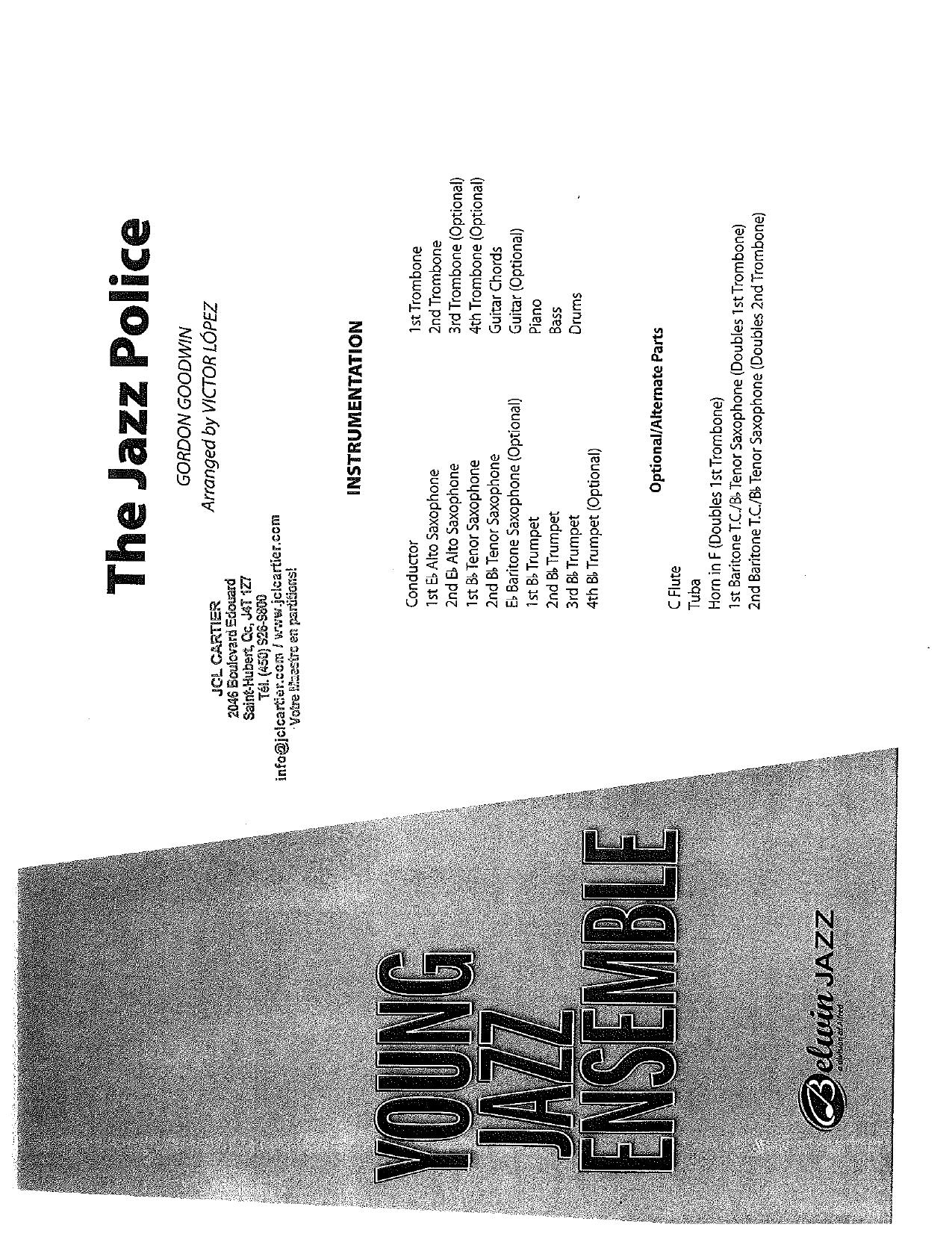
The Jazz Police (V.Lopez) sheet music preview

The Jazz Police (V.Lopez)

Composed by Gordon Goodwin

Arranged by Gordon Goodwin

  • Ensemble: Big Band
  • Pages: 83
  • Instruments (23): Conductor, 1st Eb Alto Saxophone, 2nd Eb Alto Saxophone, 1st Bb Tenor Saxophone, 2nd Bb Tenor Saxophone, Eb Baritone Saxophone, 1st Bb Trumpet, 2nd Bb Trumpet, 3rd Bb Trumpet, 4th Bb Trumpet, 1st Trombone, 2nd Trombone, 3rd Trombone, 4th Trombone, Guitar, Piano, Bass, Drums, C Flute, Tuba, Horn in F, 1st Baritone T.C., 2nd Baritone T.C.
  • Difficulty: advanced
  • Content: Individual Parts
  • Format: PDF Download (Instant)
  • Price: $24.99

Blistering velocity, intricate contemporary big band writing, and relentless forward momentum define "The Jazz Police," a modern masterwork originally crafted and popularized by Gordon Goodwin’s Big Phat Band. Emerging from the vibrant West Coast jazz scene of the early 2000s on the acclaimed album *Scrappin'*, this high-octane chart revitalized the large ensemble tradition by fusing traditional swing architecture with contemporary fusion energy, complex odd-meter nods, and razor-sharp precision. It has since cemented its status as a contemporary big band benchmark, revered by musicians and audiences alike for its sheer athletic brilliance and sophisticated harmonic vocabulary. At a scorching up-tempo swing feel, the piece operates as a high-stakes sonic pursuit, propelled by a relentless walking bassline, aggressive brass stabs, and intricate woodwind flourishes. The harmonic language is intensely colorful, featuring extended alterations, soaring trumpet lines that frequently venture into the stratosphere, and dense saxophone solis that demand absolute technical mastery. The emotional landscape shifts rapidly from heart-pounding urgency to swaggering, confident cool, evoking the breathless excitement of a high-speed cinematic chase sequence translated directly into a 21-century jazz idiom. Gordon Goodwin’s signature arranging style is on full display here, characterized by virtuosic ensemble passages, airtight counterpoint, and clever stylistic winks. The arrangement features breathtaking sax solis that weave complex chromatic lines through shifting tonal centers, alongside a powerhouse shout chorus that forces every section to project with absolute clarity and punch. Goodwin expertly balances heavy orchestration with moments of transparent rhythmic interplay, ensuring that even during the densest multi-phonic climaxes, every melodic voice cuts through the texture cleanly without muddying the overarching harmonic stack. Melodic duties are shared dynamically across the ensemble, though the woodwinds and lead trumpet carry the primary burdens of the blistering head. The chart provides substantial spotlight opportunities for featured soloists—traditionally tenor saxophone and piano—allowing improvisers to stretch out over driving rhythm changes and modal extensions. Technical challenges abound, notably in the blistering articulation required across all sections, rapid-fire tongue-twister passages in the saxes, and extreme endurance demands placed upon the lead trumpet chair. Overcoming these hurdles yields an immensely rewarding performance experience, punctuated by dramatic dynamic swells and a climactic ending that invariably brings audiences to their feet. Advanced collegiate ensembles, elite high school jazz bands, and professional repertory orchestras are best suited for this demanding chart. Due to its rigorous tempo, complex syncopations, and advanced reading requirements, it serves as the ultimate showcase piece for programs looking to test their technical limits, ensemble synchronization, and modern swing articulation. Conductors must approach "The Jazz Police" with a primary focus on time feel, rhythmic precision, and section-wide articulation uniformity. The absolute priority is maintaining the relentless up-tempo swing groove without rushing; the rhythm section—particularly the drummer and bassist—must anchor the tempo like a metronome while keeping the ride cymbal pattern light and driving. Key technical challenges include executing the blistering unison lines cleanly at high speeds. Brass players should utilize controlled, aggressive tonguing for staccato accents while managing air support during extended high-register passages. Saxophones must practice their intricate bebop-inflected lines slowly with a metronome before attempting performance tempo, ensuring smooth finger transitions across the register breaks. Incorporate dynamic contrast as a crucial rehearsal tool; do not allow the band to sit at a constant fortissimo. Exaggerate the written subtones, ghost notes, and sharp accent marks (doits and falls should be executed with precise pitch control rather than chaotic sliding). Rehearsal strategy should isolate the sax soli and the shout chorus, practicing them section by section with a click track before integrating the full ensemble texture. Q: What specific instrumentation and parts are included in this 21-instrument big band arrangement? A: The arrangement includes a complete 21-instrument big band instrumentation featuring Alto Saxophone 1 & 2, Tenor Saxophone 1 & 2, Baritone Saxophone, 4 Trumpets, 4 Trombones, Bass Trombone, Guitar, Piano, Bass, Drum Set, and a comprehensive conductor score spanning 83 pages. Q: What is the official difficulty level of this Gordon Goodwin chart? A: This arrangement is rated as advanced/difficult, making it most appropriate for elite university ensembles, advanced high school jazz bands, and professional musicians with strong sight-reading skills and stamina. Q: What is the historical background and musical style of "The Jazz Police"? A: Composed and arranged by Gordon Goodwin, the piece debuted on the Big Phat Band's early 2000s album *Scrappin'* and represents a modern, high-energy fusion of traditional swing big band writing with contemporary jazz-funk sensibilities. Q: What makes this specific Gordon Goodwin arrangement unique compared to standard swing charts? A: It stands out due to its relentless cinematic energy, dense chromatic harmonies, virtuosic saxophone solis, and Goodwin's signature knack for blending intricate contemporary counterpoint with high-octane big band swagger. Q: What are the expected performance tempo and duration of this piece? A: The piece is set at a scorching up-tempo swing feel—typically around quarter note = 260 BPM or faster—and generally runs for approximately 4 to 5 minutes depending on the length of the improvised solos.

Questions and answers

What is included in the The Jazz Police (V.Lopez) PDF?
The verified current file contains a conductor score and individual parts across 83 pages.
How many instruments or parts are listed for The Jazz Police (V.Lopez)?
The verified instrumentation list contains 23 entries for this Big Band arrangement.
Who is credited for The Jazz Police (V.Lopez)?
Composer: Gordon Goodwin. Arranger: Gordon Goodwin.
What difficulty is listed for The Jazz Police (V.Lopez)?
The verified difficulty level is advanced.
Can I preview The Jazz Police (V.Lopez) before buying?
Yes. The product page provides a preview generated from the current PDF file.
How is The Jazz Police (V.Lopez) delivered?
After successful payment, the digital PDF is made available for download. The displayed price is $24.99.

Musicians Also Search For

The Jazz Police Gordon Goodwin PDFThe Jazz Police Gordon Goodwin sheet musicThe Jazz Police arranged by Gordon GoodwinGordon Goodwin big band chartsGordon Goodwin jazz arrangements PDFThe Jazz Police Gordon Goodwin big band arrangementsThe Jazz Police big band arrangementsThe Jazz Police big band PDF downloadThe Jazz Police jazz sheet musicbig band sheet music downloadThe Jazz Police conductor score PDFThe Jazz Police individual parts downloadThe Jazz Police sheet music PDFbuy The Jazz Police sheet musicdownload The Jazz Police PDFThe Jazz Police jazz chartsbest Gordon Goodwin big band arrangementsThe Jazz Police printable sheet musicbig band repertoire PDF

All arrangements by Gordon Goodwin All Gordon Goodwin sheet music