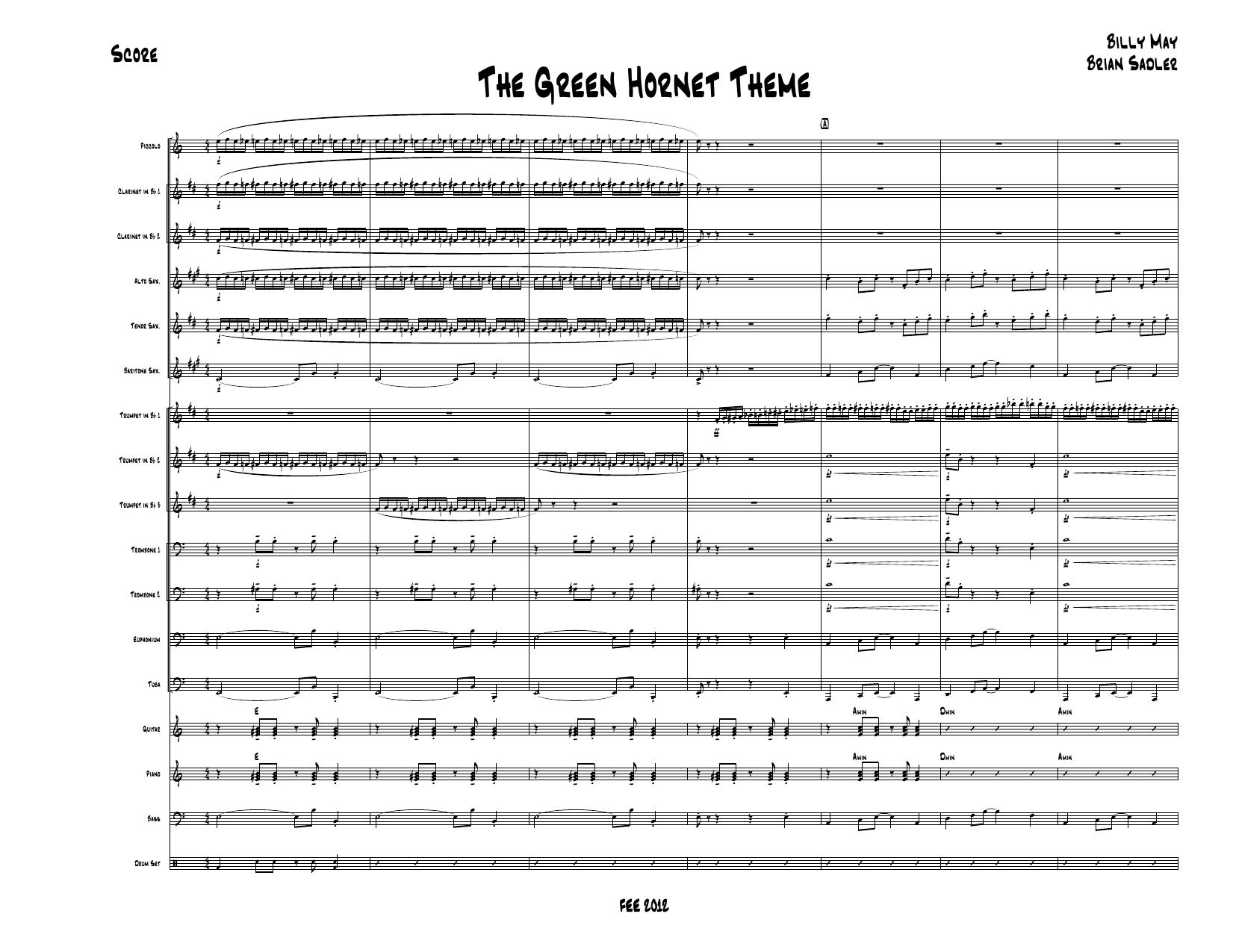
The Green Hornet Theme (B.May)
Composed by Billy May
Arranged by Billy May
- Ensemble: Big Band
- Pages: 27
- Instruments (17): Piccolo, Clarinet in Bb 1, Clarinet in Bb 2, Alto Sax., Tenor Sax., Baritone Sax., Trumpet in Bb 1, Trumpet in Bb 2, Trumpet in Bb 3, Trombone 1, Trombone 2, Euphonium, Tuba, Guitar, Piano, Bass, Drum Set
- Difficulty: medium
- Content: Individual Parts
- Format: PDF Download (Instant)
- Price: $24.99
Originally forged in the fires of 1960s television history, Billy May’s iconic theme for *The Green Hornet* remains one of the most electrifying fusions of spy-fi tension and swinging big band propulsion ever committed to tape. Composed and arranged by May for the 1966 ABC action series—and famously featuring legendary trumpeter Al Hirt on the original soundtrack—the piece immortalized the character's crime-fighting exploits through a relentless, high-octane groove. This driving motif bridges the gap between classic swing-era bombast and mid-century modal jazz-funk, capturing the restless energy of the urban underground through razor-sharp horn stabs and an unmistakable, galloping bassline feel. It stands as a monumental cultural touchstone that pushed television scoring into genuinely sophisticated jazz territory. Propelled by an aggressive, high-energy medium-up swing or straight-eight driving pulse, this arrangement oozes cinematic swagger, suspense, and raw bravado. The mood is tense yet effortlessly cool, evoking smoke-filled back alleys, high-speed chases, and the razor-sharp precision of 1960s cool jazz. Harmonically rich yet rhythmically direct, the chart relies heavily on chromatic tension and stinging brass countermelodies to generate immediate theatrical impact. The underlying pulse demands absolute precision from the rhythm section, laying down a relentless foundation that allows the surrounding horns to snap, snarl, and soar above the arrangement with maximum dramatic effect. Billy May’s signature arranging genius is stamped all over this score, heavily showcasing his trademark brass effects, including plunger mutes, dramatic rips, and biting shakes that mimic the buzzing of a hornet. May utilizes a tight, aggressive saxophone soli to slice through the texture, contrasted by thick, block-voiced brass shout choruses that build unrelenting vertical momentum. The writing exploits the extreme registers of the horns without sacrificing punch, ensuring that even a focused 9-instrument ensemble achieves the massive, room-filling sound of a full eighteen-piece jazz orchestra. Dynamic contrast is weaponized here; whispered, muted figures explode instantly into roaring, full-ensemble climaxes. Driving the thematic material, the upper reeds and lead trumpet share primary melodic duties, trading barbed motifs that require immaculate articulation and tonguing speed. While concise, the featured solo sections provide ample space for a lead horn player to stretch out over driving changes, feeding off the ferocious background figures supplied by the rest of the ensemble. Technical challenges center primarily on ensemble tightness, precise breath control during extended high-register phrases, and maintaining an unyielding rhythmic pocket through sudden tempo or dynamic shifts. The sheer kinetic joy of executing May's razor-sharp syncopations makes every rehearsal deeply rewarding and guarantees an unforgettable audience reaction. Advanced high school, collegiate, community, and professional big bands will find this arrangement an exceptional centerpiece for concerts, festival sets, and specialized radio-theme retrospectives. Because it is scored for a flexible 9-instrument configuration (Alto Sax, Tenor Sax, Baritone Sax, Trumpet, Trombone, and a robust rhythm/horn backup framework), it offers smaller or non-traditional jazz ensembles the chance to tackle heavyweight professional-grade literature without sacrificing sonic weight. Directors seeking to test their band's articulation, section blend, and theatrical presentation will discover an indispensable, crowd-pleasing masterclass in television scoring history. Executing this arrangement successfully demands absolute rhythmic unity, particularly between the rhythm section and the horn stabs. The tempo should be kept brisk and driving, avoiding any tendency to drag during the syncopated figures. Conductors must ensure that the eighth-note feel remains razor-sharp, balancing a swinging articulation with the punchy, straight-eighth edge characteristic of 1960s television action cues. Technically, the brass players will need to master immediate shifts between open horn playing and stylized effects like plunger mutes, dramatic falls, and aggressive doits. Saxophone sections must focus on light, dry tonguing during fast unison lines to maintain clarity. Rehearsals should isolate the rhythm section first to lock in the relentless, galloping groove before layering the horn sections. Pay meticulous attention to dynamic markings: when May writes a sudden *forte-piano* followed by a crescendo, the initial impact must be explosive, leaving room for the band to build even further into the phrase peaks. Q: What instruments and parts are included in this arrangement? A: This chart is scored for a 9-instrument ensemble, specifically featuring Alto Saxophone, Tenor Saxophone, Baritone Saxophone, Trumpet, Trombone, and essential rhythm section support parts across its 27 comprehensive pages. Q: What is the difficulty level of this Billy May chart? A: This arrangement is best suited for advanced high school, collegiate, and professional ensembles due to its demanding rhythmic synchronization, fast articulation requirements, and stylistic specialized mutes. Q: What is the historical style and background of the piece? A: Composed by Billy May for the 1966 *The Green Hornet* television series, the piece represents the pinnacle of mid-century cinematic jazz fusion, blending classic swing attitude with high-tension spy-genre orchestration. Q: What makes this specific arrangement unique? A: It features Billy May's trademark arranging signatures, including aggressive brass rips, plunger mute effects, and tight saxophone solis that scale down a massive cinematic sound for a focused 9-piece ensemble. Q: What is the recommended performance tempo and duration? A: The arrangement is designed for a fast, driving medium-up tempo with a performance duration of approximately 2 to 3 minutes, making it an ideal high-impact concert opener or closer.
Questions and answers
- What is included in the The Green Hornet Theme (B.May) PDF?
- The verified current file contains a conductor score and individual parts across 27 pages.
- How many instruments or parts are listed for The Green Hornet Theme (B.May)?
- The verified instrumentation list contains 17 entries for this Big Band arrangement.
- Who is credited for The Green Hornet Theme (B.May)?
- Composer: Billy May. Arranger: Billy May.
- What difficulty is listed for The Green Hornet Theme (B.May)?
- The verified difficulty level is medium.
- Can I preview The Green Hornet Theme (B.May) before buying?
- Yes. The product page provides a preview generated from the current PDF file.
- How is The Green Hornet Theme (B.May) delivered?
- After successful payment, the digital PDF is made available for download. The displayed price is $24.99.
Musicians Also Search For
The Green Hornet Theme Billy May PDF • The Green Hornet Theme Billy May sheet music • The Green Hornet Theme arranged by Billy May • Billy May big band charts • Billy May jazz arrangements PDF • The Green Hornet Theme Billy May big band arrangements • The Green Hornet Theme big band arrangements • The Green Hornet Theme big band PDF download • The Green Hornet Theme jazz sheet music • big band sheet music download • The Green Hornet Theme conductor score PDF • The Green Hornet Theme individual parts download • The Green Hornet Theme sheet music PDF • buy The Green Hornet Theme sheet music • download The Green Hornet Theme PDF • The Green Hornet Theme jazz charts • best Billy May big band arrangements • The Green Hornet Theme printable sheet music • big band repertoire PDF