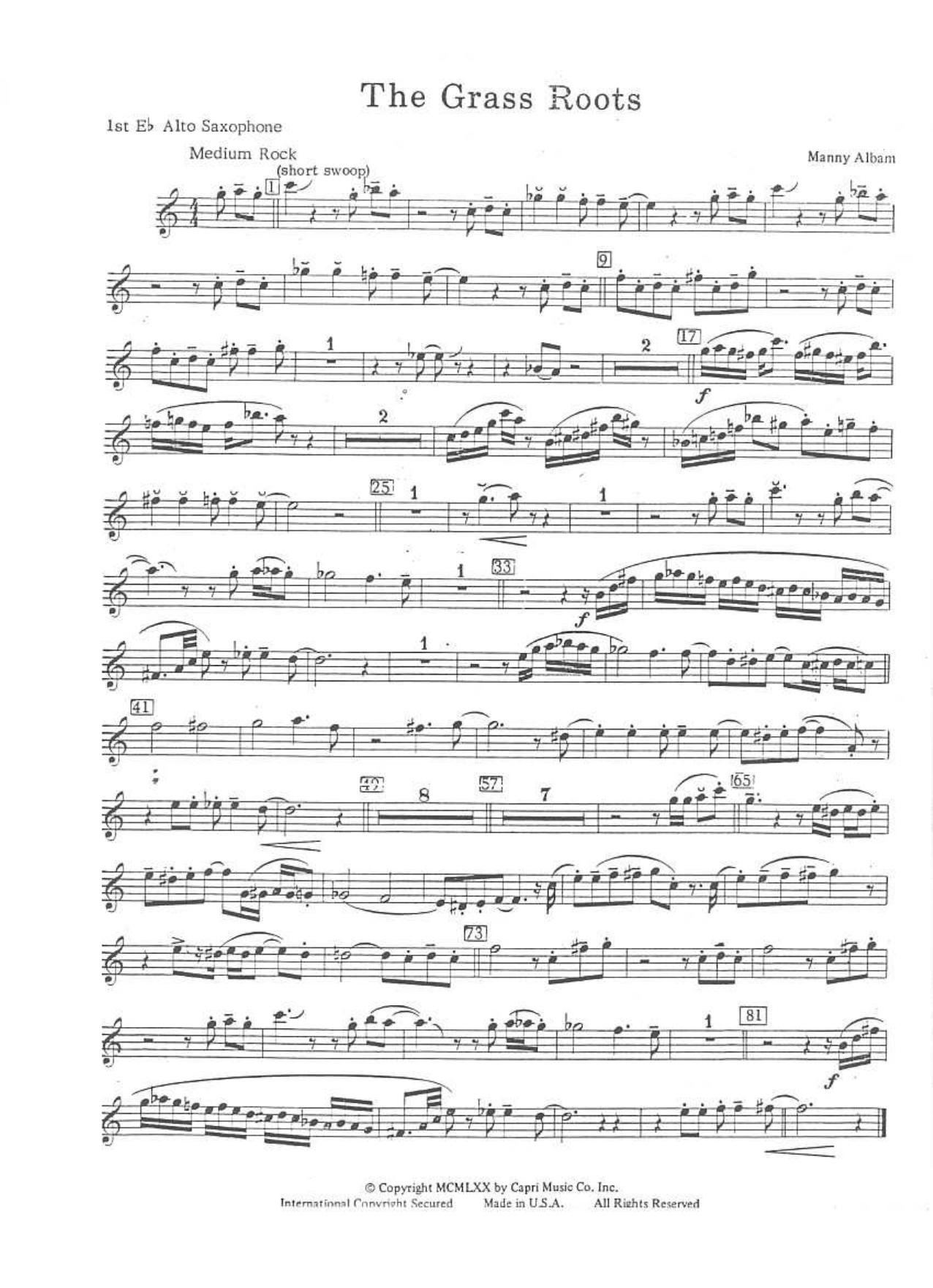
The Grass Roots (M.Albam)
Composed by Manny Albam
Arranged by Manny Albam
- Ensemble: Big Band
- Pages: 21
- Instruments (17): 1st Eb Alto Saxophone, 2nd Eb Alto Saxophone, 1st Bb Tenor Saxophone, 2nd Bb Tenor Saxophone, Eb Baritone Saxophone, 1st Trombone, 2nd Trombone, 3rd Trombone, 4th Trombone, 1st Bb Trumpet, 2nd Bb Trumpet, 3rd Bb Trumpet, 4th Bb Trumpet, Piano, Electric Bass (String Bass), Drums, Guitar
- Difficulty: medium
- Content: Individual Parts
- Format: PDF Download (Instant)
- Price: $24.99
Emanating from the vibrant New York jazz composition scene of the 1950s, Manny Albam’s "The Grass Roots" captures the sophisticated, witty, and tightly-knit modern jazz aesthetic that defined the post-swing era. Albam, renowned for his contributions to seminal recording projects like *The Jazz Workshop* and his collaborations with luminaries such as Stan Getz, Phil Woods, and the Count Basie orchestra, crafted this work as a masterclass in economy of means and smart counterpoint. Rooted in the bebop and cool jazz continuum, the composition reflects an era when writers sought to expand the harmonic vocabulary of the big band while maintaining an infectious, propulsive groove that rewarded active listening as much as social dancing. Driven by a medium-up swing feel in 4/4 time, the musical character is defined by an energetic interplay between crisp brass punches and lithe, conversational reed lines. The mood is buoyant and intellectually engaging, balancing sophisticated extended chord voicings with a blues-soaked swagger. Albam constructs the sonic architecture with signature cleverness: rather than relying strictly on heavy block-chord tuttis, he favors transparent, linear writing where voices weave independently across the ensemble. Dynamic shifts are handled with surgical precision, moving seamlessly from whispered, conspiratorial background figures to roaring, brass-heavy shout choruses that elevate the excitement without ever sounding cluttered. The arranger's unique treatment shines in the clever distribution of thematic material across the compact eight-instrument ensemble. The reed section—featuring Alto, Tenor, and Baritone Saxophones—often carries the primary thematic weight, utilizing close-interval voicings and agile countermelodies that recall Albam's penchant for distinctive tonal shadings. Solos are strategically integrated to maintain narrative momentum, giving featured improvisers ample room to stretch over harmonically rich changes while the rhythm section provides a resilient, unyielding pulse. Technical demands center on clean articulation, agile fingerwork in fast-moving modulatory passages, and an innate sense of swing subdivision to ensure the intricate ensemble figures lock together seamlessly. Advanced high school ensembles, collegiate studio jazz bands, and professional repertory groups will find this 21-page chart to be an invigorating challenge. Because the scoring is tailored for an eight-instrument configuration, individual players cannot hide behind a massive section; every part is exposed, requiring strong personal accountability, excellent intonation, and stylistic cohesion. Conductor and performers alike will discover endless depth in Albam's masterly voice-leading, making it a stellar showcase piece for concert programmers seeking sophisticated mid-century modern jazz writing that stretches the ensemble's musicianship. Achieving the correct stylistic execution of this Manny Albam chart requires careful attention to the relationship between the rhythm section and the horn players. The tempo should settle comfortably into a driving medium-swing feel where eighth notes are characteristically swung with a relaxed, forward-leaning pulse rather than an over-dotted, heavy triplet feel. Technically, the primary challenge lies in the tight ensemble integration across the eight instruments. Because the arrangement lacks the padding of a full big band, intonation and balance are critical; lead players must project clearly while inner voices balance dynamic swells to ensure counterlines remain audible beneath the melody. Articulation must be uniformly crisp—short notes should be played with a defined, dry tongue, and longer notes should feature a warm, controlled vibrato typical of the 1950s New York studio style. Rehearsals should begin by isolating the rhythm section to lock in the foundational groove before layering in the horn sections section-by-section. Pay close attention to dynamic markings; Albam's sophisticated voicings depend heavily on proper dynamic contrast to bring out inner-voice movement during transitional interludes. Soloists should study the underlying harmonic progression closely, utilizing linear bebop vocabulary that mirrors the witty, driving character of the surrounding ensemble scoring. Q: What instruments and parts are included in this arrangement? A: This arrangement is scored for an eight-instrument ensemble featuring Alto Saxophone, Tenor Saxophone, Baritone Saxophone, Trumpet, Trombone, and a complete rhythm section, spanning a total of 21 pages of music. Q: What is the difficulty level of this piece? A: This arrangement is best suited for advanced high school, collegiate, and professional jazz ensembles due to its exposed 8-part writing, intricate harmonic structures, and demand for precise individual accountability. Q: What is the historical style and context of "The Grass Roots"? A: Written by Manny Albam during the 1950s, this piece embodies the sophisticated, modern bebop and cool jazz studio aesthetic that characterized New York's elite arranging scene of that era. Q: What makes Manny Albam's arrangement style unique in this piece? A: Albam's writing is celebrated for its transparent, linear counterpoint, witty harmonic shifts, and clever distribution of melodic lines across a compact ensemble rather than relying solely on heavy tutti blocks. Q: What is the recommended tempo and performance duration? A: The piece is designed to be performed at a driving medium-swing tempo in 4/4 time, providing an energetic and concise feature suitable for competitive festival programs or formal concert sets.
Questions and answers
- What is included in the The Grass Roots (M.Albam) PDF?
- The verified current file contains individual parts across 21 pages.
- How many instruments or parts are listed for The Grass Roots (M.Albam)?
- The verified instrumentation list contains 17 entries for this Big Band arrangement.
- Who is credited for The Grass Roots (M.Albam)?
- Composer: Manny Albam. Arranger: Manny Albam.
- What difficulty is listed for The Grass Roots (M.Albam)?
- The verified difficulty level is medium.
- Can I preview The Grass Roots (M.Albam) before buying?
- Yes. The product page provides a preview generated from the current PDF file.
- How is The Grass Roots (M.Albam) delivered?
- After successful payment, the digital PDF is made available for download. The displayed price is $24.99.
Musicians Also Search For
The Grass Roots Manny Albam PDF • The Grass Roots Manny Albam sheet music • The Grass Roots arranged by Manny Albam • Manny Albam big band charts • Manny Albam jazz arrangements PDF • The Grass Roots Manny Albam big band arrangements • The Grass Roots big band arrangements • The Grass Roots big band PDF download • The Grass Roots jazz sheet music • big band sheet music download • The Grass Roots individual parts download • The Grass Roots sheet music PDF • buy The Grass Roots sheet music • download The Grass Roots PDF • The Grass Roots jazz charts • best Manny Albam big band arrangements • The Grass Roots printable sheet music • big band repertoire PDF