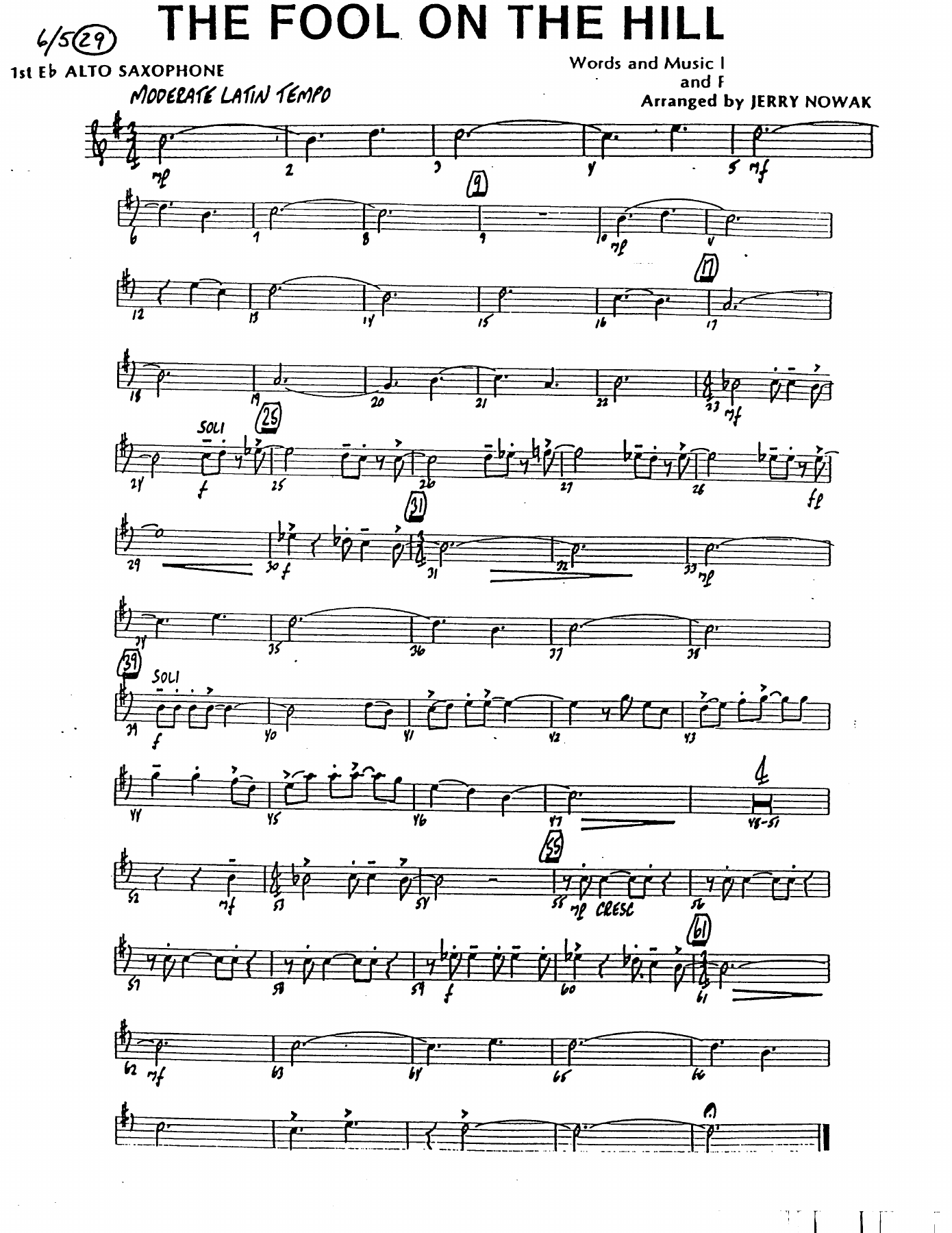
The Fool On The Hill (J.Nowak)
Composed by Lennon-McCartney
Arranged by J.Nowak
- Ensemble: Big Band
- Style: Jazz Standard
- Pages: 29
- Instruments (15): Alto Saxophone 1, Alto Saxophone 2, Tenor Saxophone 1, Tenor Saxophone 2, Baritone Saxophone, Trumpet 1, Trumpet 2, Trumpet 3, Trombone 1, Trombone 2, Trombone 3, Piano, Bass, Drums, Guitar
- Difficulty: medium
- Content: Individual Parts
- Format: PDF Download (Instant)
- Price: $24.99
"The Fool On The Hill," a timeless ballad from The Beatles' 1967 album *Magical Mystery Tour*, emerged during the zenith of psychedelic rock and pop innovation. Composed by the legendary Lennon-McCartney partnership, the song quickly transcended its pop origins, its poignant melody and introspective lyrics making it a natural fit for interpretation across diverse genres. While not traditionally a jazz standard from the Tin Pan Alley era, its enduring melodic beauty and harmonic sophistication have led countless jazz artists, including Sergio Mendes and Wes Montgomery, to embrace and reinterpret it, cementing its status as a beloved contemporary standard. The piece captures a mood of gentle contemplation and subtle melancholy, exploring themes of individuality and societal perception, which resonate deeply with the expressive capabilities of jazz. J.Nowak's arrangement for big band masterfully re-envisions this iconic tune, transforming its introspective pop sensibility into a lush, sophisticated jazz ballad. The arrangement is set in a deliberate, slow ballad tempo, likely around quarter note = 60-70 BPM, allowing ample space for the melody to unfold with expressive depth. Nowak's signature approach often involves rich, dense voicings that create a warm, enveloping sound, and this arrangement is no exception. Expect carefully crafted saxophone soli sections that highlight the ensemble's blend and intonation, alongside brass figures that provide both harmonic support and understated counterpoint. The overall mood is one of elegant introspection, building gently to moments of understated grandeur without ever sacrificing the song's inherent tenderness. The arrangement opens with an ethereal introduction, likely featuring sustained woodwind textures before the melody is introduced, perhaps initially by a featured alto saxophone or trumpet, allowing for maximum expressiveness. Nowak typically features melodic lines passed between sections, ensuring all parts contribute to the narrative. While specific solo sections are common in Nowak's work, here they would likely be lyrical and harmonically rich, offering a soloist (perhaps tenor saxophone or flugelhorn) an opportunity for profound musical storytelling over a supportive ensemble. Technical challenges will center on achieving seamless blend and balance within the dense voicings, maintaining consistent breath support at slow tempos, and executing precise dynamic control. The reward lies in performing a truly beautiful and moving piece that showcases the band's musical maturity and expressive capabilities, culminating in a powerful, yet sensitive, full-ensemble statement before a reflective coda. This arrangement is ideally suited for college-level jazz ensembles, advanced community bands, and professional big bands seeking a sophisticated and emotionally resonant ballad for their repertoire. Its demands on intonation, blend, and musicality make it an excellent vehicle for developing expressive performance skills, while its familiar melody ensures audience engagement. The depth of Nowak's writing provides ample interpretive opportunities, making it a rewarding experience for both musicians and listeners. Conductors should prioritize achieving a unified, sustained sound, particularly in the saxophone and brass sections. The tempo should be a very relaxed, slow ballad, emphasizing breath and phrase shaping over rhythmic drive. Aim for a quarter note around 60-66 BPM, allowing the melody to breathe. Key technical challenges include maintaining precise intonation within the rich, often close-voiced harmonies, especially in the saxophone soli passages. Encourage musicians to listen across sections to ensure blend and balance. Dynamics are crucial; guide the band through subtle crescendos and decrescendos to build and release tension naturally. Articulation should be legato and warm, avoiding harsh attacks. Rehearsal time should focus on long tones within chords, ensuring each voice contributes to the overall timbre, and on shaping the melodic lines with sensitivity. No special mutes or extended techniques are explicitly required, allowing the natural beauty of the ensemble's sound to shine. Q: What instruments are included in this arrangement? A: This is a standard 17-instrument big band arrangement, including Alto Saxophone 1, Alto Saxophone 2, Tenor Saxophone 1, Tenor Saxophone 2, Baritone Saxophone, Trumpet 1, Trumpet 2, Trumpet 3, Trumpet 4, Trombone 1, Trombone 2, Trombone 3, Trombone 4, Piano, Bass, Drums, and Guitar. Q: What is the difficulty level of "The Fool On The Hill (J.Nowak)"? A: This arrangement is considered advanced intermediate to advanced. Its demands on ensemble blend, intonation, and expressive musicality make it suitable for college-level, advanced community, or professional jazz ensembles. Q: What musical style does this arrangement represent, and what is its historical context? A: This arrangement presents "The Fool On The Hill," a 1967 Lennon-McCartney pop ballad, as a sophisticated jazz standard. J.Nowak reinterprets the original's introspective mood within a lush big band jazz ballad framework. Q: What makes J.Nowak's arrangement of "The Fool On The Hill" unique? A: J.Nowak's treatment is characterized by rich, dense voicings, carefully crafted saxophone soli sections, and a focus on expressive, lyrical playing within a slow ballad tempo. It transforms the pop original into a deeply emotional and harmonically sophisticated jazz piece. Q: What is the typical performance duration or tempo for this piece? A: Given its slow ballad tempo (approximately quarter note = 60-70 BPM) and the depth of the arrangement, a typical performance duration would likely range from 4 to 6 minutes, depending on soloist improvisation and interpretive choices.
Musicians Also Search For
The Fool On The Hill J.Nowak PDF • The Fool On The Hill J.Nowak sheet music • The Fool On The Hill arranged by J.Nowak • J.Nowak big band charts • J.Nowak jazz arrangements PDF • The Fool On The Hill Lennon-McCartney sheet music • The Fool On The Hill Lennon-McCartney big band arrangement • Lennon-McCartney big band charts • The Fool On The Hill big band arrangement • The Fool On The Hill big band PDF download • The Fool On The Hill jazz ensemble sheet music • big band sheet music instant download • The Fool On The Hill individual parts download • The Fool On The Hill sheet music with parts • The Fool On The Hill Jazz Standard chart • Jazz Standard big band arrangements • buy The Fool On The Hill sheet music online • download The Fool On The Hill PDF • The Fool On The Hill jazz chart • best J.Nowak big band arrangements • Lennon-McCartney songs arranged by J.Nowak • The Fool On The Hill printable sheet music • big band repertoire PDF