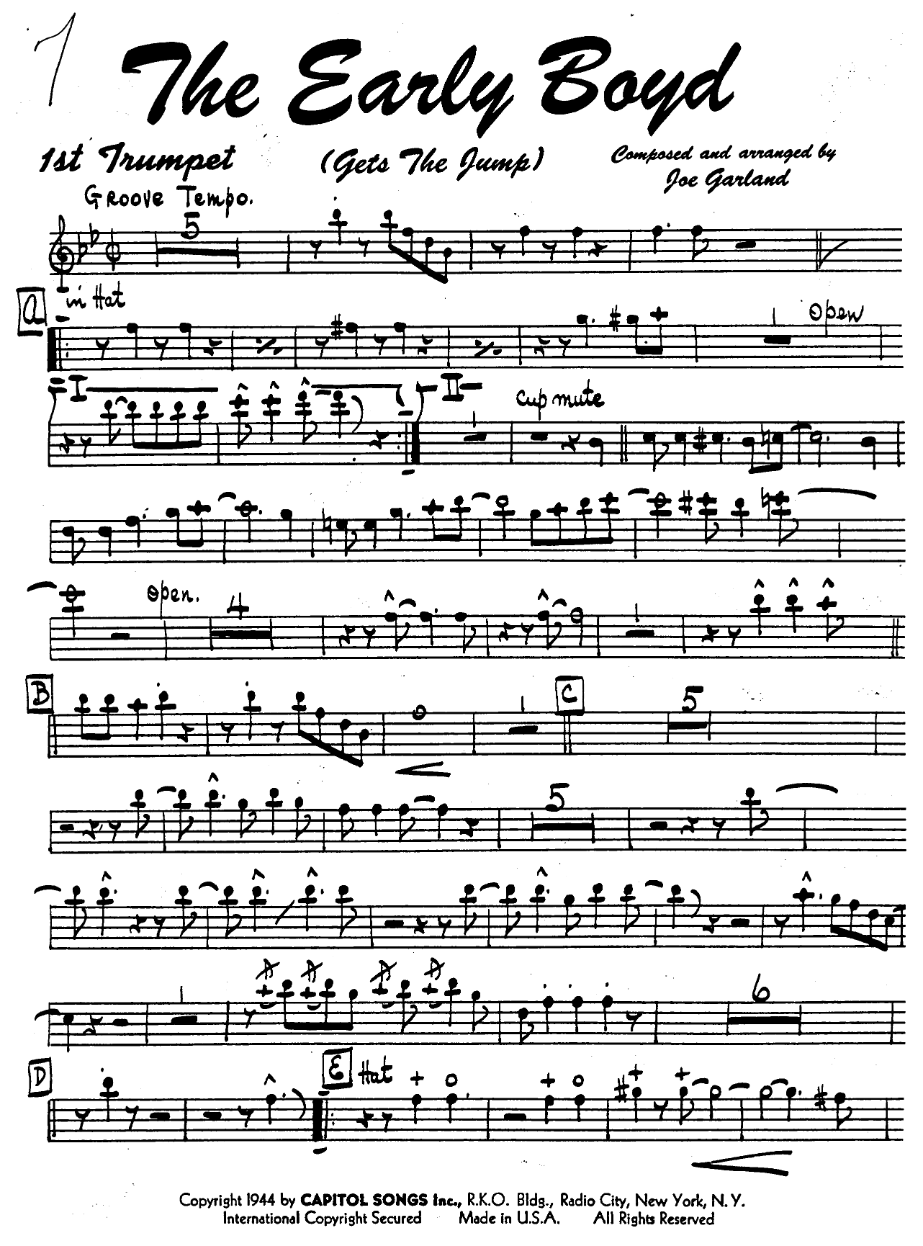
The Early Boyd (J.Garland) sheet music preview

The Early Boyd (J.Garland)

Composed by Joe Garland

Arranged by Benny Carter

  • Ensemble: Big Band
  • Style: Jazz Standard
  • Pages: 31
  • Instruments (14): 1st Trumpet, 2nd Trumpet, 3rd Trumpet, 1st Trombone, 2nd Trombone, 3rd Trombone, 1st Alto Sax., 3rd Alto Sax., 1st Tenor Sax., 2nd Tenor Sax., 5th Eb Bar. Sax., Bass, Drums, Piano
  • Difficulty: medium
  • Content: Individual Parts
  • Format: PDF Download (Instant)
  • Price: $24.99

"The Early Boyd," penned by the prolific composer and saxophonist Joe Garland, stands as a quintessential big band jazz standard, embodying the vibrant energy and sophisticated harmonic language of the swing era. While Garland's name is perhaps most famously associated with "In the Mood," "The Early Boyd" showcases his mastery of crafting memorable melodies and driving rhythmic figures that became the bedrock of big band repertoire. This particular arrangement, masterfully conceived by the legendary Benny Carter, breathes new life into the classic, presenting a medium-up swing chart that is both historically significant and immensely rewarding to perform. The original piece likely gained traction in the late 1930s or early 1940s, a period when big bands dominated the popular music landscape, and its infectious groove and catchy theme made it a favorite among dancers and musicians alike. Benny Carter's treatment of "The Early Boyd" is a masterclass in big band arranging, reflecting his unparalleled ear for voicings and his profound understanding of instrumental capabilities. Known for his elegant and often understated approach, Carter imbues this chart with his signature warmth and clarity. The arrangement maintains a bright, medium-up swing tempo in 4/4, primarily in the key of C major, evoking a mood of sophisticated exuberance. Carter's distinctive sax section voicings are immediately apparent, characterized by their smooth, close-knit harmonies that glide effortlessly over the rhythm section. The brass writing is punchy yet refined, avoiding bombast in favor of precision and melodic integrity. Soli sections for the saxophones are prominent, showcasing intricate lines that demand tight ensemble playing and excellent blend. The arrangement features the main melody carried initially by the saxophone section, often doubled or harmonized, before being passed to the brass. Carter skillfully employs call-and-response figures between sections, creating dynamic interplay and building intensity. There are ample opportunities for featured solos, typically for tenor saxophone and trumpet, allowing individual players to shine within the ensemble framework. The technical challenges lie in maintaining the precise swing feel at a brisk tempo, executing clean articulations, and achieving impeccable balance and blend, particularly in the intricate soli passages and shout choruses. The rewarding aspect of performing this chart is experiencing the seamless flow of Carter's writing, the joy of a well-executed swing groove, and the opportunity to contribute to a piece of jazz history. This arrangement is ideally suited for advanced high school, college, community, and professional big bands. Its musical depth and technical demands offer significant educational value for developing musicians, while its inherent swing and sophisticated arranging make it a compelling choice for seasoned ensembles. Bands seeking to explore the nuanced artistry of Benny Carter and the enduring appeal of swing-era standards will find "The Early Boyd" to be an indispensable addition to their repertoire. "The Early Boyd" demands a consistent, driving medium-up swing feel from the outset; conductors should emphasize a crisp, unhurried quarter-note pulse. Articulation is paramount, particularly in the sax soli sections and brass figures, requiring precise short notes and controlled releases. Pay close attention to Benny Carter's characteristic dynamic markings, which are crucial for shaping phrases and highlighting melodic content. Trumpet and trombone sections should focus on blend and intonation, especially in unison and harmonized lines, while the rhythm section must provide a solid, swinging foundation without overpowering the horns. Encourage soloists to embrace the swing idiom, focusing on melodic invention and rhythmic drive. Rehearsal time should be dedicated to cleaning up the intricate sax soli passages and ensuring the shout chorus builds effectively without becoming unwieldy. No special mutes or extended techniques are explicitly required beyond standard jazz articulations like falls and scoops. Q: What instruments are included in this arrangement of "The Early Boyd"? A: This big band arrangement is scored for 17 instruments, including Alto Saxophone 1 & 2, Tenor Saxophone 1 & 2, Baritone Saxophone, Trumpet 1-4, Trombone 1-4, Guitar, Piano, Bass, and Drums. Q: What is the difficulty level of this arrangement? A: This arrangement is considered advanced high school to college/professional level. It requires strong ensemble playing, precise articulation, and a solid understanding of the swing idiom. Q: What is the musical style and historical context of this piece? A: "The Early Boyd" is a classic jazz standard from the swing era (late 1930s/early 1940s), originally composed by Joe Garland. This arrangement by Benny Carter exemplifies sophisticated big band writing of that period. Q: What makes Benny Carter's arrangement of "The Early Boyd" unique? A: Benny Carter's distinctive approach is evident in his elegant saxophone voicings, tasteful brass writing, and seamless melodic development. His arrangements are known for their clarity, balance, and sophisticated harmonic language. Q: What is the typical performance duration and tempo for this piece? A: While variable based on solos, a typical performance of this medium-up swing chart would be approximately 3-4 minutes. The tempo should be a bright, driving medium-up swing, around 180-200 BPM.

Questions and answers

What is included in the The Early Boyd (J.Garland) PDF?
The verified current file contains individual parts across 31 pages.
How many instruments or parts are listed for The Early Boyd (J.Garland)?
The verified instrumentation list contains 14 entries for this Big Band arrangement.
Who is credited for The Early Boyd (J.Garland)?
Composer: Joe Garland. Arranger: Benny Carter.
What difficulty is listed for The Early Boyd (J.Garland)?
The verified difficulty level is medium.
What style is listed for The Early Boyd (J.Garland)?
The catalog lists the style as Jazz Standard.
Can I preview The Early Boyd (J.Garland) before buying?
Yes. The product page provides a preview generated from the current PDF file.
How is The Early Boyd (J.Garland) delivered?
After successful payment, the digital PDF is made available for download. The displayed price is $24.99.

Musicians Also Search For

The Early Boyd Benny Carter PDFThe Early Boyd Benny Carter sheet musicThe Early Boyd arranged by Benny CarterBenny Carter big band chartsBenny Carter jazz arrangements PDFThe Early Boyd Joe Garland sheet musicThe Early Boyd Joe Garland big band arrangementsJoe Garland big band chartsThe Early Boyd big band arrangementsThe Early Boyd big band PDF downloadThe Early Boyd jazz sheet musicbig band sheet music downloadThe Early Boyd individual parts downloadThe Early Boyd sheet music PDFThe Early Boyd Jazz Standard chartsJazz Standard big band arrangementsbuy The Early Boyd sheet musicdownload The Early Boyd PDFThe Early Boyd jazz chartsbest Benny Carter big band arrangementsJoe Garland arranged by Benny CarterThe Early Boyd printable sheet musicbig band repertoire PDF

All arrangements by Benny Carter All Joe Garland sheet music