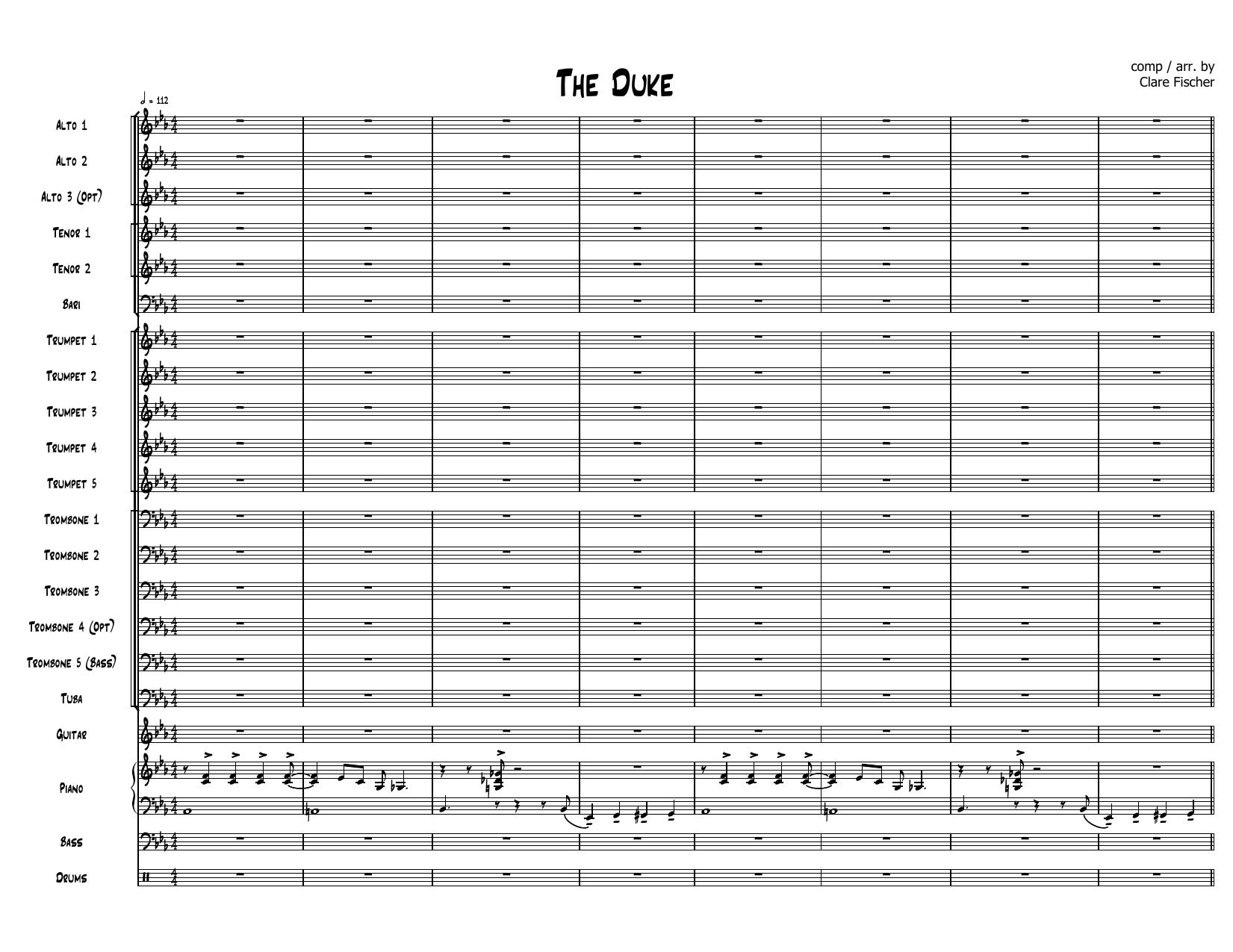
The Duke (C.Fischer) sheet music preview

The Duke (C.Fischer)

Composed by Dave Brubeck

Arranged by C.Fischer

  • Ensemble: Big Band
  • Style: Jazz Standard
  • Pages: 81
  • Instruments (21): Alto Saxophone 1, Alto Saxophone 2, Alto Saxophone 3 (Optional), Tenor Saxophone 1, Tenor Saxophone 2, Baritone Saxophone, Trumpet 1, Trumpet 2, Trumpet 3, Trumpet 4 (Jazz), Trumpet 5, Trombone 1, Trombone 2 (Jazz), Trombone 3, Trombone 4 (Optional), Trombone 5 (Bass), Tuba, Guitar, Piano, Bass, Drums
  • Difficulty: advanced
  • Content: Individual Parts
  • Format: PDF Download (Instant)
  • Price: $24.99

Dave Brubeck originally composed "The Duke" in 1954 as a tribute to Duke Ellington, releasing it first on his landmark 1955 Columbia album *Brubeck Time*. Built upon a fascinating harmonic and structural concept where the blues progression is subtly inverted and reharmonized, the composition quickly transcended its origins as a cool jazz classic to become a staple of modern big band repertoire. Brubeck’s conceptualization bridges the sophisticated compositional language of the Ellington orchestra with West Coast counterpoint and modal exploration. The piece stands out among jazz standards for its deceptive simplicity on the surface, masking a rich tapestry of chromatic voice-leading and subtle rhythmic shifts that challenge both performer and listener alike. C.Fischer’s contemporary big band setting captures the sophisticated essence of Brubeck's original vision while expanding its sonic palette for a full 21-piece ensemble. Set in a relaxed, infectious medium swing groove, the chart opens with an understated, atmospheric introduction before laying down a supple, blues-inflected rhythmic foundation. The mood shifts effortlessly between velvety, Ellingtonian chord clusters in the brass and crisp, linear counterpoint in the saxophone section. Rich extended harmonies—utilizing major sevenths, sharp-elevenths, and altered dominants—create a lush, sophisticated sonic landscape that evokes late-night sophisticated cool balanced by moments of surging, triumphant big band power. The melodic weight is distributed artfully across the ensemble, featuring lush woodwind solis that highlight the three-alto saxophone configuration (with an optional third alto part for expanded voicing flexibility). The arrangement showcases ample space for featured soloists over traditional blues-based changes, allowing advanced improvisers to stretch out within a secure structural framework. C.Fischer builds momentum through a carefully paced dynamic arc, leading into a harmonically adventurous shout chorus that reinterprets Brubeck's themes with biting brass stabs and rolling saxophone lines. Technical demands center on clean articulation, stylistic uniformity within the saxophone section, and precise control over dynamic shading during exposed ensemble passages. Advanced high school ensembles with strong section players, as well as collegiate, community, and professional big bands, will find this chart an immensely rewarding centerpiece for a concert program. The inclusion of a comprehensive conductor score alongside the 21 individual instrumental parts ensures that directors can meticulously balance the intricate inner-voices and counter-melodies that define Fischer's arrangement. Performing this chart offers students and professionals alike a masterclass in dynamic contrast, stylistic versatility, and the translation of small-group cool jazz idioms into a powerful, widescreen big band medium. Recreating the authentic feel of "The Duke" requires a deep understanding of medium swing phrasing; eighth notes should be characteristically swung with weight given to the backbeats (beats two and four), avoiding any stiff, square execution. The rhythm section is the engine of this chart: the drummer should maintain a light, driving ride-cymbal pattern with crisp hi-hat chicks on two and four, while the bass player walks a steady, quarter-note line that anchors the shifting chromatic harmony without overcrowding. Brass players must exercise careful intonation control during the dense, muted ensemble sections, utilizing cup or straight mutes where indicated to achieve that classic smoky, textured timbre. During the sax soli, ensure the blend is homogeneous, keeping the lead alto at the forefront while the inner voices lock tightly into the chordal drops. Rehearsal should begin slowly, isolating the tricky modulatory transitions and interlocking rhythm section figures before locking in the tempo. Q: What instruments and parts are included in this publication? A: The physical and digital materials comprise a full 81-page conductor score and 21 distinct instrumental parts, including three alto saxophones (with Alto 3 marked as optional), two tenor saxophones, a baritone saxophone, four trumpets, four trombones, guitar, piano, bass, and drums. Q: What is the overall difficulty level of this arrangement? A: This arrangement is graded as advanced-intermediate to advanced, making it ideal for skilled high school, collegiate, and professional big bands due to its sophisticated harmonic language and ensemble-wide rhythmic interplay. Q: What is the historical style and musical context of "The Duke"? A: Originally composed by Dave Brubeck in 1954 as a tribute to Duke Ellington, this piece represents a sophisticated synthesis of cool jazz modernism and traditional Ellingtonian big band voicing, built upon an ingenious blues-based harmonic structure. Q: What makes C.Fischer's arrangement unique compared to other versions? A: Fischer utilizes an expanded 21-instrument voicing—incorporating an optional third alto saxophone—alongside lush, modern harmonic reharmonizations and a meticulously paced dynamic arc that transforms a classic piano-triad concept into a vibrant, multi-layered big band showcase. Q: What is the performance duration and recommended tempo for this chart? A: While performance time varies slightly based on soloist choruses and stylistic choices, the piece typically runs around 4 to 5 minutes at a relaxed, driving medium-swing tempo of approximately 116 to 120 beats per minute.

Questions and answers

What is included in the The Duke (C.Fischer) PDF?
The verified current file contains a conductor score and individual parts across 81 pages.
How many instruments or parts are listed for The Duke (C.Fischer)?
The verified instrumentation list contains 21 entries for this Big Band arrangement.
Who is credited for The Duke (C.Fischer)?
Composer: Dave Brubeck. Arranger: C.Fischer.
What difficulty is listed for The Duke (C.Fischer)?
The verified difficulty level is advanced.
What style is listed for The Duke (C.Fischer)?
The catalog lists the style as Jazz Standard.
Can I preview The Duke (C.Fischer) before buying?
Yes. The product page provides a preview generated from the current PDF file.
How is The Duke (C.Fischer) delivered?
After successful payment, the digital PDF is made available for download. The displayed price is $24.99.

Musicians Also Search For

The Duke C.Fischer PDFThe Duke C.Fischer sheet musicThe Duke arranged by C.FischerC.Fischer big band chartsC.Fischer jazz arrangements PDFThe Duke Dave Brubeck sheet musicThe Duke Dave Brubeck big band arrangementsDave Brubeck big band chartsThe Duke big band arrangementsThe Duke big band PDF downloadThe Duke jazz sheet musicbig band sheet music downloadThe Duke conductor score PDFThe Duke individual parts downloadThe Duke sheet music PDFThe Duke Jazz Standard chartsJazz Standard big band arrangementsbuy The Duke sheet musicdownload The Duke PDFThe Duke jazz chartsbest C.Fischer big band arrangementsDave Brubeck arranged by C.FischerThe Duke printable sheet musicbig band repertoire PDF

All arrangements by C.Fischer All Dave Brubeck sheet music