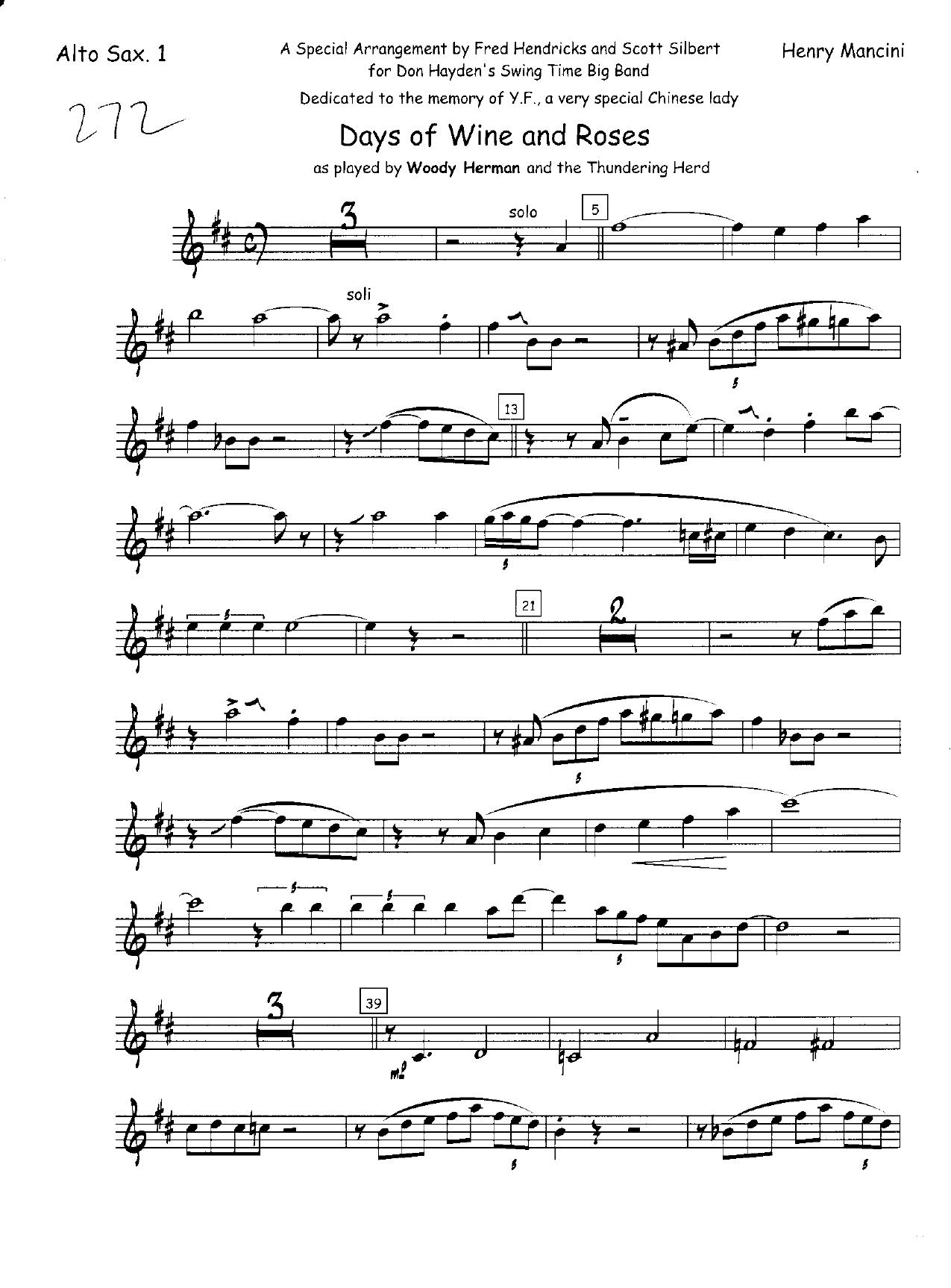
The Days Of Wine And Roses (S.Silbert)
Composed by Henry Mancini
Arranged by S.Silbert
- Ensemble: Big Band
- Style: Jazz Standard
- Pages: 42
- Instruments (16): Alto Sax. 1, Alto Sax. 2, Tenor Sax. 1, Tenor Sax. 2, Baritone Sax., Trumpet 1, Trumpet 2, Trumpet 3, Trumpet 4, Trombone 1, Trombone 2, Trombone 3, Trombone 4, Piano, Bass, Drum Set
- Difficulty: medium
- Content: Individual Parts
- Format: PDF Download (Instant)
- Price: $24.99
Henry Mancini and Johnny Mercer’s cinematic masterpiece "The Days of Wine and Roses," introduced in the 1962 film of the same name and immortalized by Andy Williams and countless jazz icons, occupies a revered place in the Great American Songbook. Earning both the Academy Award for Best Original Song and the Grammy Award for Record of the Year, its bittersweet, evocative melody quickly transitioned from the silver screen into an essential jazz standard. Improvised interpretations by legends such as Bill Evans, Wes Montgomery, and Oscar Peterson cemented its reputation as a sophisticated vehicle for harmonic exploration, balancing poignant nostalgia with driving momentum. In this compelling big band adaptation, arranger S.Silbert breathes new life into the familiar 32-bar AABA form, casting the composition in a sophisticated medium-swing groove that highlights the inherent tension and release of Mancini’s changes. The chart opens with an atmospheric, harmonically rich intro before settling into a relaxed yet propulsive pocket. The mood oscillates between tender introspection and vibrant, swinging exuberance, evoking late-night smoky club atmospheres punctuated by bursts of brass-driven jubilation. S.Silbert utilizes lush, extended chord voicings in the reed and brass sections to heighten the emotional weight of the melody, weaving counterlines that add depth without muddying the texture. S.Silbert’s distinct arranging voice shines through inventive section writing and dynamic contrast. The melody is initially introduced by a breathy saxophone soli before the full ensemble gradually builds into punchy, interconnected shout choruses that showcase tight ensemble phrasing. Skilful use of dynamic shading and subtle modulations keeps the narrative arc engaging from the first downbeat to the final chord. Featured solo space allows a lead horn player to stretch out over standard changes, supported by crisp background figures from the brass that drive the soloist forward without crowding the sonic space. Advanced high school ensembles, collegiate jazz orchestras, and professional community big bands will find this 42-page arrangement to be an exceptionally rewarding addition to their repertoire. While the rhythm section must maintain a steady, buoyant swing feel and the lead trumpet will navigate comfortable upper-register demands, the primary challenge lies in achieving a unified, vocal-like phrasing across the entire 16-instrument ensemble. Conscientious attention to articulation, balance, and rubato-to-tempo transitions will yield a polished, professional performance that captivates audiences and honors the timeless elegance of the original composition. Success with S.Silbert’s chart hinges on nailing the relaxed medium-swing tempo—avoid rushing the groove, as the momentum should feel effortless and forward-driving. Rhythm section players must lock in tightly; the drummer should favor a feather-light bass drum touch and crisp ride cymbal pattern, while the pianist and guitarist should lean toward sparse, comping chord shells that emphasize upper-structure extensions rather than heavy block chords. Key technical challenges involve the execution of synchronized dynamic swells and clean, articulated bebop-infused lines in the horn sections. Ensure that the saxophone soli breathes together as a single voice, matching vibrato widths and articulation styles. Brass players should pay close attention to marked dynamic contrasts, ensuring that background figures support rather than overpower the designated soloists. Rehearsal time is best spent isolating the transitional interludes and balancing the chordal voicings in the muted brass sections before running the chart at full tempo. Q: What specific instruments and parts are included in this 16-instrument arrangement? A: The instrumentation comprises a standard big band setup across 42 pages of score and parts, specifically featuring Alto Saxophone 1, Alto Saxophone 2, Tenor Saxophone 1, Tenor Saxophone 2, Baritone Saxophone, and a full complement of brass and rhythm sections. Q: What is the difficulty level of S.Silbert's big band arrangement of "The Days Of Wine And Roses"? A: This chart is graded as intermediate-advanced, making it ideal for skilled high school jazz bands, collegiate ensembles, and professional community big bands looking for a sophisticated challenge. Q: What musical style and historical context does this arrangement explore? A: Rooted in the jazz standard tradition, this arrangement reimagines Henry Mancini’s 1962 Academy Award-winning composition through a sophisticated, medium-swing big band lens that echoes the golden era of orchestrated jazz. Q: What makes this particular arrangement by S.Silbert unique? A: S.Silbert distinguishes this chart through lush extended harmonies, inventive saxophone solis, evocative dynamic shifting, and clever background figures that keep the classic AABA form fresh and engaging for performers and listeners alike. Q: What is the recommended performance duration and tempo feel for this piece? A: The arrangement is built around a relaxed, medium-swing tempo in 4/4 time, yielding a performance duration of approximately 4 to 5 minutes depending on the length allotted for improvised solos.
Questions and answers
- What is included in the The Days Of Wine And Roses (S.Silbert) PDF?
- The verified current file contains individual parts across 42 pages.
- How many instruments or parts are listed for The Days Of Wine And Roses (S.Silbert)?
- The verified instrumentation list contains 16 entries for this Big Band arrangement.
- Who is credited for The Days Of Wine And Roses (S.Silbert)?
- Composer: Henry Mancini. Arranger: S.Silbert.
- What difficulty is listed for The Days Of Wine And Roses (S.Silbert)?
- The verified difficulty level is medium.
- What style is listed for The Days Of Wine And Roses (S.Silbert)?
- The catalog lists the style as Jazz Standard.
- Can I preview The Days Of Wine And Roses (S.Silbert) before buying?
- Yes. The product page provides a preview generated from the current PDF file.
- How is The Days Of Wine And Roses (S.Silbert) delivered?
- After successful payment, the digital PDF is made available for download. The displayed price is $24.99.
Musicians Also Search For
The Days Of Wine And Roses S.Silbert PDF • The Days Of Wine And Roses S.Silbert sheet music • The Days Of Wine And Roses arranged by S.Silbert • S.Silbert big band charts • S.Silbert jazz arrangements PDF • The Days Of Wine And Roses Henry Mancini sheet music • The Days Of Wine And Roses Henry Mancini big band arrangements • Henry Mancini big band charts • The Days Of Wine And Roses big band arrangements • The Days Of Wine And Roses big band PDF download • The Days Of Wine And Roses jazz sheet music • big band sheet music download • The Days Of Wine And Roses individual parts download • The Days Of Wine And Roses sheet music PDF • The Days Of Wine And Roses Jazz Standard charts • Jazz Standard big band arrangements • buy The Days Of Wine And Roses sheet music • download The Days Of Wine And Roses PDF • The Days Of Wine And Roses jazz charts • best S.Silbert big band arrangements • Henry Mancini arranged by S.Silbert • The Days Of Wine And Roses printable sheet music • big band repertoire PDF