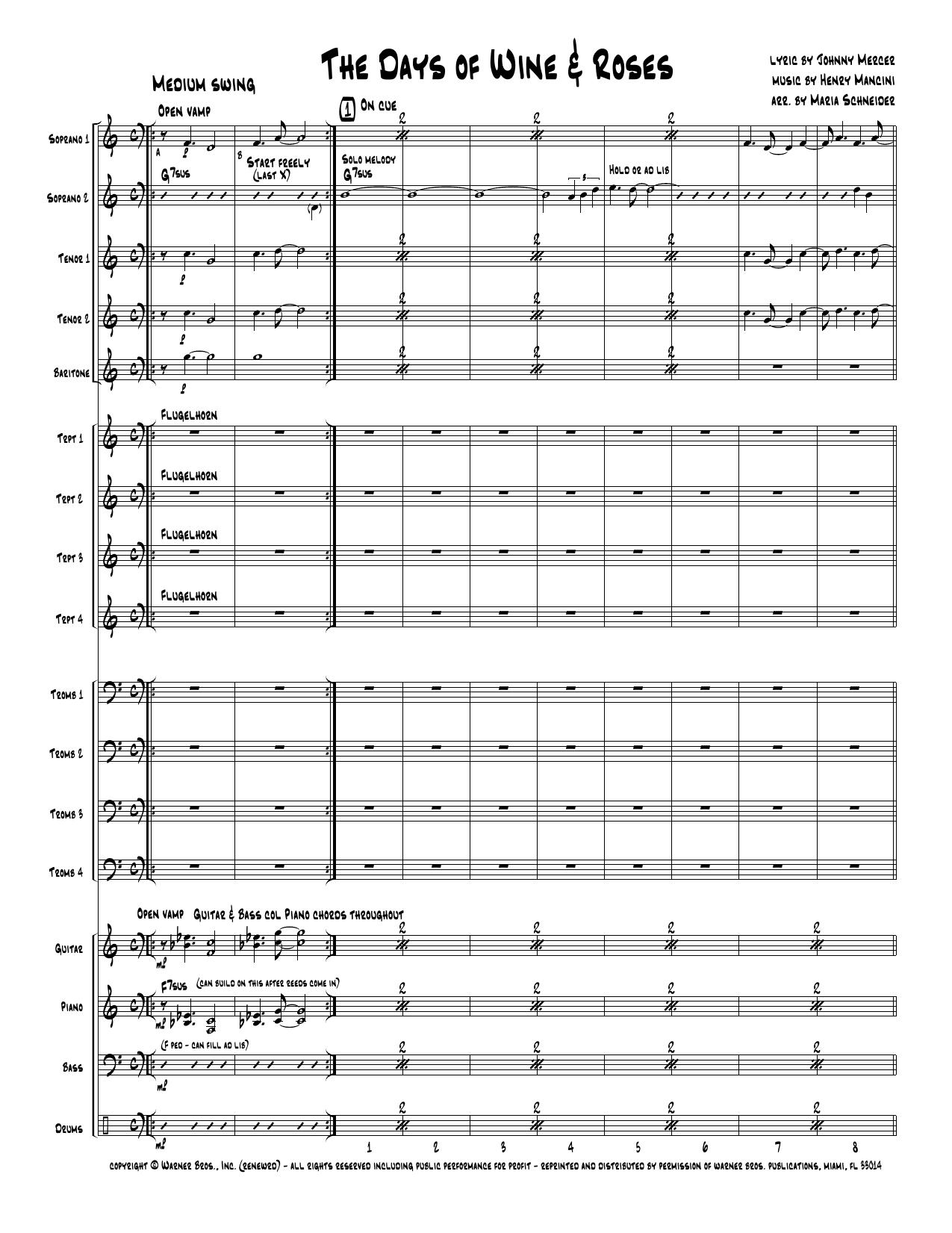
The Days Of Wine and Roses (M.Schneider) sheet music preview

The Days Of Wine and Roses (M.Schneider)

Composed by Henry Mancini

Arranged by Maria Schneider

  • Ensemble: Big Band
  • Pages: 40
  • Instruments (17): Soprano 1, Soprano 2, Tenor 1, Tenor 2, Baritone Saxophone, Trumpet 1, Trumpet 2, Trumpet 3, Trumpet 4, Trombone 1, Trombone 2, Trombone 3, Trombone 4, Guitar, Piano, Bass, Drums
  • Difficulty: medium
  • Content: Individual Parts
  • Format: PDF Download (Instant)
  • Price: $24.99

Henry Mancini and Johnny Mercer originally crafted "The Days of Wine and Roses" for the 1962 film of the same name, earning an Academy Award for Best Original Song and quickly cementing itself in the upper echelon of the Great American Songbook. While vocalists and small groups immediately embraced its bittersweet lyricism, jazz composers found endless harmonic potential in its flowing changes. Over the decades, it transitioned from a lush cinematic theme into a quintessential jazz standard, interpreted by legends like Bill Evans, Wes Montgomery, and Joe Pass, each finding new depths in its melancholy yet hopeful progression. Maria Schneider reimagines this classic through her unmistakable modern compositional lens, shifting the focus from a standard head-solos-head format into a grand, textural tone poem. Eschewing a traditional medium swing feel, Schneider re-envisions the tune with an expansive, atmospheric groove that relies heavily on rubato-like pacing, shifting metric subdivisions, and lush, impressionistic orchestrations. The mood evolves from an introspective, watercolor-like stillness into towering, sunlit crescendos, evoking a profound sense of nostalgia, memory, and emotional unfolding. The harmonies are rich with extended tertian and quartal structures, avoiding predictable resolutions in favor of floating, suspended tensions that breathe new life into Mancini's familiar baseline architecture. The arrangement utilizes a specialized 9-instrument instrumentation—featuring a distinctive horn-heavy frontline of Alto Saxophone, Tenor Saxophone, Baritone Saxophone, Trumpet, and Trombone, alongside a full rhythm section—to maximize color and transparency. Schneider weaves melodic fragments intricately across the ensemble, avoiding static block-chord writing in lieu of flowing counterpoint where woodwinds and brass dialogue seamlessly. Solo opportunities are integrated organically into the structural fabric, requiring soloists who can navigate sophisticated harmonic landscapes with lyrical sensitivity rather than just rapid-fire scalar execution. Technical challenges center around intonation, balance across unusual section voicings, and maintaining a unified rhythmic pulse during fluid, unmetered-sounding transitional passages. Advanced college ensembles, elite community jazz orchestras, and professional big bands will find this chart an extraordinary vehicle for developing mature listening skills and stylistic nuance. Because the chart relies entirely on subtle dynamic gradations, precise articulation control, and deep collaborative interaction rather than brute volume, it challenges players to transcend traditional section playing. Performing this arrangement offers a deeply rewarding masterclass in modern jazz composition, giving advanced groups a chance to explore impressionistic colors, cinematic pacing, and sophisticated harmonic storytelling. Achieving success with this arrangement requires an acute focus on dynamic control, balance, and stylistic flexibility. The conductor must act as a classical mallet or orchestral conductor at times, carefully cueing fluid tempo shifts and rubato phrases that breathe naturally rather than adhering to a rigid click. Technically, the primary challenge lies in the complex, stacked voicings across the compact 9-instrument texture; every voice is exposed, meaning intonation errors or poor blend will immediately muddy the impressionistic harmonies. Section leaders should insist on unified articulation, particularly during soft, linear passages where breath support must remain steady despite low volume levels. Rhythm section players must approach their roles with restraint and tonal imagination. The drummer should utilize coloristic cymbal work and brushed textures rather than a driving, heavy ride pattern, keeping the pulse elastic and transparent. Pianists and guitarists need to voice chords cleanly, omitting roots where necessary to let Schneider’s upper-structure extensions ring clearly. Prioritize sectional sectional rehearsals focusing solely on blend and intonation before attempting to integrate the soaring solo sections. Q: What instruments and parts are included in this 9-instrument configuration? A: The arrangement is scored for a specialized 9-piece ensemble consisting of Alto Saxophone, Tenor Saxophone, Baritone Saxophone, Trumpet, Trombone, Piano, Guitar, Bass, and Drums. Q: What is the overall difficulty level of this Maria Schneider arrangement? A: This chart is designed for advanced college, professional, and elite community jazz ensembles due to its sophisticated harmonic language, exposed writing, and demand for subtle stylistic nuance. Q: How does this arrangement fit into the historical legacy of "The Days of Wine and Roses"? A: While retaining the core identity of Henry Mancini's classic 1962 melody, Schneider reframes the standard through a contemporary, impressionistic jazz composition lens that emphasizes rich textures over a traditional swing format. Q: What makes this particular arrangement unique compared to standard big band charts? A: It features Schneider's signature transparent orchestrations, flowing counterpoint, and unmetered-feeling transitional passages that trade standard shout choruses for sweeping, cinematic emotional arcs. Q: What is the approximate performance duration and tempo feel of the piece? A: The arrangement runs approximately 6 to 7 minutes and utilizes an expansive, elastic tempo feel that fluctuates between rubato-esque atmospheric sections and flowing, modern-groove pacing.

Questions and answers

What is included in the The Days Of Wine and Roses (M.Schneider) PDF?
The verified current file contains a conductor score across 40 pages.
How many instruments or parts are listed for The Days Of Wine and Roses (M.Schneider)?
The verified instrumentation list contains 17 entries for this Big Band arrangement.
Who is credited for The Days Of Wine and Roses (M.Schneider)?
Composer: Henry Mancini. Arranger: Maria Schneider.
What difficulty is listed for The Days Of Wine and Roses (M.Schneider)?
The verified difficulty level is medium.
Can I preview The Days Of Wine and Roses (M.Schneider) before buying?
Yes. The product page provides a preview generated from the current PDF file.
How is The Days Of Wine and Roses (M.Schneider) delivered?
After successful payment, the digital PDF is made available for download. The displayed price is $24.99.

Musicians Also Search For

The Days Of Wine and Roses Maria Schneider PDFThe Days Of Wine and Roses Maria Schneider sheet musicThe Days Of Wine and Roses arranged by Maria SchneiderMaria Schneider big band chartsMaria Schneider jazz arrangements PDFThe Days Of Wine and Roses Henry Mancini sheet musicThe Days Of Wine and Roses Henry Mancini big band arrangementsHenry Mancini big band chartsThe Days Of Wine and Roses big band arrangementsThe Days Of Wine and Roses big band PDF downloadThe Days Of Wine and Roses jazz sheet musicbig band sheet music downloadThe Days Of Wine and Roses conductor score PDFThe Days Of Wine and Roses sheet music PDFbuy The Days Of Wine and Roses sheet musicdownload The Days Of Wine and Roses PDFThe Days Of Wine and Roses jazz chartsbest Maria Schneider big band arrangementsHenry Mancini arranged by Maria SchneiderThe Days Of Wine and Roses printable sheet musicbig band repertoire PDF

All arrangements by Maria Schneider All Henry Mancini sheet music