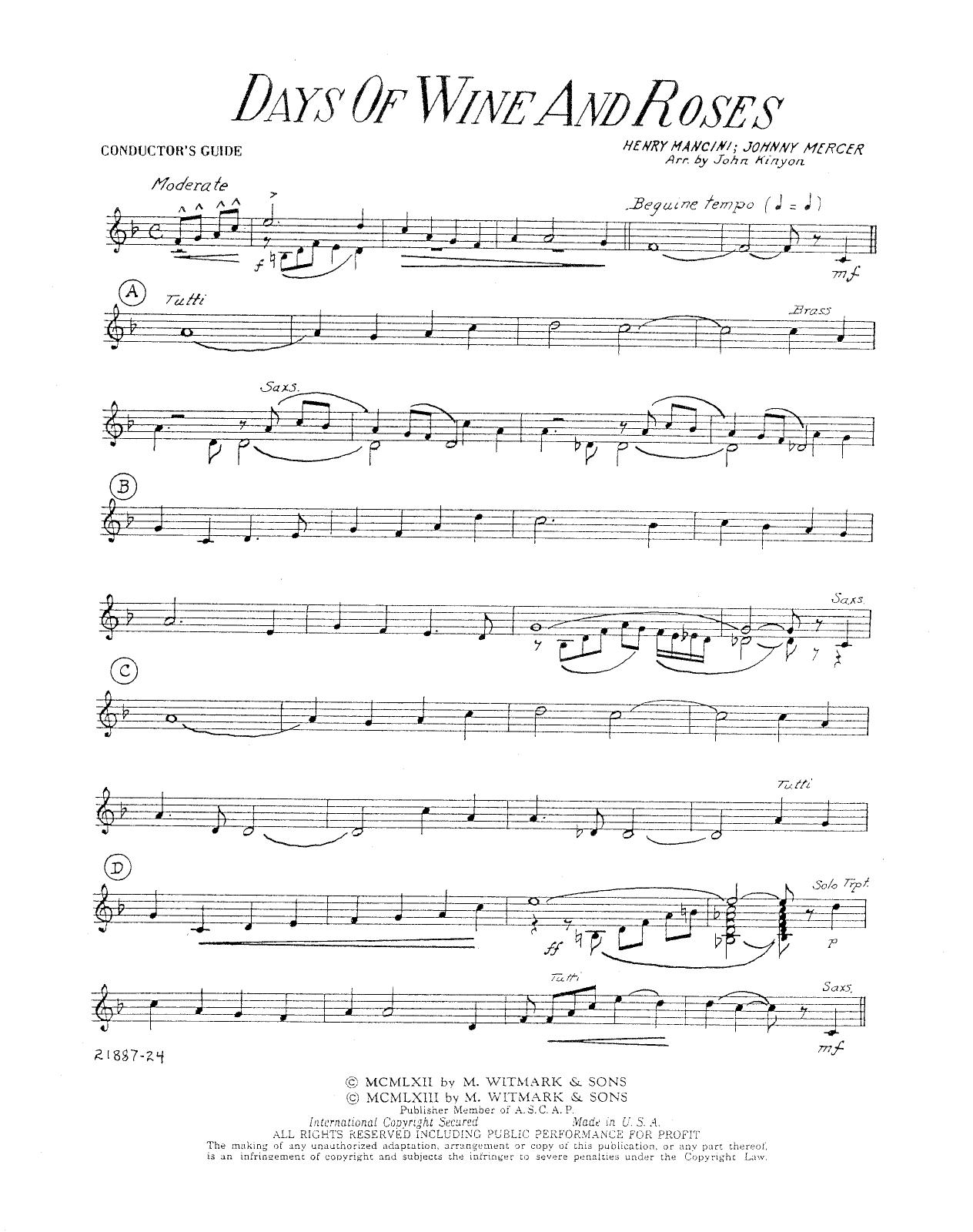
The Days Of Wine And Roses (J.Kinyon) sheet music preview

The Days Of Wine And Roses (J.Kinyon)

Composed by Henry Mancini

Arranged by J.Kinyon

  • Ensemble: Big Band
  • Style: Jazz Vocal
  • Pages: 24
  • Instruments (20): Conductor's Guide, Lead Sheet (Voice), 1st Sax. - Eb Alto, 3rd Sax. - Eb Alto, 2nd Sax. - Bb Tenor, 4th Sax. - Bb Tenor, 5th Sax. - Eb Alto (Bari), 1st Bb Trumpet, 2nd Bb Trumpet, 3rd Bb Trumpet, 4th Bb Trumpet, 1st Trombone, 2nd Trombone, 3rd Trombone, 4th Trombone, Guitar, Piano, String Bass, Bass Tuba, Drums
  • Difficulty: medium
  • Content: Individual Parts
  • Format: PDF Download (Instant)
  • Price: $24.99

Henry Mancini and Johnny Mercer’s timeless masterwork "The Days of Wine and Roses," introduced in the 1962 film of the same name and subsequently capturing the Academy Award for Best Original Song, stands as an immovable pillar of the Great American Songbook. Before long, it was seized upon by jazz luminaries like Bill Evans, Wes Montgomery, and Frank Sinatra, transforming from a poignant cinematic theme into an essential jazz standard. Its sophisticated, melancholic harmonic progression and sweeping lyrical contour offer a masterclass in modal mixture and melancholy, making it a perennial favorite for jazz vocalists seeking to connect deeply with an audience through rich storytelling and nuanced phrasing. In this masterful big band vocal adaptation, arranger J.Kinyon anchors the chart in an evocative, relaxed medium-swing groove that highlights the inherent warmth and bittersweet nostalgia of Mancini’s melody. The arrangement opens with an inviting, atmospheric instrumental introduction that establishes a lush harmonic palette, utilizing extended chord voicings in the saxophones and muted brass to set a reflective mood. Kinyon deftly balances the demands of accompanying a vocal soloist with providing colorful counter-melodies and rhythmic punctuation. The arrangement avoids overcrowding the vocalist, instead utilizing sparse, tasteful background figures that build in density and emotional weight as the chart progresses toward a satisfyingly full ensemble expression. Kinyon's signature pedagogical and idiomatic writing style shines through in the careful pacing of the arrangement. The saxophone section enjoys rich, interwoven solis that echo the vocal phrasing, while the brass section alternates between warm, cushioned pads and pointed, articulate punch chords. Rather than relying on a heavy-handed shout chorus, this chart achieves its dramatic climax through a swelling, multi-layered tutti passage that allows the vocalist to soar effortlessly over a rich wall of big band sound before tapering into a gentle, lingering coda. The dynamic arc is carefully mapped, ensuring that the ensemble supports rather than competes with the front-line singer. Advanced high school ensembles, collegiate jazz orchestras, and professional community big bands will find this arrangement an exceptionally rewarding addition to their repertoire. It provides an ideal vehicle for showcasing a guest vocalist who possesses a strong sense of swing and lyrical interpretation, while simultaneously offering the instrumentalists a masterclass in dynamic control, blend, and stylistic restraint. The technical demands are moderate rather than virtuosic, placing the primary focus squarely on musicality, intonation, and stylistic cohesion across all 18 constituent parts. Realizing the full emotional potential of Kinyon’s chart requires meticulous attention to dynamic balance, particularly between the rhythm section, the ensemble, and the vocalist. The tempo should settle comfortably into a relaxed medium-swing feel around quarter note equals 116 BPM; rushing this tempo instantly strips the arrangement of its sophisticated, late-night atmosphere. The rhythm section must anchor the groove with a steady, unhurried bass line and light, conversational ride cymbal phrasing, avoiding any heavy-handedness. Brass players should utilize cup or basket mutes where indicated in the background figures to ensure the vocal line remains pristine and unmasked in the audio mix. Rehearsal should initially focus on sectional balance during the delicate transitional passages, ensuring that the inner voices of the saxophone section are properly voiced and tuned against the sustained brass pads. Directors should emphasize long, connected phrasing over choppy articulation, maintaining the smooth, legato contour inherent to Mancini's original melodic conception while keeping the underlying eighth-note swing crisp and unified. Q: What instruments and parts are included in this publication? A: The arrangement is scored for a standard 18-instrument big band lineup, featuring Alto Saxophone 1, Alto Saxophone 3, Tenor Saxophone 2, Tenor Saxophone 4, Baritone Saxophone 5, alongside full brass and rhythm sections, plus a dedicated conductor score and vocal part. Q: What is the difficulty level of this arrangement? A: This chart is graded as medium difficulty, making it highly accessible for accomplished high school jazz bands while offering enough sophisticated harmonic depth and interpretive nuance to engage collegiate and professional ensembles. Q: What is the musical style and historical context of this piece? A: Styled as a classic jazz vocal medium swing chart, it adapts the 1962 Academy Award-winning Henry Mancini composition into a format deeply rooted in the traditional big band vocal repertoire popularized during the mid-20th century. Q: What makes J.Kinyon's arrangement unique compared to other versions? A: Kinyon uniquely balances lush, pedagogical scoring with professional-grade dynamic contouring, providing sophisticated saxophone solis and tasteful vocal background figures that support rather than overpower the soloist. Q: What is the standard performance duration and tempo for this chart? A: The arrangement typically runs between 3.5 to 4 minutes when performed at the recommended medium-swing tempo of approximately quarter note = 116 BPM.

Questions and answers

What is included in the The Days Of Wine And Roses (J.Kinyon) PDF?
The verified current file contains a conductor score and individual parts across 24 pages.
How many instruments or parts are listed for The Days Of Wine And Roses (J.Kinyon)?
The verified instrumentation list contains 20 entries for this Big Band arrangement.
Who is credited for The Days Of Wine And Roses (J.Kinyon)?
Composer: Henry Mancini. Arranger: J.Kinyon.
What difficulty is listed for The Days Of Wine And Roses (J.Kinyon)?
The verified difficulty level is medium.
What style is listed for The Days Of Wine And Roses (J.Kinyon)?
The catalog lists the style as Jazz Vocal.
Can I preview The Days Of Wine And Roses (J.Kinyon) before buying?
Yes. The product page provides a preview generated from the current PDF file.
How is The Days Of Wine And Roses (J.Kinyon) delivered?
After successful payment, the digital PDF is made available for download. The displayed price is $24.99.

Musicians Also Search For

The Days Of Wine And Roses J.Kinyon PDFThe Days Of Wine And Roses J.Kinyon sheet musicThe Days Of Wine And Roses arranged by J.KinyonJ.Kinyon big band chartsJ.Kinyon jazz arrangements PDFThe Days Of Wine And Roses Henry Mancini sheet musicThe Days Of Wine And Roses Henry Mancini big band arrangementsHenry Mancini big band chartsThe Days Of Wine And Roses big band arrangementsThe Days Of Wine And Roses big band PDF downloadThe Days Of Wine And Roses jazz sheet musicbig band sheet music downloadThe Days Of Wine And Roses conductor score PDFThe Days Of Wine And Roses individual parts downloadThe Days Of Wine And Roses sheet music PDFThe Days Of Wine And Roses Jazz Vocal chartsJazz Vocal big band arrangementsbuy The Days Of Wine And Roses sheet musicdownload The Days Of Wine And Roses PDFThe Days Of Wine And Roses jazz chartsbest J.Kinyon big band arrangementsHenry Mancini arranged by J.KinyonThe Days Of Wine And Roses printable sheet musicbig band repertoire PDF

All arrangements by J.Kinyon All Henry Mancini sheet music