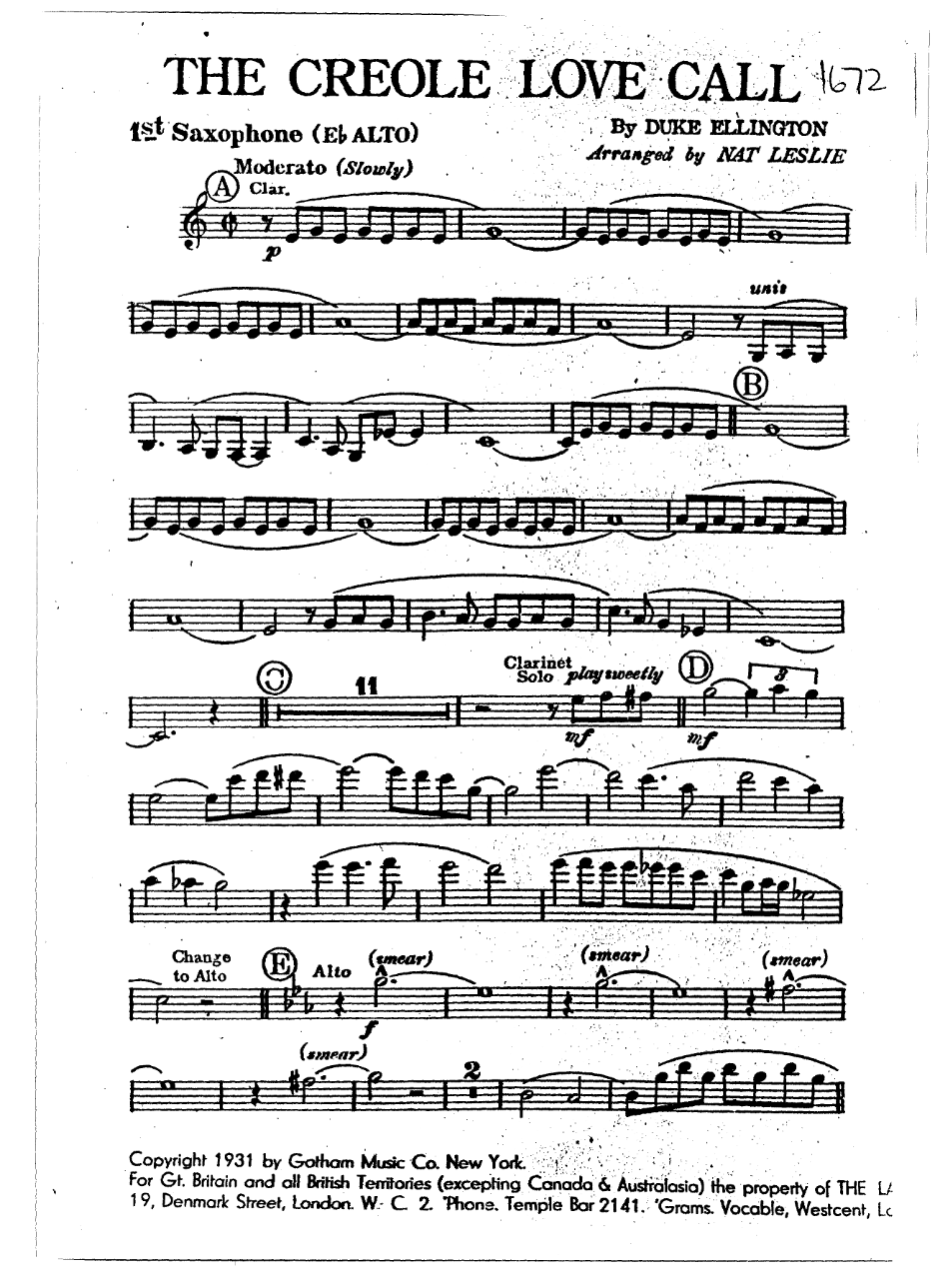
The Creole Love Call (N.Leslie) sheet music preview

The Creole Love Call (N.Leslie)

Composed by Duke Ellington

Arranged by Nat Leslie

  • Ensemble: Big Band Dance
  • Style: Big Band Dance
  • Pages: 32
  • Instruments (14): 1st Saxophone (Eb Alto), 2nd Saxophone (Eb Alto), 3rd Saxophone (Bb Tenor), 2nd Saxophone (Bb Tenor), Eb Baritone Saxophone, 1st Bb Trumpet, 2nd Bb Trumpet, 3rd Bb Trumpet, Trombone, Bass, Banjo, Drums, Piano, 1st Violin
  • Difficulty: medium
  • Content: Individual Parts
  • Format: PDF Download (Instant)
  • Price: $24.99

Duke Ellington's "Creole Love Call," a cornerstone of early jazz, first captivated audiences in 1927, emerging from the vibrant, innovative period of the Harlem Renaissance. This iconic piece, famously featuring Adelaide Hall's wordless vocalizations mimicking a trombone, became a signature tune for Ellington's Orchestra, showcasing his pioneering use of instrumental colors and orchestral textures. It represents a pivotal moment in jazz history, blurring lines between composition and improvisation, and solidifying Ellington's reputation as a visionary bandleader and composer who elevated jazz beyond dance music to an art form. Its distinctive, haunting melody and call-and-response structure have cemented its place as a revered standard, celebrated for its emotional depth and groundbreaking instrumentation. Nat Leslie's arrangement of "The Creole Love Call" reimagines this classic for a contemporary Big Band Dance ensemble, staying true to its original spirit while injecting a fresh, danceable energy. Leslie masterfully captures the medium-slow, bluesy 4/4 feel, maintaining the original's melancholic yet captivating mood. The arrangement is primarily in the key of F minor, providing a rich, dark harmonic palette that underpins the expressive melodic lines. Leslie's distinctive approach often involves intricate voicings that highlight the unique timbres of the saxophones and brass, creating a lush, full sound without sacrificing clarity. Expect carefully crafted soli sections that allow each instrument family to shine, reminiscent of the Ellingtonian tradition of showcasing individual voices within the collective. The arrangement opens with the familiar, evocative melody carried by the alto saxophone, setting the stage with its expressive, vocal-like quality. Throughout the piece, Leslie skillfully alternates between the melody in the alto and the full ensemble, building dynamic contrast. While there isn't an extended open solo section in the traditional sense, the arrangement features beautifully orchestrated melodic statements and counter-melodies that give the impression of featured voices. The technical challenges lie more in achieving a cohesive, blended sound and maintaining the subtle rhythmic nuances of the medium-slow swing feel rather than demanding virtuosic improvisation. Articulation and dynamic control are paramount to conveying the piece's inherent emotional depth and danceable groove. This arrangement is ideally suited for college, community, and advanced high school jazz ensembles looking to explore the rich heritage of early big band jazz with a modern, playable interpretation. Its focus on ensemble blend, rhythmic precision, and expressive phrasing makes it an excellent teaching tool for developing musicality and historical awareness. The rewarding aspect of performing this piece lies in its ability to transport both musicians and audience to a bygone era of sophisticated dance halls and groundbreaking jazz, all while delivering a performance that is both historically informed and vibrantly alive. The unique blend of sorrowful melody and underlying rhythmic drive creates a compelling narrative that is a joy to perform. "The Creole Love Call" should be approached with a medium-slow, relaxed 4/4 swing feel, emphasizing a subtle, danceable pulse rather than a heavy swing. The tempo should allow for expressive phrasing, particularly in the lead alto saxophone's melodic statements. Key technical challenges include achieving precise ensemble blend and balance, especially in the harmonized soli sections, where careful listening across sections is crucial. Dynamics are vital; encourage a wide range from soft, intimate passages to fuller, yet always controlled, ensemble swells. Trumpet and trombone sections should pay close attention to plunger mute indications, ensuring a consistent and vocal-like "wah" effect. Rehearsal time should focus on articulation consistency, particularly for the slurs and ghost notes, and on developing a unified rhythmic pocket that supports the piece's melancholic yet grooving character. Q: What instruments and parts are included in this arrangement? A: This arrangement is scored for a standard big band dance ensemble, including Alto Saxophone, Tenor Saxophone, Trumpet, Trombone, Piano, Bass, and Drums. It is an 8-instrument arrangement. Q: What is the difficulty level of Nat Leslie's "The Creole Love Call"? A: This arrangement is suitable for intermediate to advanced ensembles, including college, community, and advanced high school bands. It requires good ensemble blend, rhythmic precision, and expressive musicality rather than extreme technical virtuosity. Q: What musical style and historical context does this arrangement represent? A: This arrangement is a Big Band Dance interpretation of Duke Ellington's "The Creole Love Call," originally composed in 1927. It embodies the early big band jazz style of the Harlem Renaissance, known for its sophisticated orchestration and emotional depth. Q: What makes Nat Leslie's arrangement of "The Creole Love Call" unique? A: Nat Leslie's arrangement distinctively reinterprets Ellington's classic with a focus on a danceable medium-slow swing feel, intricate voicings, and carefully crafted soli sections that honor the original's spirit while providing a fresh, playable experience for contemporary ensembles. Q: What is the approximate performance duration and tempo for this piece? A: The performance duration will vary slightly based on interpretation, but typically ranges from 3:00 to 4:00 minutes. It should be played with a medium-slow, relaxed 4/4 swing feel, allowing for expressive melodic lines.

Questions and answers

What is included in the The Creole Love Call (N.Leslie) PDF?
The verified current file contains individual parts across 32 pages.
How many instruments or parts are listed for The Creole Love Call (N.Leslie)?
The verified instrumentation list contains 14 entries for this Big Band Dance arrangement.
Who is credited for The Creole Love Call (N.Leslie)?
Composer: Duke Ellington. Arranger: Nat Leslie.
What difficulty is listed for The Creole Love Call (N.Leslie)?
The verified difficulty level is medium.
What style is listed for The Creole Love Call (N.Leslie)?
The catalog lists the style as Big Band Dance.
Can I preview The Creole Love Call (N.Leslie) before buying?
Yes. The product page provides a preview generated from the current PDF file.
How is The Creole Love Call (N.Leslie) delivered?
After successful payment, the digital PDF is made available for download. The displayed price is $24.99.

Musicians Also Search For

The Creole Love Call Nat Leslie PDFThe Creole Love Call Nat Leslie sheet musicThe Creole Love Call arranged by Nat LeslieNat Leslie big band dance chartsNat Leslie jazz arrangements PDFThe Creole Love Call Duke Ellington sheet musicThe Creole Love Call Duke Ellington big band dance arrangementsDuke Ellington big band dance chartsThe Creole Love Call big band dance arrangementsThe Creole Love Call big band dance PDF downloadThe Creole Love Call jazz sheet musicbig band dance sheet music downloadThe Creole Love Call individual parts downloadThe Creole Love Call sheet music PDFThe Creole Love Call Big Band Dance chartsBig Band Dance big band dance arrangementsbuy The Creole Love Call sheet musicdownload The Creole Love Call PDFThe Creole Love Call jazz chartsbest Nat Leslie big band dance arrangementsDuke Ellington arranged by Nat LeslieThe Creole Love Call printable sheet musicbig band dance repertoire PDF

All arrangements by Nat Leslie All Duke Ellington sheet music