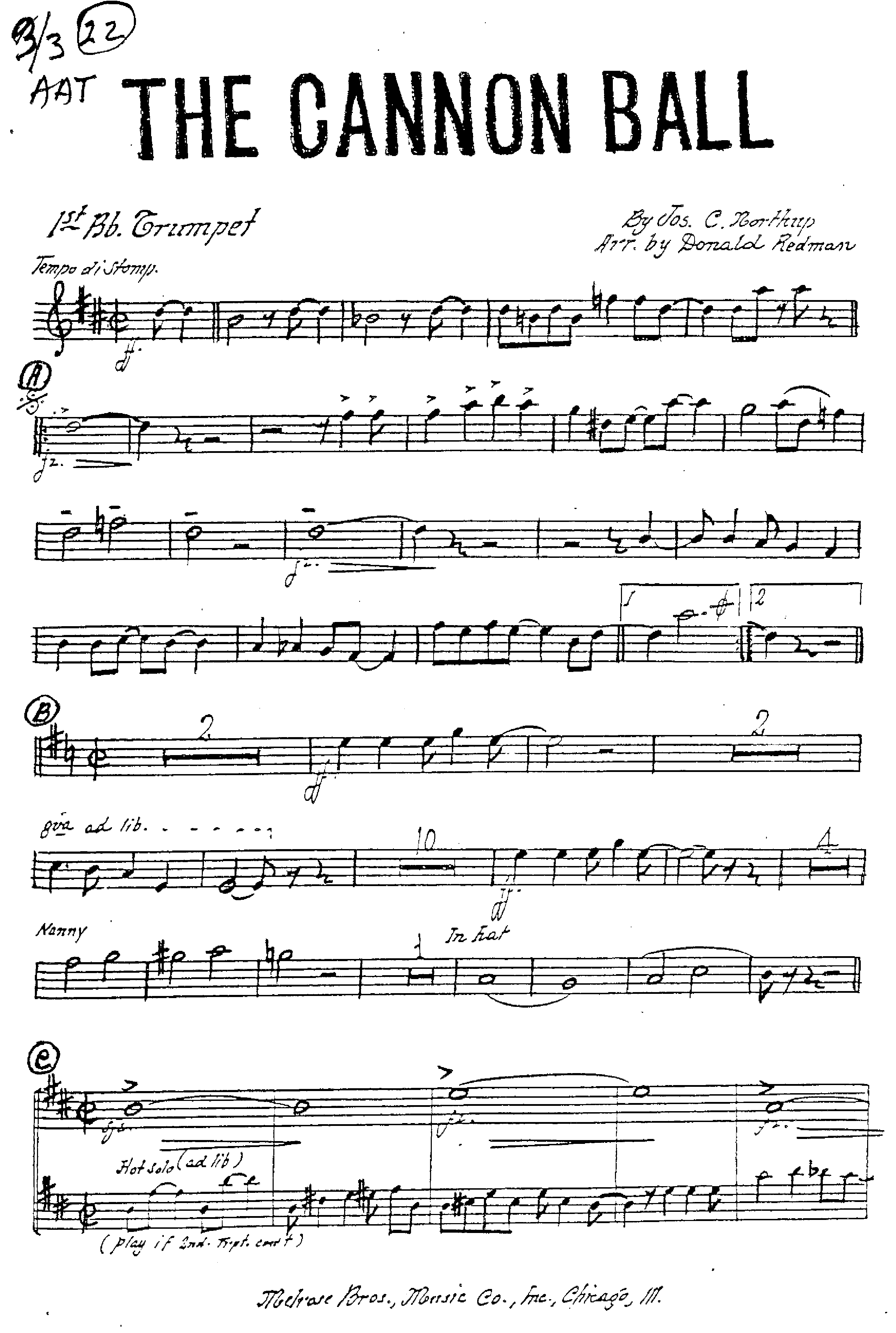
The Cannon Ball (D.Redman)
Composed by Don Redman
Arranged by Don Redman
- Ensemble: Big Band
- Pages: 22
- Instruments (10): 1st Bb Trumpet, 2nd Bb Trumpet, Trombone, 1st Eb Alto Sax, 2nd Eb Alto Sax, Bb Tenor Sax, Piano, Banjo, Bass, Drums
- Difficulty: medium
- Content: Individual Parts
- Format: PDF Download (Instant)
- Price: $24.99
Master architect of the early big band sound, Don Redman crafted "The Cannon Ball" as a quintessential showcase of 1930s swing innovation, bridging the gap between small-group hot jazz and the emerging, highly organized orchestral jazz paradigm. Recorded during an era when the language of jazz was rapidly expanding to accommodate larger ensembles, Redman’s composition stands out as a brilliant display of counterpoint, rhythmic drive, and sectional interplay. As a central figure who shaped the arranging styles of both Fletcher Henderson and McKinney's Cotton Pickers, Redman infused this chart with the signature ingenuity that defined the Harlem Renaissance and early swing era, cementing its status as a fascinating historical artifact and a thrilling live performance piece. Driven by an infectious, buoyant medium-up swing feel in 4/4 time, "The Cannon Ball" crackles with a vibrant, high-energy mood that immediately evokes the smoky elegance and kinetic pulse of classic Harlem dance halls. The composition moves with locomotive momentum, propelled by crisp rhythmic hits and a joyful, unbridled spirit. From the opening thematic statement to the final harmonic resolution, the chart maintains an effervescent buoyancy, balancing tight, interlocking ensemble passages with moments of loose, driving improvisation that capture the quintessential swinging ethos of the 1930s jazz tradition. Redman’s arranging genius shines through his pioneering use of sectional writing, particularly in how he pits the reed section against the brass with conversational call-and-response figures. Rather than merely doubling voices, Redman utilizes advanced-for-the-era harmonic voicings, colorful counter-melodies, and clever instrumental shifting that distributes melodic interest across the entire ensemble. The writing features tightly knit sax solis and punchy ensemble shout choruses that build organic dramatic tension. His approach rewards a light, articulate touch, relying heavily on seamless transitions between written polyphonic textures and driving, swing-era groove elements. Carrying the melodic weight are the primary reed voices—specifically the Alto and Tenor Saxophones—which frequently interweave lead lines supported by crisp trumpet and trombone punctuations, while the piano anchors the harmonic and rhythmic foundation. Featured improvised solo spaces allow standout horn players to stretch out over changes that nod to early swing chordal structures. Technically, the chart demands precise articulation, agile fingerwork in the woodwinds, and a strong collective sense of time rather than sheer brute force. Advanced high school, collegiate, and professional repertory bands will find this arrangement immensely rewarding for its historical depth, stylistic educational value, and sheer entertainment punch. Unlocking the authentic vitality of "The Cannon Ball" requires rigorous attention to early swing articulation and stylistic stylistic nuance. Conductors should target a brisk, driving medium-up tempo where the quarter note swings steadily, avoiding any tendency to rush the triplets. The primary technical challenge lies in the execution of the intricate sax soli passages, which demand absolute unanimity in phrasing, breath support, and dynamic shading. Horn players must master short, detached quarter notes and articulated upbeats characteristic of the 1930s idiom, ensuring that syncopated figures snap crisply without sounding heavy-handed. While specialized effects like plunger mutes are optional depending on historical recreation goals, natural brass lip-slurs, gentle falls, and controlled vibrato should be utilized to emulate the vocal quality of early jazz brass. During rehearsals, isolate the rhythm section first to lock in the foundational stride-inflected piano comping and steady bass pulse before layering in the horn sections. Balance is paramount: ensure the counter-melodies woven by the trombones do not obscure the primary melodic lines carried by the saxophones. Q: What specific instruments and parts are included in this 8-instrument big band arrangement? A: This arrangement is scored for an 8-instrument ensemble featuring Alto Saxophone, Tenor Saxophone, Trumpet, Trombone, Piano, and accompanying rhythm section parts across a comprehensive 22-page master score and set of parts. Q: What is the overall difficulty level of this Don Redman chart? A: It is best suited for advanced high school, collegiate, and professional jazz ensembles due to its dense counterpoint, stylistic demands, and the requirement for tight sectional blend and articulation. Q: What is the historical style and musical context of "The Cannon Ball"? A: Composed and arranged by Don Redman, this piece represents the pinnacle of 1930s Harlem swing and early big band writing, showcasing the transitional techniques that evolved from small-group hot jazz into sophisticated orchestral swing. Q: What makes this specific arrangement unique compared to standard swing charts? A: It features Don Redman's pioneering sectional writing style, which utilizes intricate counter-melodies, conversational call-and-response figures between reeds and brass, and advanced-for-the-era harmonic voicings rather than basic block chords. Q: What is the recommended performance duration and tempo feel for this piece? A: The arrangement is designed to be played at an energetic medium-up swing tempo (approximately quarter note = 160-176 BPM), resulting in a performance duration of roughly 3 to 4 minutes.
Questions and answers
- What is included in the The Cannon Ball (D.Redman) PDF?
- The verified current file contains individual parts across 22 pages.
- How many instruments or parts are listed for The Cannon Ball (D.Redman)?
- The verified instrumentation list contains 10 entries for this Big Band arrangement.
- Who is credited for The Cannon Ball (D.Redman)?
- Composer: Don Redman. Arranger: Don Redman.
- What difficulty is listed for The Cannon Ball (D.Redman)?
- The verified difficulty level is medium.
- Can I preview The Cannon Ball (D.Redman) before buying?
- Yes. The product page provides a preview generated from the current PDF file.
- How is The Cannon Ball (D.Redman) delivered?
- After successful payment, the digital PDF is made available for download. The displayed price is $24.99.
Musicians Also Search For
The Cannon Ball Don Redman PDF • The Cannon Ball Don Redman sheet music • The Cannon Ball arranged by Don Redman • Don Redman big band charts • Don Redman jazz arrangements PDF • The Cannon Ball Don Redman big band arrangements • The Cannon Ball big band arrangements • The Cannon Ball big band PDF download • The Cannon Ball jazz sheet music • big band sheet music download • The Cannon Ball individual parts download • The Cannon Ball sheet music PDF • buy The Cannon Ball sheet music • download The Cannon Ball PDF • The Cannon Ball jazz charts • best Don Redman big band arrangements • The Cannon Ball printable sheet music • big band repertoire PDF