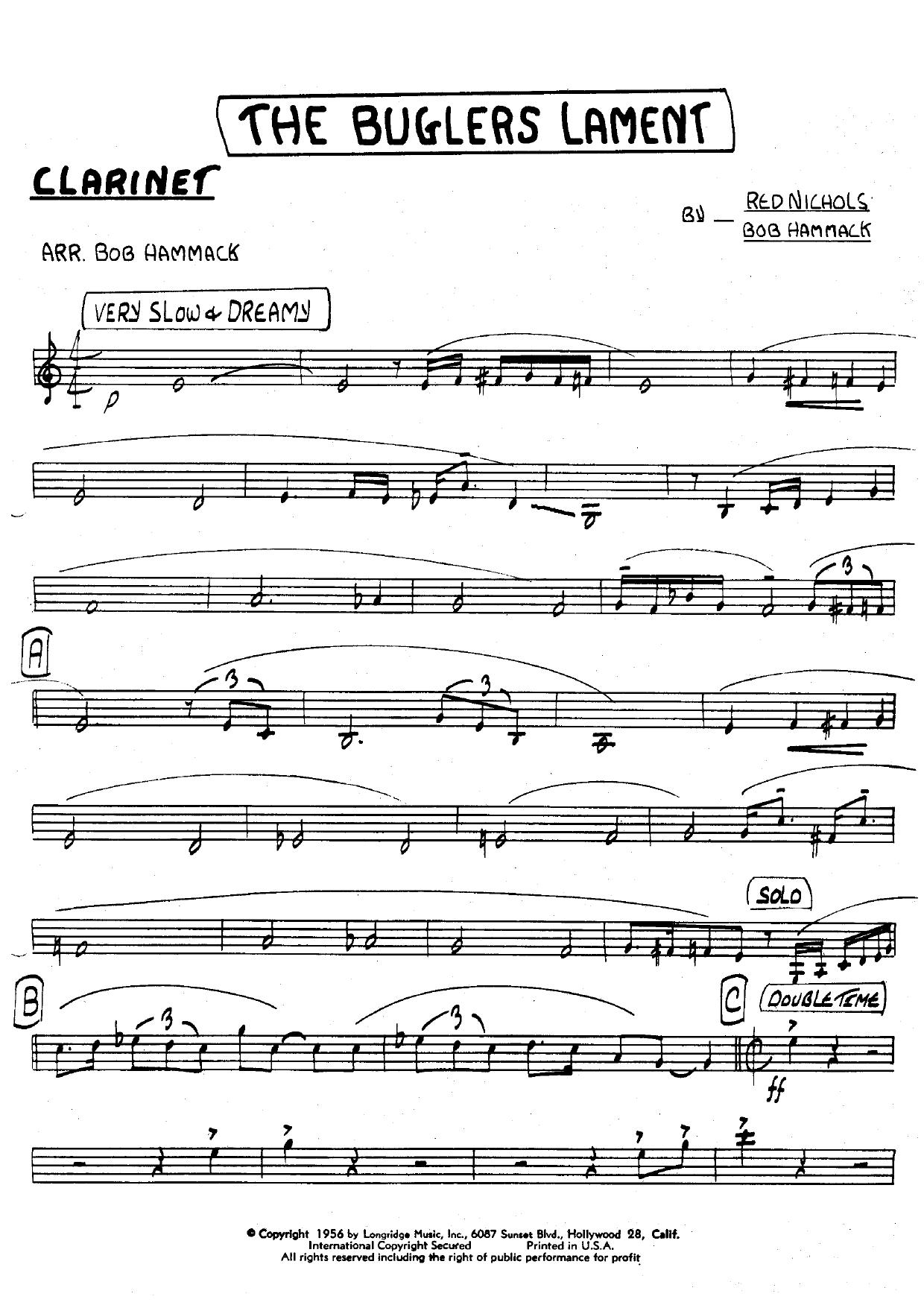
The Bugler's Lament R.Nichols (B.Hammack)
Composed by Red Nichols
Arranged by Bob Hammack
- Ensemble: Dixieland Band
- Style: Dixieland
- Pages: 16
- Instruments (8): Clarinet, Tenor Sax, Trumpet, Trombone, Piano, Bass, Drums, Guitar
- Difficulty: easy
- Content: Individual Parts
- Format: PDF Download (Instant)
- Price: $18.99
"The Bugler's Lament," originally composed by the legendary Red Nichols, stands as a quintessential example of early jazz, capturing the vibrant spirit and melodic ingenuity of the Dixieland era. Nichols, a cornetist and bandleader, was a prominent figure in the 1920s, known for his clean, melodic playing and his role in popularizing "hot" jazz in a more structured, ensemble-oriented format. This piece, with its distinctive title evoking a military call to sorrow, embodies the melancholic yet often spirited narratives common to the period, showcasing the expressive capabilities of the brass instruments at the forefront of Dixieland ensembles. While not as universally known as some other standards, it is a significant work within Nichols's repertoire, celebrated for its memorable melodic lines and its capacity for both poignant expression and lively improvisation. Bob Hammack's masterful arrangement of "The Bugler's Lament" for Dixieland band breathes new life into this classic, respecting its historical roots while providing a polished, performable chart. Hammack, renowned for his meticulous attention to authentic style and clever voicings, approaches this piece with a medium-slow swing feel, typically around 80-90 BPM, set in a comfortable concert key of F major. The mood oscillates between a reflective, almost mournful quality in the main theme and an uplifting, collective joy in the ensemble sections, characteristic of Dixieland's emotional range. Hammack's signature is evident in the carefully crafted counter-melodies and the interplay between the front-line instruments (trumpet, clarinet, trombone), ensuring each voice contributes meaningfully to the overall texture without sacrificing the spontaneous feel of the style. This arrangement features the trumpet prominently carrying the initial melodic statements, true to Nichols's original instrumentation, before transitioning into a full ensemble treatment. Soli sections are expertly woven throughout, allowing the clarinet to shine with its characteristic lyrical flourishes and the trombone to provide its signature glissandos and rhythmic accents. While there are no explicitly notated "solos" in the modern jazz sense, ample space is provided for traditional Dixieland-style improvisation over the chord changes, particularly for the trumpet, clarinet, and trombone, encouraging creative interplay within the ensemble. Technical challenges include maintaining a cohesive yet flexible swing feel at a slower tempo, precise articulation for the brass and woodwind lines, and the nuanced execution of dynamics to convey the piece's emotional depth. The rewarding aspect lies in the ensemble's ability to capture the authentic Dixieland sound—a blend of individual expression and collective joy—culminating in a spirited shout chorus that brings the piece to a satisfying close. "The Bugler's Lament" is ideally suited for high school, college, community, and professional Dixieland bands seeking an authentic and engaging repertoire piece. Its clear structure and Hammack's thoughtful scoring make it accessible for developing ensembles to grasp the stylistic nuances of Dixieland, while offering seasoned musicians ample opportunity for expressive performance and improvisation. The arrangement's balance of melodic beauty, rhythmic drive, and ensemble interaction makes it a superb choice for concerts, festivals, or any occasion where the timeless charm of Dixieland jazz is appreciated. To truly capture the essence of "The Bugler's Lament," aim for a medium-slow swing feel, around 80-90 BPM, emphasizing a relaxed, flowing pulse rather than a rigid metronomic beat. The primary technical challenge lies in achieving a unified yet individualistic Dixieland sound; encourage musicians to listen intently to each other, allowing for subtle rhythmic pushes and pulls within the overall swing. Articulation should be crisp but not overly aggressive, especially in the melodic lines, with a focus on clear tone production. The trumpet and trombone will benefit from exploring subtle plunger mute work in their improvised sections, adding authentic color. Clarinetists should focus on lyrical phrasing and fluid technique. Rehearsal tips include isolating the soli sections to ensure balance and clarity, and practicing the ensemble sections to achieve a cohesive, joyful sound without losing individual voice. Emphasize the dynamic contrasts to highlight the piece's emotional arc. Q: What instruments are included in this arrangement? A: This arrangement is scored for a standard Dixieland band, typically including Trumpet, Clarinet, Trombone, Piano, Bass (or Tuba), and Drums. Specific parts for each of these instruments are provided. Q: What is the difficulty level of "The Bugler's Lament R.Nichols (B.Hammack)"? A: This arrangement is rated as medium difficulty, suitable for high school, college, community, and professional Dixieland bands. It requires solid instrumental technique and an understanding of Dixieland stylistic conventions. Q: What style of jazz does this arrangement represent, and what is its historical context? A: This arrangement is firmly rooted in the Dixieland style of jazz, representing the early jazz era of the 1920s. It features the melodic and ensemble characteristics popularized by composer Red Nichols. Q: What makes Bob Hammack's arrangement of "The Bugler's Lament" unique? A: Hammack's arrangement is distinguished by its authentic stylistic voicings, clever counter-melodies, and well-structured ensemble sections that allow for both individual expression and cohesive group interplay, all while honoring the original composer's intent. Q: What is the typical performance duration and tempo for this piece? A: "The Bugler's Lament" typically performs for approximately 3-4 minutes, depending on improvisation. It is intended to be played at a medium-slow swing tempo, generally between 80-90 beats per minute.
Questions and answers
- What is included in the The Bugler's Lament R.Nichols (B.Hammack) PDF?
- The verified current file contains individual parts across 16 pages.
- How many instruments or parts are listed for The Bugler's Lament R.Nichols (B.Hammack)?
- The verified instrumentation list contains 8 entries for this Dixieland Band arrangement.
- Who is credited for The Bugler's Lament R.Nichols (B.Hammack)?
- Composer: Red Nichols. Arranger: Bob Hammack.
- What difficulty is listed for The Bugler's Lament R.Nichols (B.Hammack)?
- The verified difficulty level is easy.
- What style is listed for The Bugler's Lament R.Nichols (B.Hammack)?
- The catalog lists the style as Dixieland.
- Can I preview The Bugler's Lament R.Nichols (B.Hammack) before buying?
- Yes. The product page provides a preview generated from the current PDF file.
- How is The Bugler's Lament R.Nichols (B.Hammack) delivered?
- After successful payment, the digital PDF is made available for download. The displayed price is $18.99.
Musicians Also Search For
The Bugler's Lament R.Nichols Bob Hammack PDF • The Bugler's Lament R.Nichols Bob Hammack sheet music • The Bugler's Lament R.Nichols arranged by Bob Hammack • Bob Hammack dixieland band charts • Bob Hammack jazz arrangements PDF • The Bugler's Lament R.Nichols Red Nichols sheet music • The Bugler's Lament R.Nichols Red Nichols dixieland band arrangements • Red Nichols dixieland band charts • The Bugler's Lament R.Nichols dixieland band arrangements • The Bugler's Lament R.Nichols dixieland band PDF download • The Bugler's Lament R.Nichols jazz sheet music • dixieland band sheet music download • The Bugler's Lament R.Nichols individual parts download • The Bugler's Lament R.Nichols sheet music PDF • The Bugler's Lament R.Nichols Dixieland charts • Dixieland dixieland band arrangements • buy The Bugler's Lament R.Nichols sheet music • download The Bugler's Lament R.Nichols PDF • The Bugler's Lament R.Nichols jazz charts • best Bob Hammack dixieland band arrangements • Red Nichols arranged by Bob Hammack • The Bugler's Lament R.Nichols printable sheet music • dixieland band repertoire PDF